
Personalizing Affect: Bridging Personality Traits and Cognitive Emotion Theory in NLP
RHVHDUFK RQ TH[WXDO EPRWLRQ RHFRJQLWLRQ IQFRUSRUDWLQJ PHUVRQDOLW\ FDFWRU
This paper proposes a textual emotion recognition model that integrates the Five-Factor Model (FFM) of personality with a simplified OCC (Ortony, Clore, and Collins) cognitive theory of emotions. By utilizing ConceptNet for commonsense reasoning and MontyLingua for NLP parsing, the model transitions from generic emotion rules to personalized reasoning, achieving significant accuracy improvements in identifying complex emotional states.
TL;DR
Researchers have developed a textual emotion recognition model that doesn't just look at what was said, but who said it. By merging the OCC cognitive model of emotions with the Five-Factor Model (FFM) of personality, and leveraging ConceptNet for commonsense reasoning, the system can distinguish why a conversation might bring "joy" to an extrovert but "distress" to an introvert.
Context & Positioning
In the landscape of Human-Computer Interaction (HCI), sensing affect from text has evolved from simple keyword matching to complex statistical models. However, even SOTA models often ignore the observer's bias. This paper positions itself as a bridge between psychological theory and computational linguistics, refining the classical OCC model for practical NLP applications.
The Problem: The "One Size Fits All" Fallacy
Traditional NLP tools treat language as a static mapping. But human emotion is subjective.
- Prior Work Limits: Keyword spotting fails at negation (e.g., "not happy"); statistical methods require massive datasets and lack explainability.
- The Missing Link: Personality serves as a "mental filter." Prior cognitive models implemented the OCC rules as a rigid set of 22 emotions, making them computationally heavy and socially agnostic.
Methodology: Rules Meets Commonsense
The authors' approach consists of a three-tier architecture:
1. Simplified OCC Reasoning
The original 22 OCC emotions were pruned to 16 core emotions (e.g., joy, anger, disappointment) better suited for textual data. Each emotion is defined by a logical function involving:
- Event Consequence: What happened?
- Focus of Action: Who did it (Self vs. Other)?
- Expectancy: Was the event anticipated?
2. Commonsense Integration via ConceptNet
To evaluate these logical functions (like DesireOf(agent, event)), the model queries ConceptNet. If a user says "I won the lottery," ConceptNet provides the semantic link that "winning" is a "DesirousEffect," triggering the Joy rule.
3. The Personality Update
This is the core innovation. The model adopts the Big Five Personality Traits (Extraversion, Agreeableness, Conscientiousness, Neuroticism, Openness).
- The Logic: An Agreeable person might feel "Happy-for" someone else's success, while a person scoring low on Agreeableness might feel "Resentment."
- Dynamic Properties: For an extrovert, the concept "fire" might link to the property "warm" (Positive); for an introvert, it might link to "dangerous" (Negative).
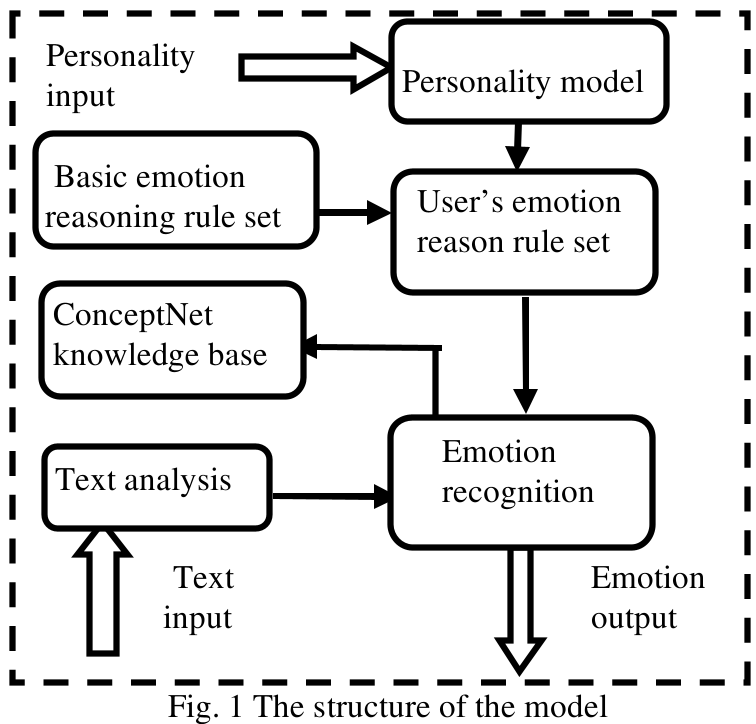 Figure 1: The architecture showing the flow from Text Analysis to Personality-Driven Emotion Recognition.
Experiments & Quantitative Results
The model was tested in an "Emotional Chatting System" with 48 participants.
- Baseline: Basic OCC rules without personality.
- Experimental: Personality-aware OCC rules.
Key Findings:
- Accuracy Boost: Emotions highly dependent on social attitude (like "pity," "gloating," and "joy") saw the highest accuracy gains.
- Consistency: The results aligned with human psychological laws (e.g., extroverts naturally leaning toward positive emotion synthesis).
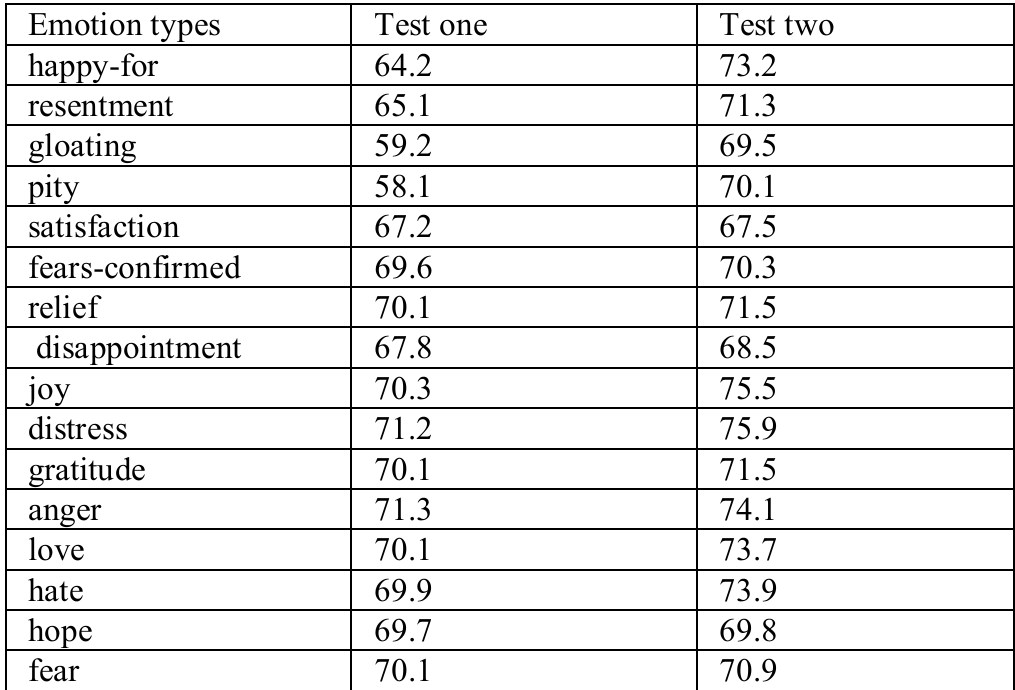 Table: Comparison shows significant gains in Test One (Personality-Included) vs. Test Two (Baseline).
Critical Insight & Future Outlook
While the model significantly outperforms personality-agnostic systems, it still operates primarily at the sentence level. The authors acknowledge that contextual emotion (emotions stemming from a history of interactions) remains a challenge.
Takeaway: The future of empathetic AI lies in "User Embeddings"—not just understanding the semantic content of a message, but the psychological blueprint of the speaker. This work provides a foundation for more "human" digital tutors and chatting agents that can adapt their emotional intelligence to the specific individual they are serving.
Limitations
- No Intensity Modeling: The model detects the type of emotion but not the strength (e.g., "annoyed" vs. "furious").
- Sentence-Level Constraint: It struggles with emotional shifts that occur across multiple turns of dialogue.