
NonKin Village: Beyond Scripting—Building Scientifically Grounded Social Agents
Rich socio-cognitive agents for immersive training environments: case of NonKin Village
The paper introduces NonKin Village, a framework for generating immersive social training environments populated by "rich" socio-cognitive agents. It utilizes a Model-Driven Architecture (MDA) to synthesize dozens of social science theories (cognitive, economic, and socio-political) into unified, autonomous agents that can explain their own world and grievances.
TL;DR
NonKin Village is a breakthrough in immersive training that replaces scripted NPCs with "rich" socio-cognitive agents. By synthesizing theories from psychology, sociology, and economics into a Model-Driven Architecture (MDA), the researchers created a virtual Afghan village where agents don't just follow paths—they possess values, feel grievances, and can explain their complex social networks to human trainees.
Academic Positioning: This work moves beyond "2nd Generation" thematic models toward "3rd Generation" trans-disciplinary agents, bridging the gap between micro-level cognition (PMFserv) and macro-level social structures (FactionSim).
The Problem: The Brittle Reality of Scripted NPCs
In traditional military or cultural training simulations, the world is often populated by human role-players (expensive) or "Finite State Machines" (FSMs). FSMs are essentially "puppets" following branching scripts. If a trainee does something unexpected, the illusion of life shatters. These agents lack what the authors call "social realism"—the ability to reflect the deep-seated grievances, cultural norms, and economic pressures that drive real-world conflicts.
The authors argue that the industry has been trapped by the KISS (Keep It Simple, Stupid) principle. While simple rules create "emergent" behavior, they cannot sustain the "up close" scrutiny required for rapport-building or high-stakes negotiation training.
Methodology: The "Model of Models"
The core innovation lies in the Model-Driven Architecture (MDA). Instead of hard-coding behaviors into a specific game engine like Unity or VBS2, the authors created a platform-independent "server" of behavioral models.
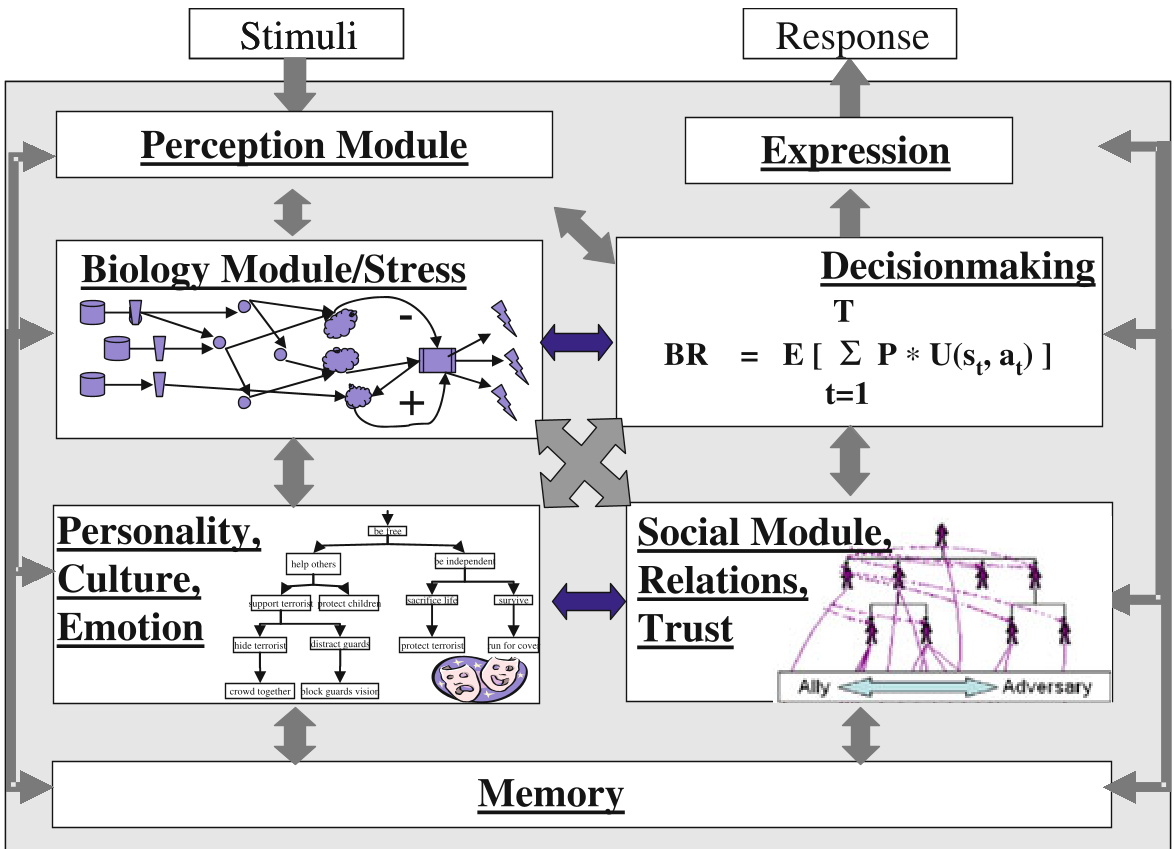
1. PMFserv (The Individual Mind)
Every agent runs an OODA loop (Observe, Orient, Decide, Act).
- Orient: Agents use "Performance Moderator Functions" (PMFs) to calculate stress, fatigue, and hunger.
- Value Systems: An agent’s culture and personality are encoded in GSP (Goals, Standards, and Preferences) Trees. For example, a village elder and a Taliban insurgent might share the same "tree" structure but have vastly different Bayesian weights, leading to different appraisals of the same event.
2. FactionSim (The Social Framework)
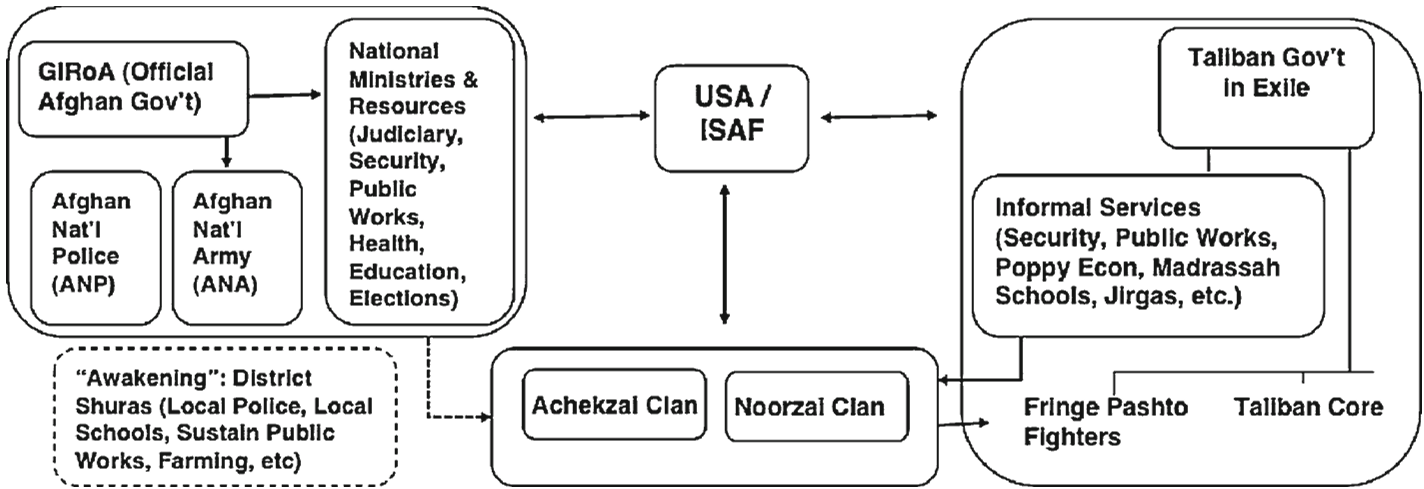
While PMFserv handles the "mind," FactionSim handles the "tribe." It tracks "tanks" of resources: Economy (E), Security (S), and Politics (P). Leaders manage these resources to keep followers loyal, and these macro-indicators flow back down to influence the individual agent's decision-making.
The Complexity Paradox: Why More is Easier
The most striking claim of the paper is the Complexity Paradox. In simple systems, authors must manually write thousands of lines of dialogue for every possible state. In NonKin Village, because the agent knows its own hunger level, its loyalty to its clan, and its fear of the player, it can autonomously generate dialogue.
Using an Utterance Catalog, an agent can explain:
- "I am angry at you because you violated a social taboo (Taboo Transgression)."
- "I trust the Malik because he provides security for our clan (Alignment Metric)."
Experimental Results: The Village of Baja
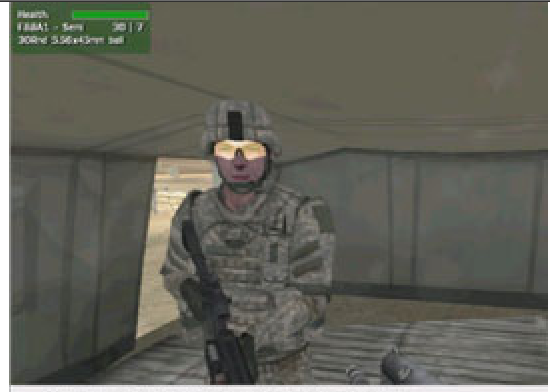
The researchers tested this by building "Baja," a virtual Afghan village. They integrated the behavioral server with VBS2 (the platform-specific model).
- SOTA Performance: The faction models achieved 80% accuracy in replicating conflict and cooperation decisions observed in real-world sociological data.
- Immersive Impact: Trainees could build rapport via "Tea Ceremonies" where the agent's "Familiarity" metric would increase over multiple visits, unlocking more sensitive information—a feat impossible for standard scripted NPCs.
Critical Insight & Conclusion
NonKin Village demonstrates that professionalism in AI requires moving away from "tricks" (like anthropomorphism) and toward "truth" (scientific models).
Limitations: While the logic is sound, the "bridge" between the server and the 3D client still faces challenges in real-time pathfinding and animation synchronization. Furthermore, although the models are statistically valid, authoring the initial weights for a new culture still requires significant domain expertise.
Future Outlook: The next frontier is the PIMMM (Meta-MetaModel)—a set of editors that allow non-programmers (cultural historians or anthropologists) to "drag and drop" values into an agent's mind to instantly generate a new artificial society.