
Distributed Planning in the OR: Why Deviating from the Plan is Key to Surgical Safety
Getting the Right Tools for the Job: Distributed Planning in Cardiac Surgery
This paper presents an ethnographic study of cardiac surgery through the lens of Distributed Cognition (DCog). It introduces the concepts of "preparatory configuration" and "active replanning" to explain how surgical teams maintain safety and efficiency amidst uncertainty, shifting the focus from individual error to system-level resilience.
TL;DR
In the high-stakes world of cardiac surgery, safety isn't just about following the rules—it's about the "distributed" ability of a team to rewrite the rules on the fly. This paper explores how Operating Room (OR) teams use preparatory configuration to streamline routine work and active replanning to survive the unexpected. By treating the OR as a single cognitive system, the authors argue that what we currently call "error" is often a vital part of system resilience.
Problem & Motivation: The Myth of the Static Plan
The Institute of Medicine traditionally defines error as the failure of a planned action. But in a "heart room," plans are never static. The authors argue that focusing on individual human error misses the bigger picture. In reality, surgery is a complex dance of human and technological interaction. The real challenge is understanding how teams manage "minor errors"—small, subtle discrepancies that, if left unmanaged, multiply into catastrophic outcomes.
Methodology: High-Fidelity Cognitive Ethnography
To understand this, the researchers didn't just look at charts; they embedded themselves in the OR. Using cognitive ethnography, they observed 200 hours of surgery and analyzed video from 20 cases. They used the Distributed Cognition (DCog) framework, which views the OR not as a group of individuals, but as a system that processes information by "propagating representations"—passing info through verbal commands, monitor displays, and even the physical layout of tools.
Methodology: The Core Mechanism
The authors break down planning into two critical phases:
- Preparatory Configuration: Before the patient even enters, the team "programs" the room. They use "cheat sheets" (surgeon-specific preference lists) and standardized tool layouts. This reduces the surgeon’s cognitive load, allowing them to receive the right tool simply by holding out a hand—no words needed.
- Active Replanning: When a "re-do" surgery or a new technology (like spring clips) introduces novelty, the initial configuration fails. The system must then "replan" in real-time, shifting from implicit cues to explicit, resource-intensive verbal communication.
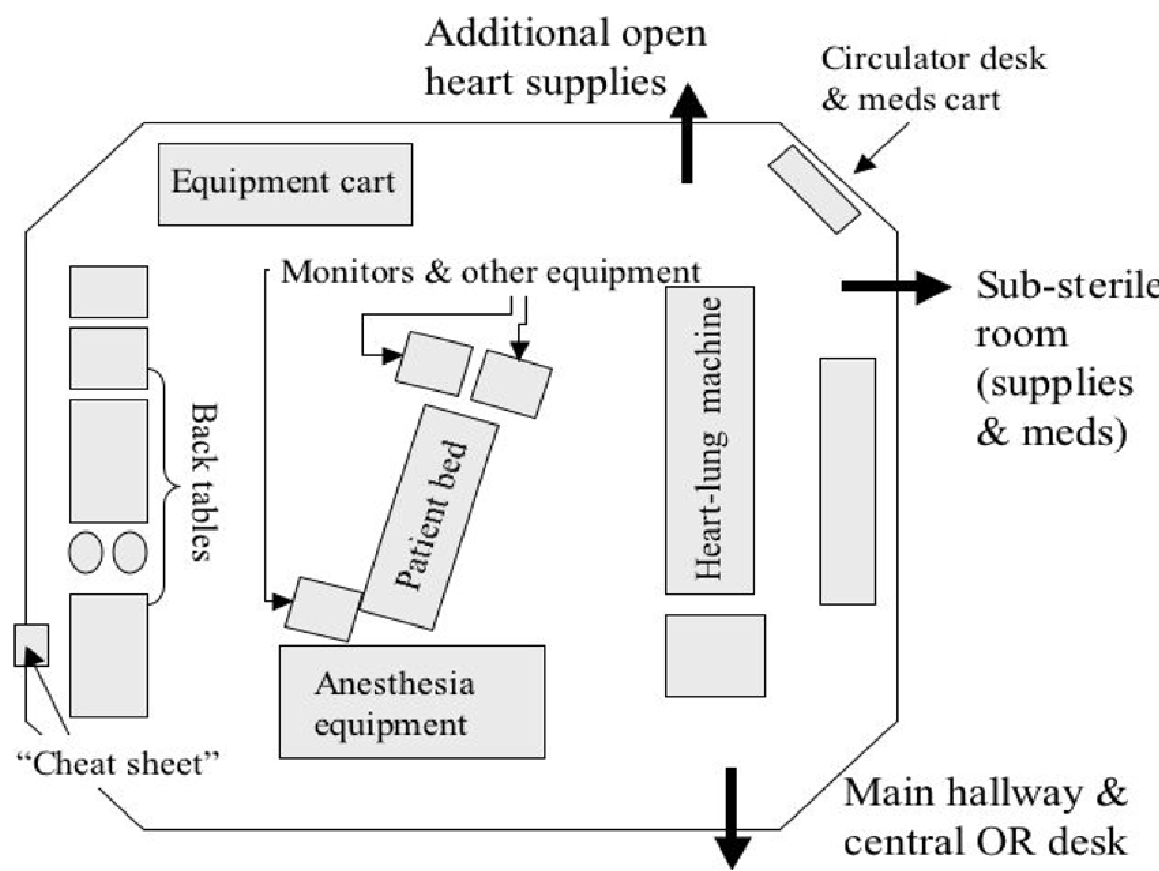 Fig 1. The OR layout during preparatory configuration, designed to minimize cognitive friction.
A Case Study in Resilience: The Spring Clip Conflict
The paper highlights a fascinating case where a surgeon decided to use a new "spring clip" technology mid-operation. Because these clips were unfamiliar, the "representations" (labels and names) became ambiguous.
- The Conflict: The scrub nurses across different shifts confused the "distal" clips with "proximal" clips because the labels only showed numbers, not functions.
- The Detection: The surgeon, wearing magnifying loupes and feeling the tactile difference of the needle, caught the error.
- The Result: Instead of a "hard stop," the surgeon formulated a "Replan 3," deciding the currently used clips were "good enough" for the specific arterial tissue, thus maintaining surgical flow.
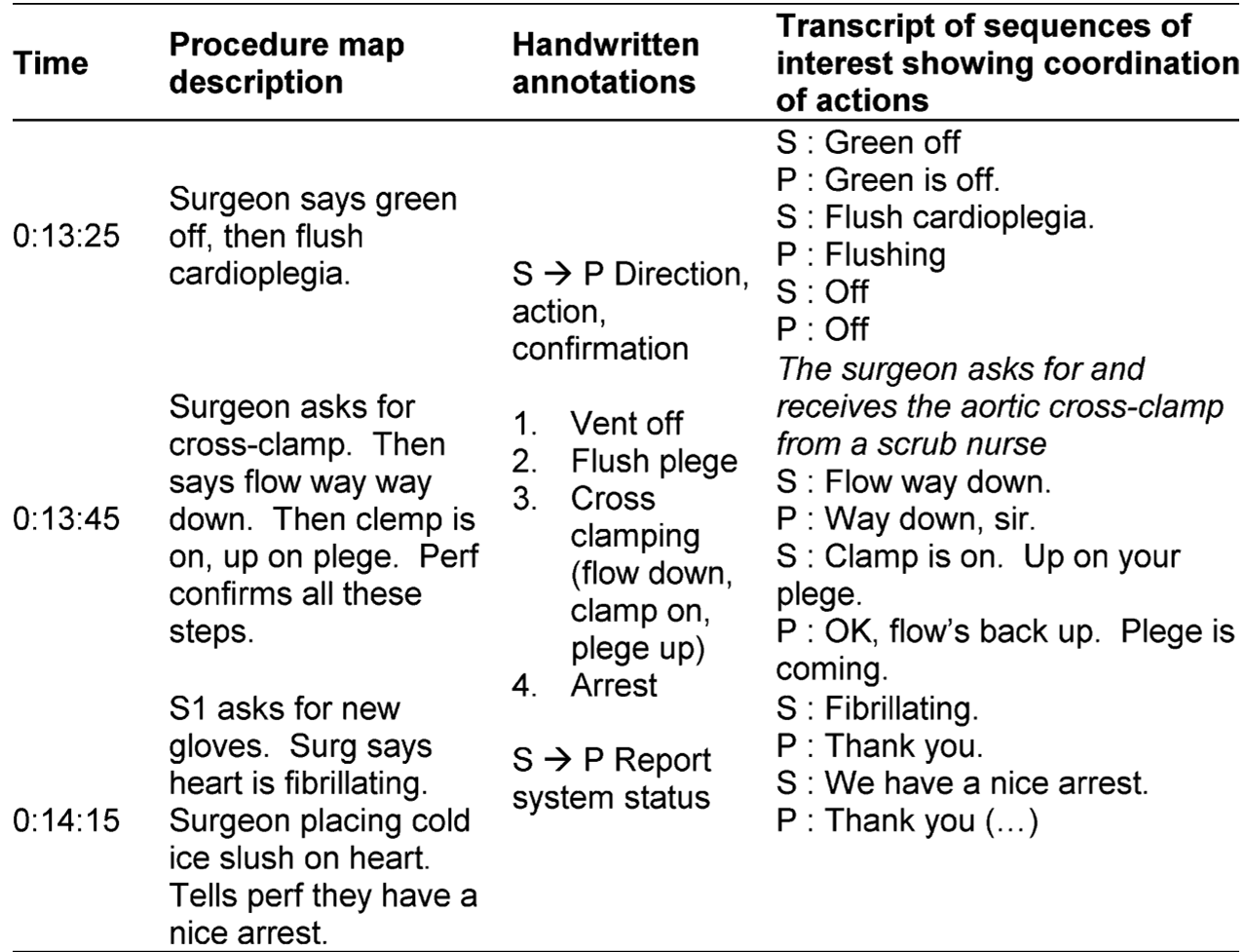 Table 1. A section of the procedure map showing the propagation of directions and confirmations between the Surgeon (S) and Perfusionist (P).
Results & Deep Insights
The study's key finding is that the OR system is resilient because it is redundant.
- Redundancy of Attention: While the nurses were focused on the labels, the surgeon was focused on the tactile feel.
- Redundancy of Plans: The system always has "fallback" plans ready to go.
Crucially, the authors challenge the definition of "error." If the team had stuck rigidly to the standard protocol when the technology failed, they might have caused more harm through delay. Replanning is not a failure of the original plan; it is a successful adjustment to reality.
Critical Analysis & Conclusion
Takeaway
The industry value of this work lies in how we design medical technology. We shouldn't just design "better tools"; we must design better "representations." For example, the spring clip error occurred because the packaging was discarded, leaving the scrub nurse with ambiguous numbers.
Limitations
The study focuses on a highly experienced team. For junior teams, the transition from "routine" to "replanning" might be much more chaotic and less resilient.
Future Outlook
As we move toward AI-assisted and robotic surgery, this DCog framework is more relevant than ever. We must ask: How does an AI agent participate in "active replanning"? Does it clarify our mental models, or does it add a new layer of "novelty" that stresses the system?
Conclusion: Safety in surgery is a "distributed" property. It lives in the "cheat sheets" on the walls, the layout of the tray, and the team's shared ability to toss the plan out the window when the situation changes.