
Ring-Zero: Scaling Zero RL to 1T Parameters and the Era of Autonomous Reasoning
Ring-Zero: Scaling Zero RL to a Trillion Parameters for Emergent Reasoning
Ring-Zero is a 1-trillion parameter Mixture-of-Experts (MoE) reasoning model trained using a multi-stage "Zero RL" pipeline. Starting from a base model without human-annotated data, it achieves state-of-the-art performance on competitive math benchmarks (e.g., 93.2% on AIME 2026) by eliciting emergent chain-of-thought (CoT) behaviors through reinforcement learning with verifiable rewards.
TL;DR
The AI community has long speculated whether the "DeepSeek-R1" magic—Reinforcement Learning without human data—would scale to trillion-parameter models. Ring-Zero definitively answers "Yes." By scaling Zero RL to a 1-Trillion parameter MoE architecture, researchers from Renmin University and Ant Group have demonstrated that massive scale doesn't just improve accuracy; it triggers the spontaneous emergence of human-like cognitive strategies—categorically proving the Bitter Lesson of AI once again.
The Scaling Paradox: Why Naive RL Fails at 1T
Prior work in reasoning models often suffers from a phenomenon the authors call "Length Inertia." Standard RL algorithms (like GRPO) with token-level loss implicitly reward models for being verbose. This leads to redundant, circular "rambling" that wastes inference tokens without gaining accuracy.
Furthermore, at the 1T scale, numerical stability becomes a nightmare. Subtle floating-point differences between the inference engine (generating samples) and the training engine (calculating gradients) can cause the importance-sampling ratio to explode, leading to catastrophic training collapse.
Methodology: The Multi-Stage Evolution
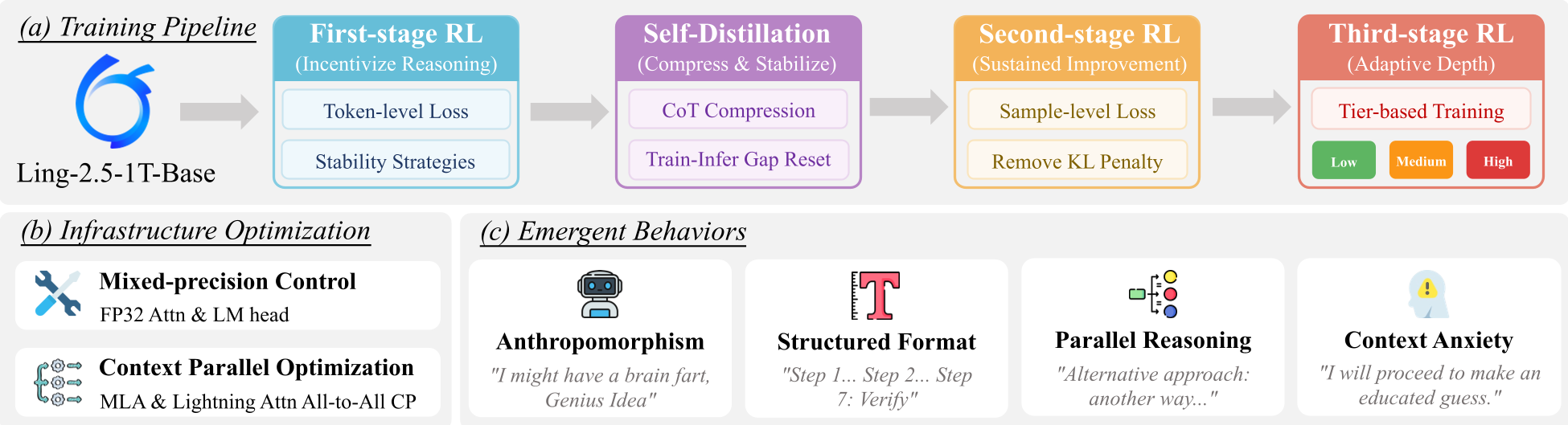
To solve these issues, the Ring-Zero pipeline moves beyond a single "Big Bang" RL stage into a structured evolution:
- Reasoning Elicitation: Uses clipped importance sampling to aggressively boost low-probability reasoning tokens.
- Self-Distillation: A critical "reset" button. The model filters its own best, most concise reasoning paths and fine-tunes on them to eliminate verbosity.
- Sample-Level RL: Pivots to a loss function that normalizes by length, preventing the model from becoming a "token-maximizing" rambling machine.
- Tier-based Adaptive Training: Teaches the model to use short thoughts for easy tasks and long thoughts for hard ones via system prompts.
Key Finding: Discovery vs. Sharpening
The authors resolve a major debate: Does RL expand the "search boundary" or just "sharpen" the model's existing knowledge? They prove it does both in a sequential two-phase process:
- Phase 1 (Discovery): The model unlocks dormant reasoning pathways (Pass@1024 increases).
- Phase 2 (Sharpening): The model learns to consistently hit the bullseye within that boundary (Pass@1 increases while @1024 plateaus).
The Bitter Lesson: Spontaneous Cognitive Emergence
Perhaps the most striking result is what the researchers didn't code. Without any explicit instruction or human templates, the 1T model autonomously developed:
- Anthropomorphism: Using phrases like "brain fart" or "winging it" during internal thought when facing difficult segments.
- Parallel Reasoning: Spontaneously branching into multiple alternative strategies (Tree-of-Thought) within a single linear output.
- Context Anxiety: A strategic "panic" where the model realizes it's running out of context window and makes an educated guess to ensure it at least produces a formatted answer.
Experimental Results: Leaner and Meaner
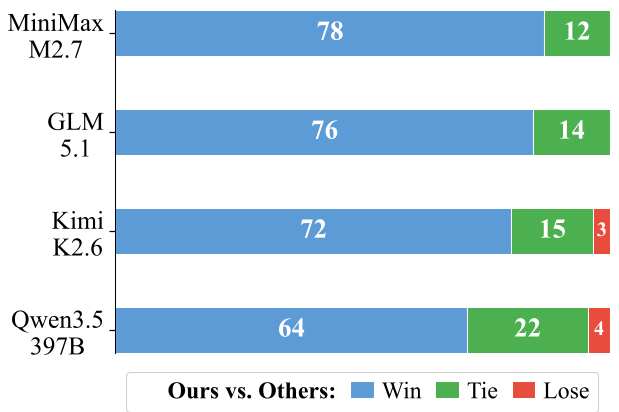
Ring-Zero isn't just bigger; it's smarter. On AIME 2026, it reaches 93.2% accuracy, but it does so with 6,368 tokens—less than 50% of the token count used by comparable frontier models. This proves that efficiency and high-level reasoning are not mutually exclusive if the RL pipeline is designed to prune redundancy.
Critical Insight & Conclusion
Ring-Zero proves that at the 1T scale, compute is the ultimate architect. We no longer need to hand-engineer "Reflection" or "Self-Correction" modules. When given enough parameters and a verifiable reward, the model discovers that these behaviors are simply the most optimal mathematical paths to the reward.
The Takeaway: Future AI development will likely shift away from "teaching" models how to think and toward building better, more scalable "environments" (like the Ring-Zero pipeline) where models can discover thinking for themselves.