
This paper presents a comprehensive ringdown model for non-spinning test particles on eccentric equatorial orbits merging with a Kerr black hole. By solving the Teukolsky equation in the time domain, the authors develop a closed-form phenomenological model that successfully integrates with the Effective-One-Body (EOB) framework to produce full inspiral-merger-ringdown (IMR) waveforms.
TL;DR
Researchers have developed a new Effective-One-Body (EOB) ringdown model for test-masses plunging into Kerr black holes along eccentric orbits. By abandoning the traditional "amplitude peak" as a starting point and instead anchoring the model to the Light-Ring (LR) crossing, the authors have achieved a robust description that remains accurate even for high-spin () and high-eccentricity () systems, including complex dynamical capture events.
The "Whirl" Before the Plunge: Why Peak-Anchoring Fails
In the world of Gravitational Wave (GW) modeling, "merger" is often synonymous with the peak of the waveform amplitude (). However, in the extreme corner of the parameter space—where black holes spin rapidly and orbits are highly eccentric—this definition breaks down.
The authors reveal a critical insight: for prograde, high-spin orbits, the particle undergoes a "whirl" phase. During this phase, the amplitude peak occurs while the particle is still outside the light-ring, meaning the signal is still heavily "source-driven." If you start a Quasi-Normal Mode (QNM) ringdown model at this peak, you are trying to fit a free-ringing solution to a driven system. Furthermore, the timing of this peak is frustratingly sensitive to the relativistic anomaly ()—essentially the "mood" of the orbit at the moment it becomes unstable.
Methodology: The Light-Ring Anchor
The core innovation of this work is the shift to a dynamical anchor. By setting the match point at , the model becomes remarkably immune to the initial orbital phase .
1. Spheroidal Mode-Mixing
Because Kerr black holes are not spherically symmetric, the standard spherical harmonic multipoles () are actually "contaminated" by multiple spheroidal modes. The authors solve this by:
- Inverting the spherical-spheroidal map.
- Fitting the "pure" spheroidal modes using monotonic activation-style templates.
- Reconstructing the spherical signal for the final EOB waveform.
2. Modeling the "Beating"
For retrograde orbits, the interaction between co-rotating and counter-rotating QNMs creates a distinct "beating" pattern in the frequency. The authors found that if they aligned these beats using the inflection point of the frequency (), the pattern became independent of eccentricity, allowing for a simplified, spin-only beating model.
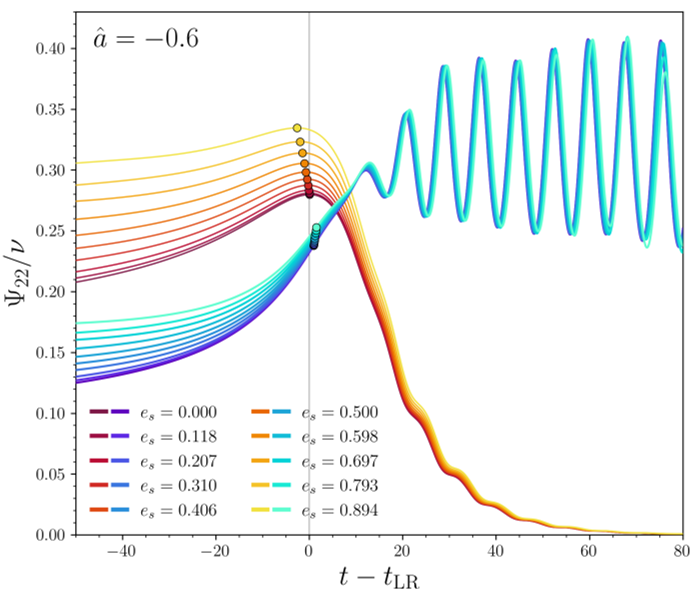 Figure 1: The effective potential landscape. Depending on the anomaly , the particle might plunge directly or "whirl" near the potential peak.
Results: From Elliptic Orbits to Dynamical Captures
The model was tested against numerical solutions of the Teukolsky equation (using the Teukode solver).
- Phase Accuracy: For the dominant (2,2) mode, the phase difference () typically stays below 0.01 radians for prograde spins.
- Spin Handling: The model remains physically robust up to spins of , where older peak-anchored models usually fail due to the massive time-delay between the peak and the actual ringdown.
- Dynamical Captures: This is perhaps the most impressive feat. The model, although trained on bound elliptic data, accurately predicts the merger of "unbound" particles that are captured via radiation reaction.
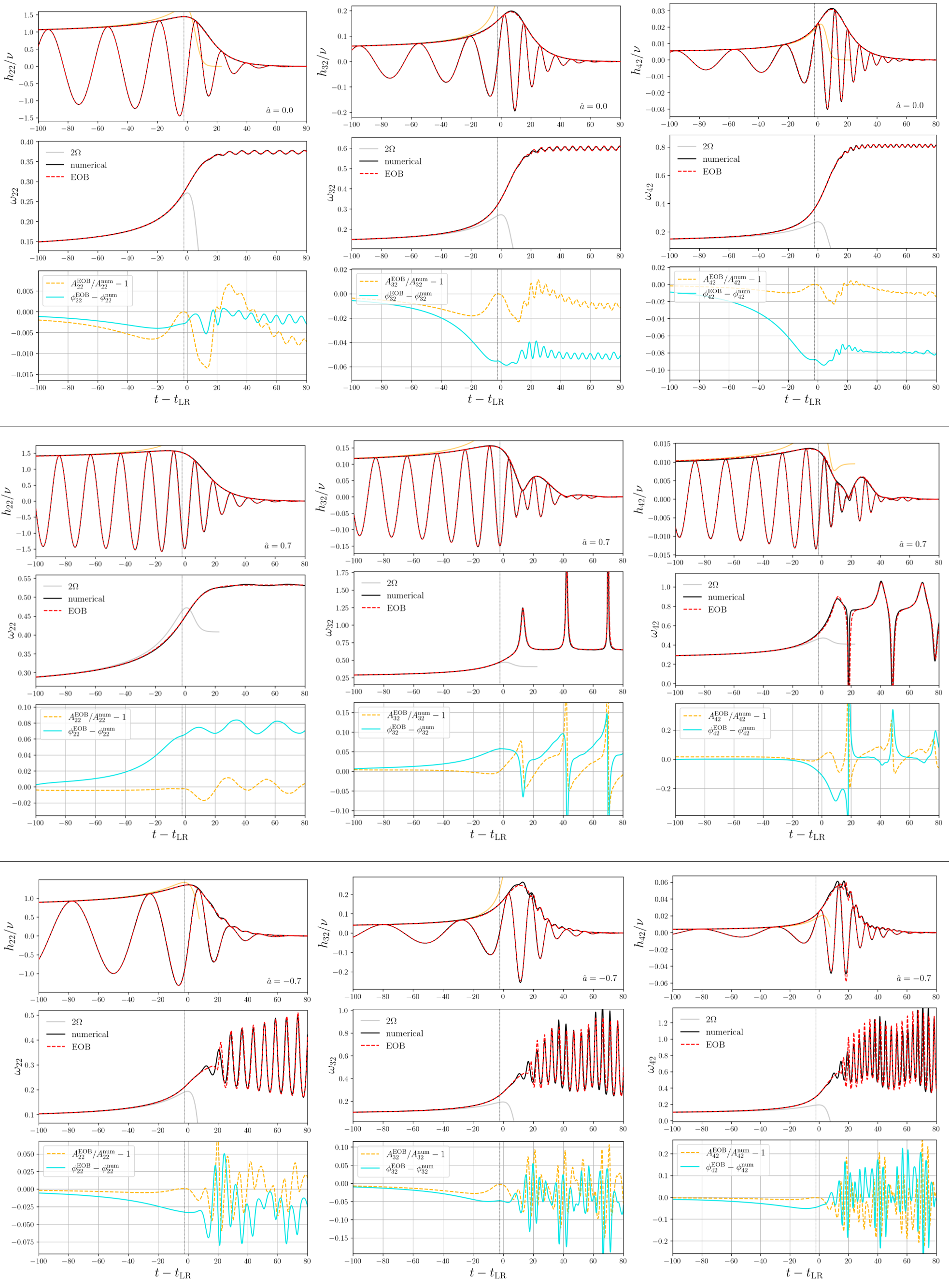 Figure 2: Waveform comparisons across different spins (). The red dashed lines (EOB) track the black numerical lines with high fidelity through the plunge and ringdown.
Why It Matters for LISA and Beyond
This research isn't just about test-masses. It provides a vital bridge to comparable-mass binaries (like those detected by LIGO/Virgo). Since the "Light-Ring" isn't strictly defined for equal-mass black holes, the authors propose using the inflection point of the frequency as a universal anchor point.
As we prepare for the LISA mission, which will observe Extreme Mass Ratio Inspirals (EMRIs) with excruciating detail, having a ringdown model that doesn't "break" when the orbit gets eccentric or the spin gets high is no longer a luxury—it's a necessity.
Conclusion
By moving the "start" of the ringdown away from the deceptive amplitude peak and closer to the dynamical light-ring, Albanesi et al. have created a more "physical" waveform model. It reminds us that in general relativity, the behavior of the spacetime geometry (the Light-Ring) is often a more reliable guide than the immediate appearance of the signal (the Peak).