
The Cat-and-Mouse Game: Decoding the Rise of Compromised Social Accounts
Rise of spam and compromised accounts in online social networks: A state-of-the-art review of different combating approaches
This paper provides a state-of-the-art review of techniques for detecting spam and compromised accounts in Online Social Networks (OSNs). It classifies detection methodologies into categories such as honey-profiles, machine learning, and behavioral analysis, highlighting the shift from simple fake accounts to the more evasive use of compromised legitimate accounts.
TL;DR
The security landscape of Online Social Networks (OSNs) is shifting. Spammers are moving away from easily detectable fake bots toward Compromised Accounts—legitimate user profiles hijacked via phishing or malware. This review paper synthesizes a decade of research, revealing that the key to modern defense lies in Behavioral Profiling: detecting subtle deviations from a user's "digital DNA," including their writing style, posting schedule, and even their social graph structure.
The Evolution of the Threat: From Bots to Hijacks
Historically, social media security focused on "Sybil" accounts—massive clusters of fake profiles created programmatically. However, as OSN providers like Facebook and Twitter implemented stricter rate limits and bot-detection heuristics, attackers adapted.
The "new" gold standard for attackers is the compromised account. Why?
- Inherent Trust: These accounts already have followers and a reputation.
- Evasion: They blend malicious links with years of legitimate history, making them "look" human to simple classifiers.
- Persistence: Unlike fake accounts, service providers cannot simply delete a compromised account without harming a real user.
Methodology: How Do We Spot an Imposter?
The paper categorizes detection into two phases: At-Sign-in (IP/Geolocation checks) and At-Use (Behavioral analysis). Since sign-in defenses are often bypassed by proxies or session hijacking, the academic community has focused heavily on "At-Use" anomalies.
1. Authorship Verifiability (The Stylometric Fingerprint)
Every user has a unique writing style—the frequency of certain n-grams, the use of emojis, or specific punctuation. Researchers use Authorship Verification (AV) to build a baseline for each user. If a new post deviates from this linguistic threshold, the account is flagged.
- Insight: n=6 in n-gram models combined with SVM classifiers has shown to be a "sweet spot" for text sensitivity.
2. The Circadian Typology (Temporal Patterns)
Users are creatures of habit. You might browse at 8 AM during your commute or 11 PM before bed. Attackers (often in different time zones) or automated scripts break these temporal "timeprints."
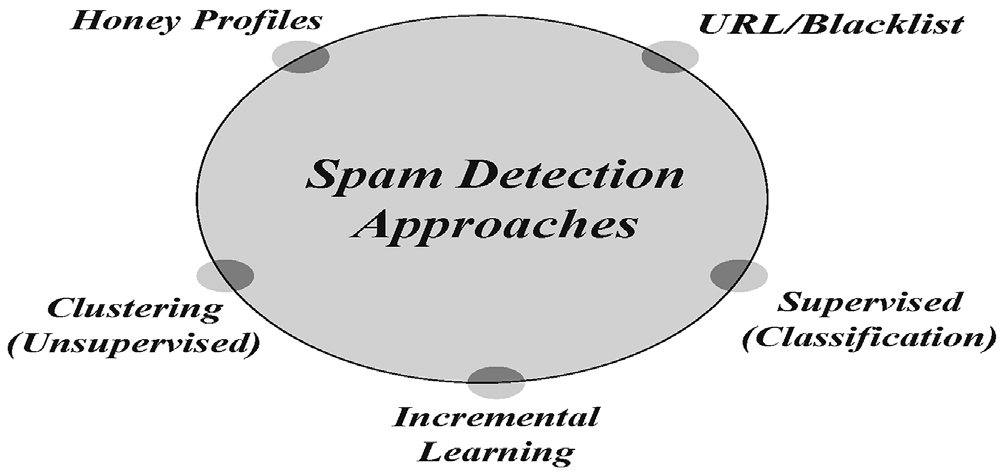 Figure: The taxonomy of detection—from honeypots to temporal analysis.
3. Graph Anomaly Detection
A hijacked account might suddenly follow thousands of new users or join "Like-for-Like" rings. By monitoring metrics like Combined PageRank and Clustering Coefficients, researchers can spot structural shifts that indicate a node in the network is no longer under its original owner's control.
Key Performance Benchmarks
The review compares various methodologies across different platforms (Twitter, Facebook, MySpace, and Sina Weibo).
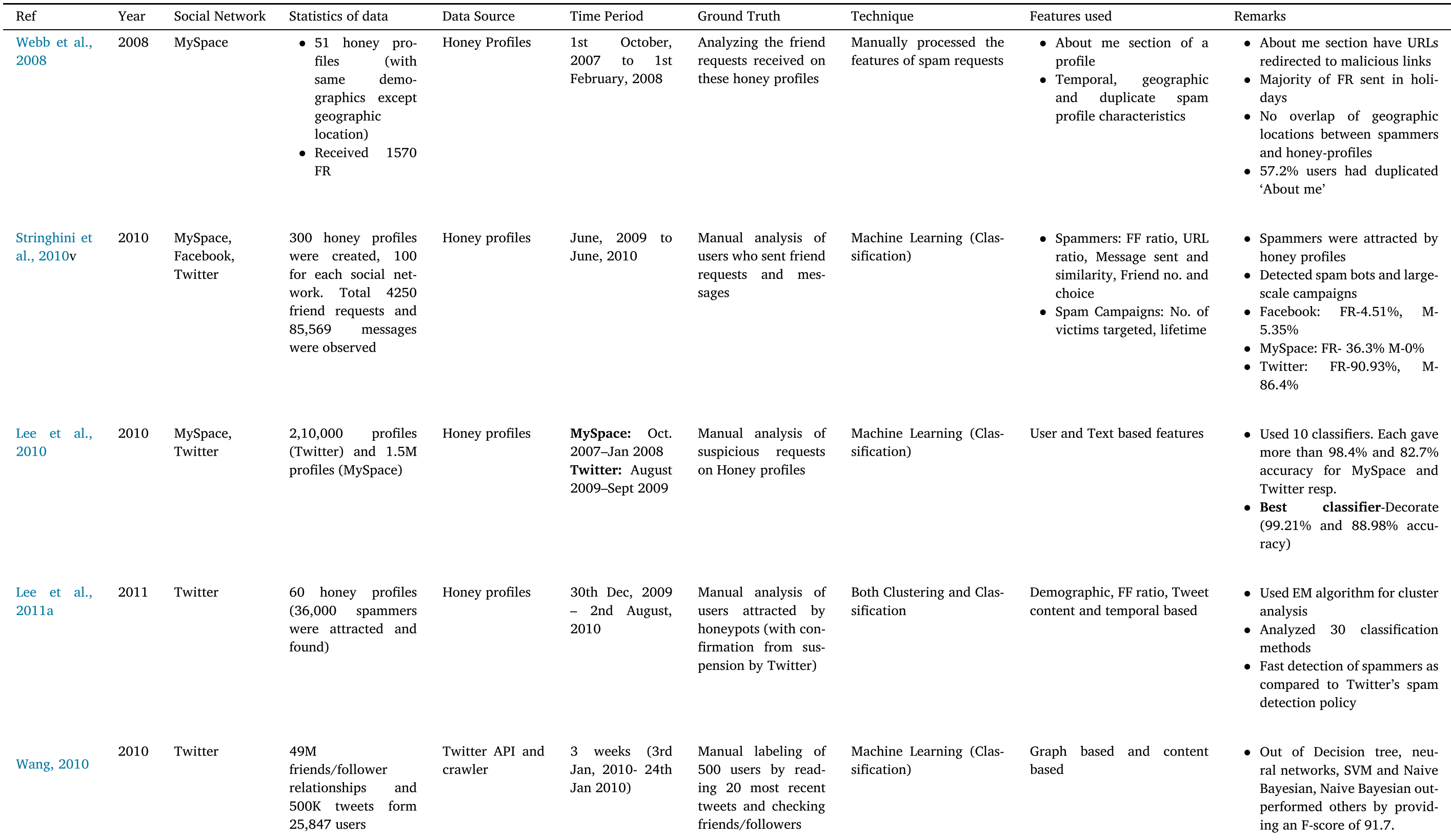 Table: A snapshot of the competitive landscape in OSN security research.
- Spam Campaigns: Graph mining techniques outperformed K-means clustering (F-score 0.96 vs 0.89), proving that the relationship between messages is more telling than the content itself.
- Compromised Detection: The COMPA system (and its successors) remains a benchmark, utilizing a multi-feature score (Time, Source, Language, Topic, Links) to achieve false negative rates as low as 0.5%.
Critical Insight: The "Silent" Interaction Gap
One of the most profound observations in this review is the Introversial vs. Extroversial behavior gap. Most research focuses on posting (extroversial). However, 92% of social network activity is browsing—clicking, searching, and reading (introversial).
The authors argue that future SOTA (State-of-the-Art) models must integrate Clickstream Analysis. A hacker might not post a single tweet but could spend hours harvesting data from a user's private messages or friend lists. This "silent" compromise is the next frontier of OSN security.
Future Outlook and Limitations
Despite high accuracy in controlled experiments, social media security faces three major hurdles:
- Zero-day Detection: How do we stop the harm before the first malicious link is clicked?
- Concept Drift: Spammers continuously update their behavior to mimic legitimate users (Incremental Learning is required).
- Data Latency: In the era of "real-time" news, a compromised account (like the 2013 AP News hack regarding a White House explosion) can tank the stock market in seconds. Detection must be near-instant.
Conclusion
The review serves as a definitive roadmap for OSN security. It highlights that while we are excellent at spotting "loud" bots, we are still refining the tools to catch the "quiet" imposter. The future of social network defense lies not in looking for "bad" behavior, but in deeply understanding what "normal" behavior looks like for every individual user.