
RISECURE: Turning Social Media into Real-Time Metro Security Sensors
RISECURE: Metro Incidents And Threat Detection Using Social Media
RISECURE is an open-source, real-time threat detection system designed for metro transit networks. It leverages social media mining (Twitter/X) and a Dynamic Query Expansion (DQE) algorithm to identify and track security incidents, achieving significantly earlier detection compared to traditional news outlets.
TL;DR
RISECURE is an automated monitoring system that mines Twitter data to detect metro incidents (shootings, stabbings, delays) long before official news cycles catch up. By using a Dynamic Query Expansion (DQE) algorithm, it filters through social noise to build a real-time "storyline" of transit threats.
Background Positioning
In the landscape of "Smart Cities," public transit systems are highly vulnerable targets but difficult to monitor comprehensively. RISECURE fits into the Event Detection & Situational Awareness category, moving beyond static train schedules to treat commuters as active "human sensors." It bridges the gap between raw social media chatter and actionable security intelligence.
The Problem: The 60-Minute Information Gap
Modern transit authorities like WMATA handle hundreds of thousands of daily riders. Current monitoring systems are often restricted to maintenance alerts. When a security threat occurs—be it a shooting or a suspicious package—there is a critical "dead zone" of time between the incident occurrence and official media reporting.
The authors identify a major insight: Promptness and Geolocation. 80% of users tweet from mobile devices, and they often post seconds after an event. The challenge is filtering the "noise" of millions of tweets to find the specific "signal" of a local metro threat.
Methodology: The Logic of Dynamic Query Expansion (DQE)
RISECURE’s core innovation isn't just searching for "gun" or "metro." It’s how the system evolves its understanding of an incident as it happens.
1. The Architecture
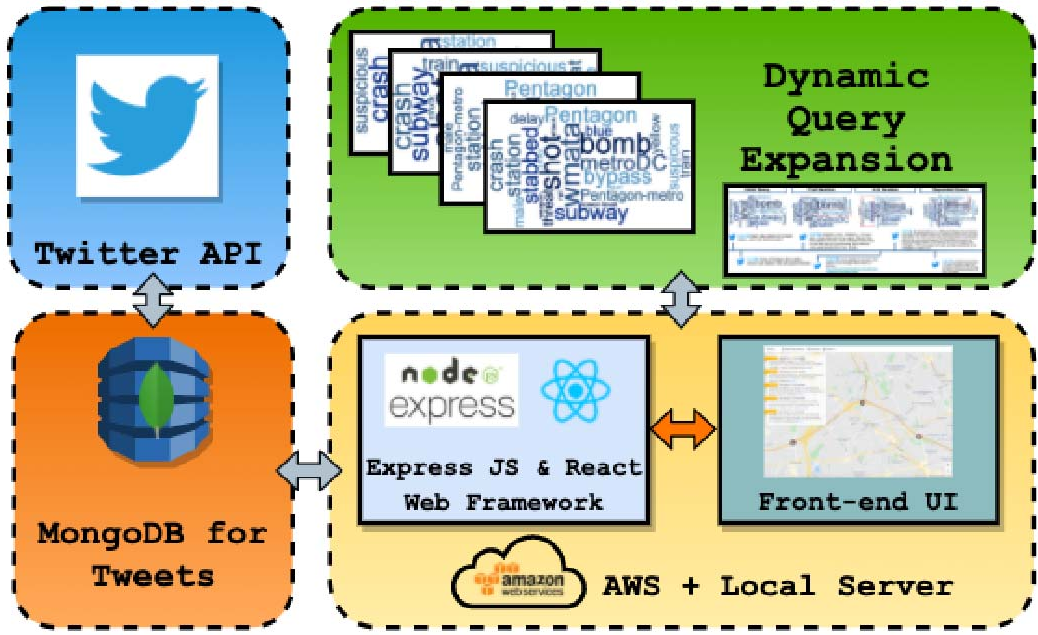
The system follows a pipeline of Acquisition -> Pre-processing -> DQE -> Visualization. Data is ingested via Twitter APIs and stored in MongoDB via AWS Lambda, ensuring the backend scales with tweet spikes during emergencies.
2. DQE: Beyond Static Keywords
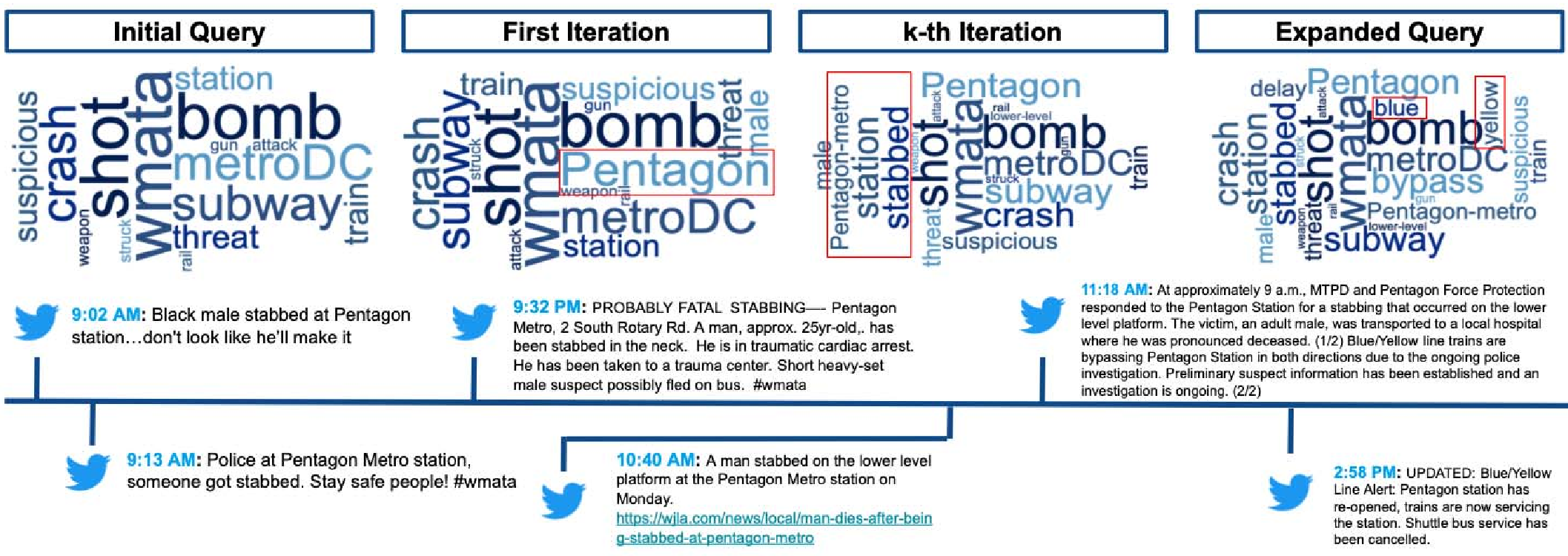
If a stabbing occurs at "Pentagon Station," the system starts with seed keywords (e.g., "metro", "weapon"). As the algorithm detects a cluster of related tweets, it calculates weights based on Inverse Document Frequency (IDF).
- The Intuition: If "Pentagon" and "Stabbing" suddenly co-occur frequently relative to their normal frequency, the algorithm "expands" its query to include these specific terms.
- Convergence: It iterates until the representative keyword set stabilizes, effectively "naming" the event automatically.
Experimental Validation: Beating the News Cycle
The authors validated RISECURE using high-profile incidents within the WMATA system. The results highlight a staggering disparity in reporting speed:
- Shaw-Howard Metro Shooting: First tweet detected at 12:58 PM. First news report (FOX News) at 1:34 PM. RISECURE was 36 minutes faster.
- Pentagon Metro Stabbing: First tweet at 9:02 AM. First news report (ABC7) at 10:40 AM. RISECURE was 98 minutes faster.
Geo-Tagging Accuracy
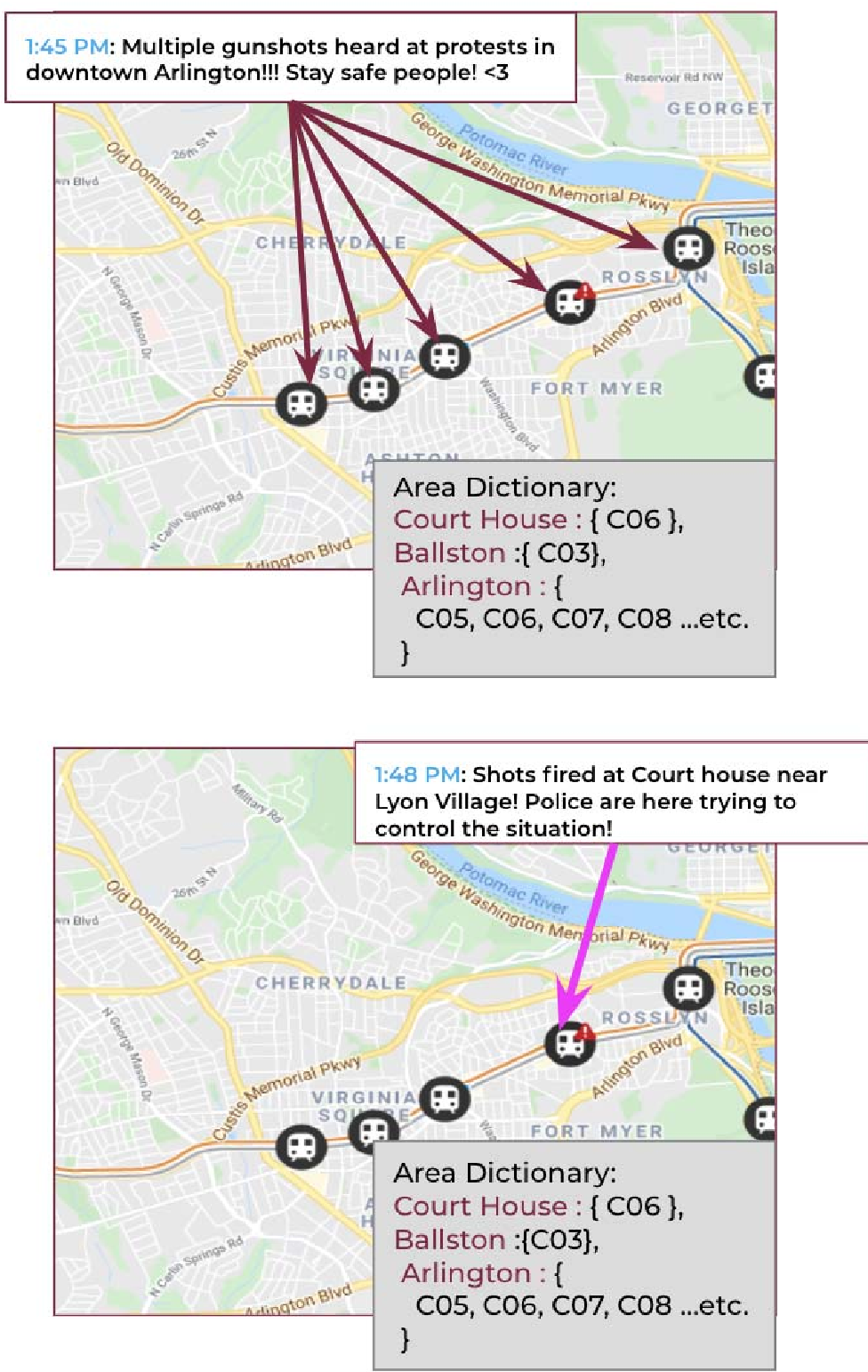
The system employs a "Location Dictionary" to handle the ambiguity of tweets. If a tweet says "Arlington," it maps to all stations in that locality; once a more specific tweet mentions "Pentagon City," the system narrows the marker to the exact coordinate.
Critical Insight & Conclusion
RISECURE demonstrates that the main hurdle in public safety isn't a lack of data, but the latency of verification. By the time a news crew arrives at a station, the situation may have already escalated.
Key Takeaways for Future Research:
- Scalability: The system is framework-agnostic and could be deployed in any city with active social media usage.
- Limitations: The system relies on the Twitter API (which has faced significant changes recently) and assumes users will post in public. Future iterations may need to incorporate multi-platform mining (e.g., Reddit, local apps).
Ultimately, RISECURE proves that "Social Media Mining" is no longer just for marketing—it is a critical tool for urban resilience and immediate threat response.