
RDTTM: Dynamic Risk-Defined Trust Transitivity in Social Networks
A Risk-defined Trust Transitivity Model for Group Decisions in Social Networks
This paper introduces the Risk-defined Trust Transitivity Model (RDTTM), a framework for Social Network Group Decision-Making (SNGDM). It utilizes a four-tuple information structure (trust, distrust, uncertainty, inconsistency) and a novel risk-defined propagation operator to handle subjective risk attitudes in trust evaluation across social networks.
TL;DR
Social Network Group Decision-Making (SNGDM) is often hindered by the rigid way trust is propagated through a network. The Risk-defined Trust Transitivity Model (RDTTM) breaks this rigidity by introducing a risk-attitude parameter (). This allows the model to adjust how quickly trust decays or distrust grows across a referral chain, providing a more personalized and human-like decision-making process.
Problem & Motivation: The "One Size Fits All" Trust Fallacy
In digital ecosystems like CouchSurfing or E-commerce platforms, we rely on the "friends of friends" logic to make decisions. However, current mathematical models for trust transitivity have a major flaw: they assume everyone views risk the same way.
If a friend you trust 80% recommends a specialist they trust 80%, a conservative person might only trust that specialist 50% (high attenuation), while a risk-taker might trust them 70%. Existing SOTA methods (like those by Wu et al.) often use fixed "uninorm" operators that reflect a single, typically conservative, risk profile. Furthermore, they often ignore inconsistency—the scenario where an evaluator provides conflicting high trust and high distrust scores simultaneously.
Methodology: The RDTTM Framework
The paper introduces a structured approach to move from sparse social data to a concrete group decision.
1. Four-Tuple Information Space
Instead of a single "trust score," the model uses a tuple , where is trust and is distrust. This expands into a space covering:
- Trust & Distrust: Direct values.
- Hesitancy: When (uncertainty).
- Inconsistency: When (conflicting data).
2. Risk-Defined Propagation ()
This is the core innovation. The operator propagates trust along a path based on a parameter :
- High : Reflects a conservative DM. Trust drops sharply across each hop in the network.
- Low : Reflects a risk-taking DM. Trust is preserved more effectively across referrals.
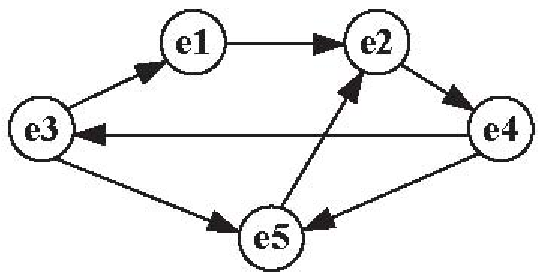 Fig 1. A typical expert trust network where nodes calculate indirect trust via propagation paths.
3. Path Centrality Aggregation
Since there are often multiple paths between two people (e.g., vs. ), the model uses Closeness Centrality. Paths involving more "central" or influential experts are given higher weights during aggregation.
Experiments: Sensitivity to Risk
The authors tested RDTTM on a "Trusted Service Selection" problem (choosing a computer supplier). The results were striking:
- At (Risk-taking), Supplier was the winner.
- At (Conservative), Supplier was the winner.
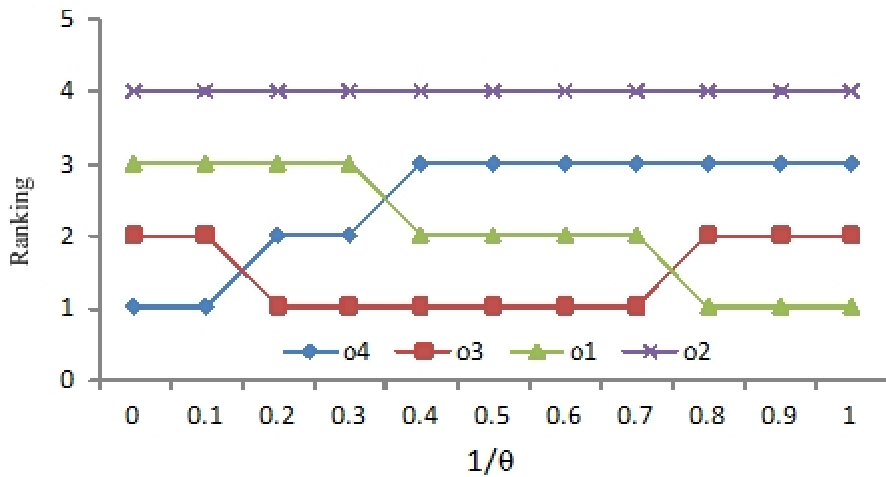 Fig 2. The ranking of suppliers shifts completely as the Decision Maker's risk attitude (1/θ) changes.
This proves that previous "fixed" models were only providing a partial view of the truth. By adjusting , the RDTTM can simulate various human behaviors, outperforming the static nature of previous SOTA methods.
Critical Insight & Conclusion
The true value of this paper lies in its Inductive Bias toward human psychology. Trust is not a physical constant; it is a subjective perception of risk. By mathematically defining the Knowledge Degree (KD) based on Euclidean distance and linking it to a tunable Risk Attitude, the authors have bridged a gap between social psychology and fuzzy mathematical logic.
Limitations: The model currently assumes that the DM knows their own value. In future iterations, an automated way to "learn" a user's risk profile from historical decisions would make the system significantly more powerful for large-scale social networks.