
Deciphering the "Witkey" Paradox: Why Risk Perception is the True Barrier to Crowdsourcing Adoption
Risk Taking Behavior in Crowdsourcing Adoption: The Case of Witkey
This study investigates the risk-taking behavior of contract-issuing parties in the "Witkey" crowdsourcing mode. By employing Structural Equation Modelling (SEM), it identifies how website characteristics—authenticity, convenience, and security—negatively impact perceived risks, thereby influencing the adoption intention of crowdsourcing services.
TL;DR
In the booming digital economy, crowdsourcing (or the "Witkey" mode) has revolutionized how services are traded. However, organizations remain hesitant to "hire the crowd." This paper reveals that adoption is not limited by cost, but by a complex matrix of perceived risks. By optimizing website authenticity, convenience, and security, platforms can systematically lower the barriers to entry for contract issuers.
Background & Motivation
Crowdsourcing platforms like Zhubajie or InnoCentive have democratized innovation, allowing firms to tap into global talent. Yet, the transition from traditional outsourcing to the "Witkey" (wisdom key) mode is fraught with uncertainty. Unlike buying a physical product, purchasing a service from an anonymous online contributor carries high stakes.
The authors argue that previous research has ignored the "buyer's" perspective. Why do some companies hesitate to post a task? The answer lies in Risk Perception.
The Multidimensional Risk Framework
The researchers break down "Risk" into four distinct silos tailored for the service-oriented Witkey environment:
- Financial Risk: The fear of losing money on a low-quality or unfinished task.
- Time Risk: The potential waste of time spent managing a failed project.
- Services Risk: The worry that the final delivery won't match the professional standards of traditional employees.
- Psychosocial Risk: The internal anxiety or organizational embarrassment of choosing an unconventional procurement route.
Methodology: Bridging Platform Features to Human Trust
To understand how to mitigate these risks, the study analyzes three "Website Antecedents":
- Authenticity: Credibility of information (UI ratings, historical reviews).
- Convenience: The "flow" of the transaction (navigation, payment speed).
- Security: Protection of private data and payment systems.
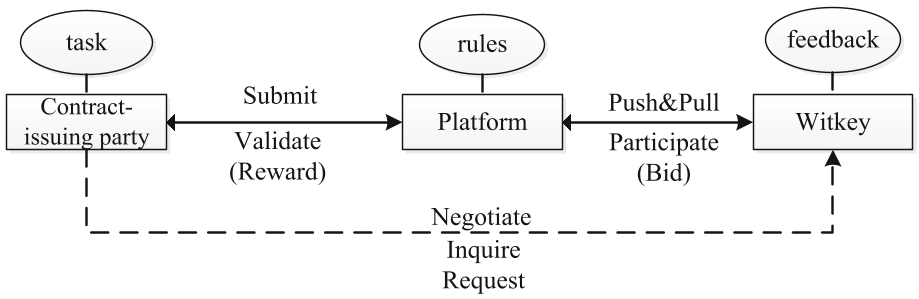 Fig 1. The structural relationship between Witkey, the Platform, and the Contract-Issuing Party.
The study utilized Structural Equation Modelling (SEM) on 325 valid questionnaires to map these relationships.
Key Findings: Security is Not Enough
The data revealed several counter-intuitive insights:
- Security vs. Psychosocial Risk: Interestingly, while security (H3) reduces financial and service risks, it has no significant impact on psychosocial risk. Instead, Convenience was the biggest driver in lowering psychological anxiety. High friction in the UI makes users "feel" the platform is unprofessional, triggering stress.
- Authenticity is Universal: Website authenticity (H1) was the only factor that successfully reduced all four risk dimensions simultaneously.
- Psychology over Economy: The impact of service and psychosocial risks on "Adopting Intention" was actually stronger than financial risk. Issuers are more afraid of "looking bad" or getting "bad service" than they are of losing a small deposit.
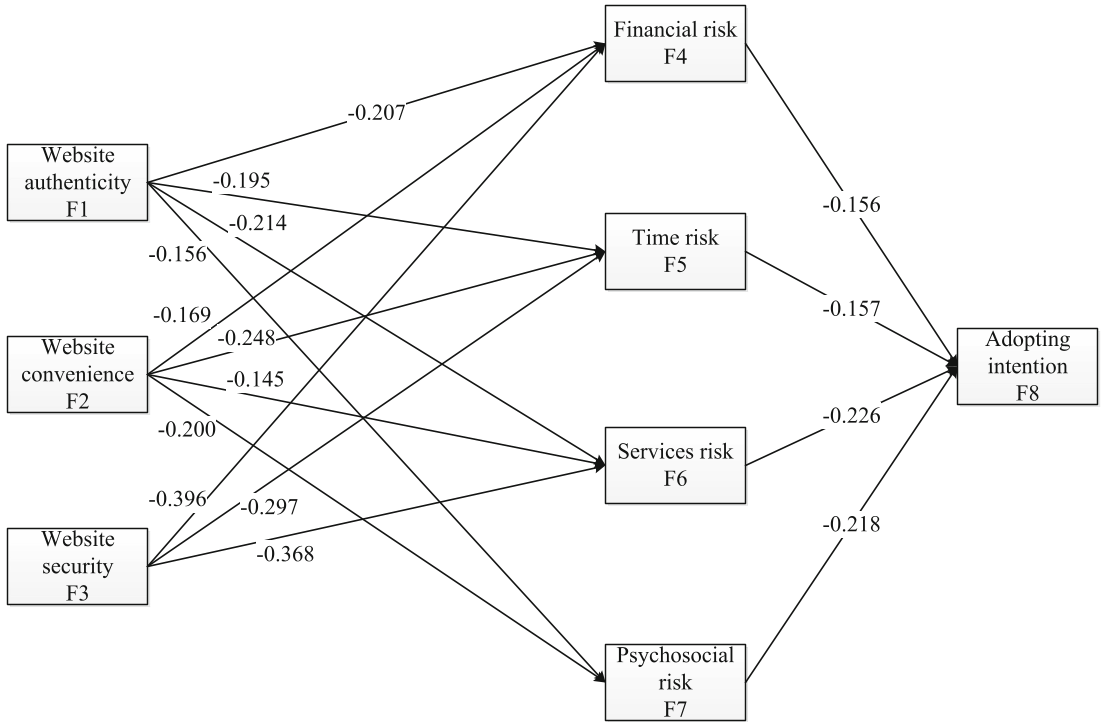 Fig 2. Path coefficients showing the significant negative correlation between perceived risks and adoption intention.
Critical Analysis & Conclusion
This paper shifts the discourse from "how to attract workers" to "how to reassure buyers." It highlights a critical Inductive Bias in platform design: many developers focus solely on encryption (Security), but forget that clarity (Authenticity) and ease of use (Convenience) are equally potent psychological "safety nets."
Takeaways for Platform Architects:
- Prioritize Third-Party Credentials: To enhance Authenticity, use external certifications for both the site and the freelancers.
- Simplify the Visual Narrative: Use icons and streamlined flows to reduce the cognitive load that leads to time and psychosocial risk.
- Focus on Service Verification: Implement stronger quality assurance (QA) milestones to directly tackle "Services Risk," which the paper identifies as a primary adoption killer.
Future Outlook: As we move toward AI-integrated crowdsourcing, the "Psychosocial Risk" of relying on non-human or anonymous labor will likely become even more prominent, making this risk-mitigation framework more relevant than ever.