
rLinkTopic: Bridging the Gap Between Digital Discourse and Physical Space
rLinktopic: a probabilistic model for discovering regional linktopic communities
The paper introduces rLinkTopic, a novel probabilistic model for discovering regional communities in social networks by jointly modeling spatio-temporal proximity, contextual links (mentions/replies), and message topics. It utilizes a generative process based on Latent Dirichlet Allocation (LDA) extensions and a collapsed Gibbs sampling algorithm to identify geographically localized and topically coherent user groups.
TL;DR
Social communities aren't just about "who follows whom"; they are bound by where we are, when we interact, and what we discuss. The rLinkTopic model is a sophisticated probabilistic framework that extracts communities by fusing geographic location, temporal proximity, and contextual interactions (like retweets) into a single generative flow. It significantly outperforms traditional models in finding communities that make sense both on a map and in a conversation.
The Missing Dimension: Why Location Matters
Most community detection algorithms treat social networks as "flat" graphs. While Latent Dirichlet Allocation (LDA) brought "topics" into the mix, these methods still miss two critical realities:
- Contextual Dynamics: A static follow is less meaningful than a specific mention or reply in a time-sensitive discussion.
- Geographic Constraints: Humans are inherently spatial. Interactions are often driven by shared local experiences—weather, local traffic, or regional events.
Existing models like TURCM or standard Topic Models often fail to capture this "Regionality," leading to communities that are topically cohesive but geographically scattered, which limits their use in local services or urban planning.
Methodology: How rLinkTopic Works
The core innovation of rLinkTopic lies in its hierarchical generative structure. It doesn't just look at a user's location; it organizes "user occurrences" into regions using a mixture of Gaussians.
The Generative Logic
The model assumes the following process for every message:
- Region Selection: Based on the user's location, an occurrence is assigned to a spatial region.
- Community Assignment: Each region is a mixture of communities; the model selects a community that fits the user's historical context.
- Topic and Interaction Generation: Within that community, a specific topic is chosen, and "contextual links" (mentions) are generated based on the community's user distribution.
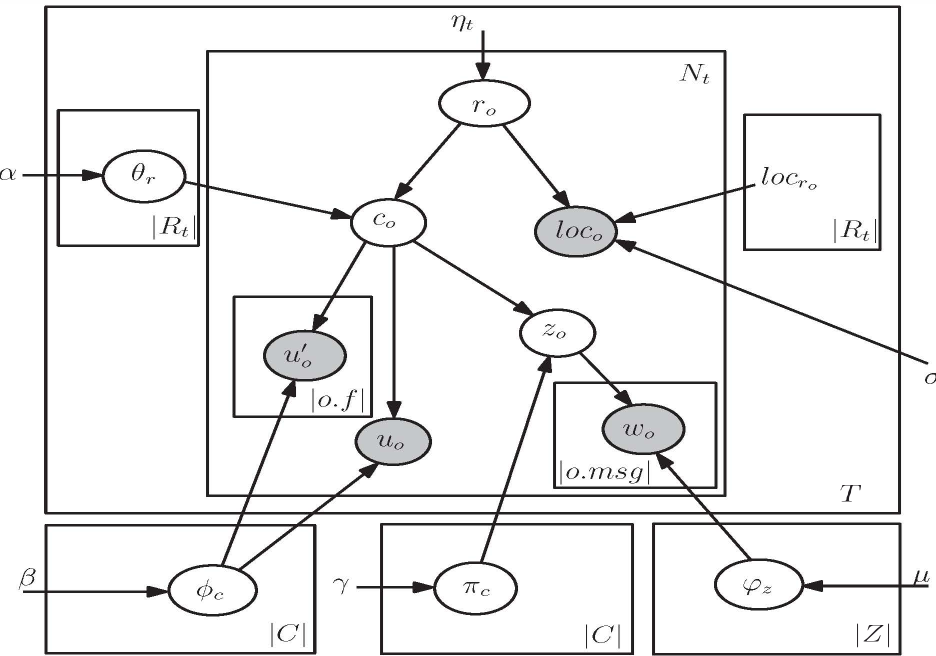 Figure 1: The graphical model showing the dependencies between regions (r), communities (c), topics (z), and observed features like locations (loc) and messages (msg).
This joint modeling ensures that the resulting communities are multi-faceted: they have a specific topic proportion and a distinct geographic footprint.
Experimental Validation
Using massive datasets from Twitter (England and US), the authors compared rLinkTopic against TURCM (Topic-User-Recipient-Community Model).
1. Topical Coherence
The model successfully identified intuitive regional clusters such as "Traffic" and "Music events" in England, and "Politics" or "Weather" in the US.
| Community | Top Terms |
|---|---|
| Traffic | station, railway, cross, airport |
| Football | watch, people, game, play |
2. Geographic Localization
By using the Spatial Entropy measure, the study proved that rLinkTopic communities are more "clustered" in the real world compared to other models. This indicates that the spatial prior in the model effectively forces the discovery of localized groups.
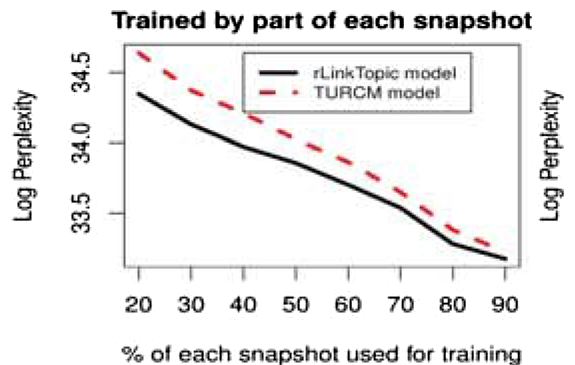 Figure 2: Visualization of user locations within specific extracted communities, showing clear geographic clustering for topics like "Music" and "Politics".
3. Model Fit (Perplexity)
Perplexity measures how well the model predicts a held-out dataset. A lower perplexity represents a better fit. rLinkTopic consistently achieved lower perplexity than TURCM, proving that adding regionality isn't just a "feature"—it's a fundamental part of the data's underlying structure.
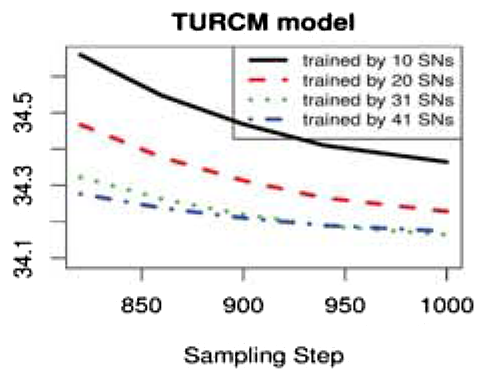 Figure 3: rLinkTopic (lower lines) shows faster convergence and better fit than the TURCM baseline across different sampling steps.
Conclusion and Future Outlook
rLinkTopic represents a shift toward "Context-Aware" social analysis. By acknowledging that our social circles are restricted by where we stand and what we are currently discussing, it provides a more authentic map of human interaction.
Limitations: The model currently treats snapshots as discrete intervals. The next frontier, as noted by the authors, is capturing the evolution of these communities—how a regional community forms during a local festival and dissolves shortly after.
The Takeaway for Developers: If you are building recommendation engines or social discovery tools, location-agnostic models are no longer enough. Integrating spatio-temporal proximity is key to boosting relevance.