
RLVECN: A Hybrid Deep Learning Powerhouse for Social Graph Analytics
Node Classification and Link Prediction in Social Graphs using RLVECN
RLVECN (Representation Learning via Knowledge-Graph Embeddings and ConvNet) is a hybrid deep learning model proposed for node classification and link prediction in social graphs. By integrating knowledge-graph embeddings with 1D Convolutional Neural Networks (CNN) and Multi-Layer Perceptrons (MLP), it achieves SOTA performance across diverse social network benchmarks including Cora and Facebook Page-Page.
TL;DR
Social Network Analysis (SNA) often hits a wall when dealing with non-linear, complex structures. RLVECN—a hybrid model combining Knowledge-Graph Embeddings and 1D Convolutional Neural Networks (ConvNet)—provides a robust solution for node classification and link prediction. By leveraging a dual-layer representation learning approach, it outperformed classical models like GCN and DeepWalk across multiple real-world datasets, achieving superior F1-scores and robustness.
Why Social Graphs are a Tough Nut to Crack
In the realm of AI, social networks are represented as graphs where actors are nodes and relationships are edges. However, these systems are:
- Complex and Non-static: Relationships evolve, and the underlying distributions are often non-linear.
- Feature Deficient: Many datasets lack the rich, vectorized feature sets required by models like Graph Convolutional Networks (GCN).
Traditional methods focus either on local neighborhood walks (DeepWalk) or global structural embeddings. The authors of RLVECN argue that a hybrid approach is necessary to capture both the semantic context of actors and the latent structural patterns within the graph.
Methodology: The Biform Feature Learning Kernel
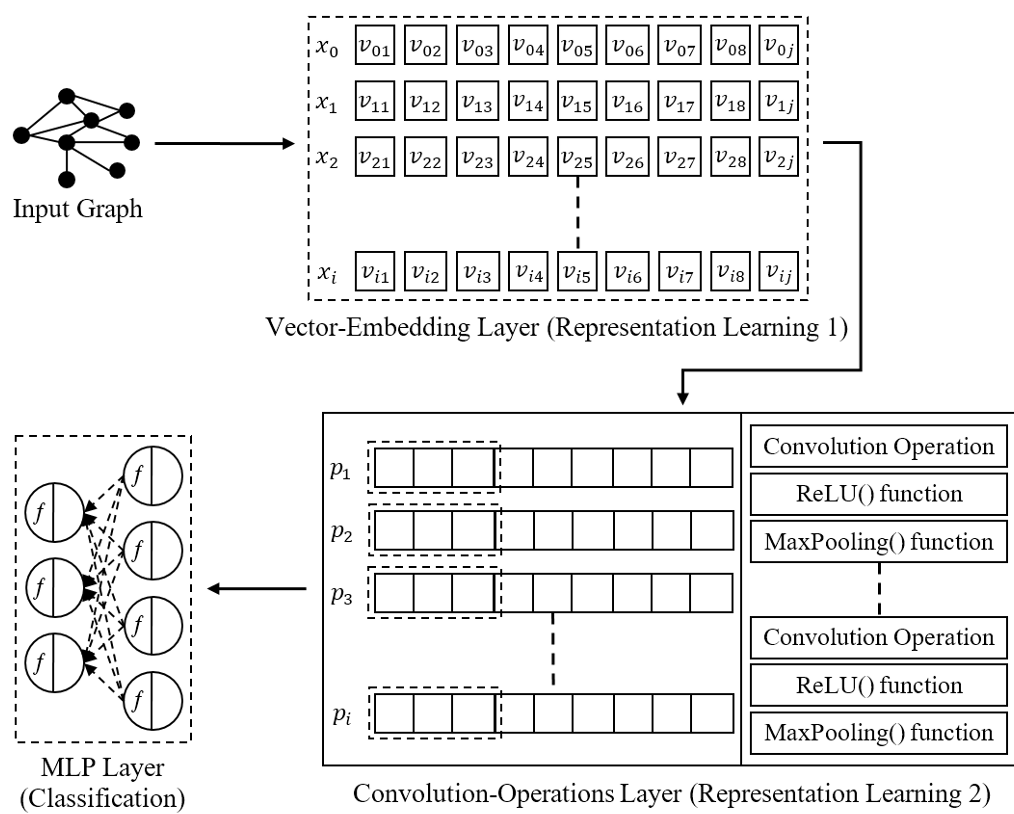
The core innovation of RLVECN lies in its architecture, which treats feature learning as a multi-stage process of dimensionality reduction and abstraction.
1. The Embedding Layer
The model first projects actors into a -dimensional real-number space, . Using an edge sampling technique, it maximizes the probability of predicting a target vertex given a source vertex. The "closeness" between actors is quantified using cosine similarity, ensuring that actors with shared social ties are placed closely in the vector space.
2. The 1D-ConvNet Layer
Following the embedding, a 1D Convolutional layer acts as a local feature extractor. It performs three critical operations:
- Convolution: Using kernels to slide over the embedding matrices to find local patterns.
- Non-linearity (ReLU): Introducing the ability to model non-linear social interactions.
- Max Pooling: Reducing dimensionality while retaining the most salient features.
3. Classification Head
The output of the ConvNet is fed into a Deep Neural Network (DNN) composed of stacked perceptrons. This layer is trained via semi-supervised learning to map high-level features to specific labels (Node Classification) or to infer the probability of a tie (Link Prediction).
Performance Benchmarking
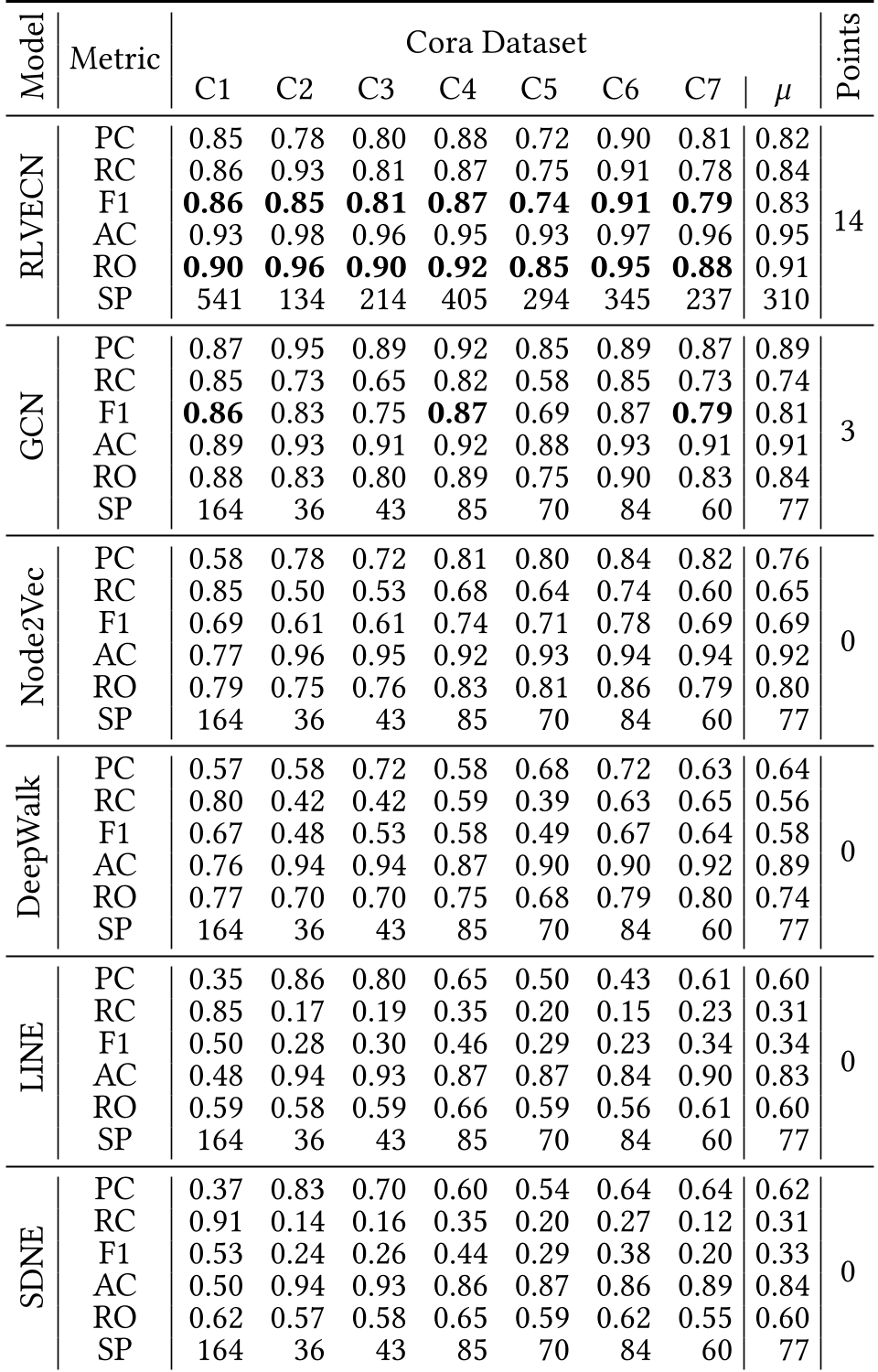
The effectiveness of RLVECN was validated against six diverse datasets, including citation networks (Cora, CiteSeer) and entity relationship graphs (Terrorists-Relation).
Key Results
- Cora Dataset: RLVECN achieved a mean Precision of 0.82 and Accuracy of 0.95, leading the pack against GCN (0.91 Acc) and Node2Vec (0.92 Acc).
- Facebook Page-Page: In this high-density graph, the model reached a nearly perfect Area Under the ROC Curve (RO = 0.98).
- Link Prediction: When compared against specialized Knowledge Graph Embedding models like ComplEx and HolE, RLVECN demonstrated exceptional stability, particularly in complex social tie prediction where it reached F1-scores as high as 0.96 (Mean).
Internal Mechanics & Regularization
Deep architectures are prone to overfitting. The researchers employed a rigorous set of regularization techniques:
- Dropout: 0.4 probability to ensure the network doesn't rely on specific neurons.
- L2 Regularization: Weight decay to prevent exploding gradients.
- Early Stopping: Monitoring training to halt at the peak of generalization (e.g., at 50 epochs for Cora).
Critical Analysis & Conclusion
The primary takeaway is that representation learning is not one-size-fits-all. By stacking embeddings (spatial context) with ConvNets (local patterns), RLVECN bypasses the rigid input requirements of GCNs, making it more applicable to real-world scenarios where metadata is sparse.
Limitations: One noted limitation is that baseline comparisons were made using default parameters. Additionally, GCN could not be tested on datasets without inherent vectorized features, highlighting a specific dependency that RLVECN successfully avoids.
Future Outlook: The integration of this hybrid kernel into temporal graph analysis (e.g., predicting how social hierarchies shift over time) represents a promising next step for the research team.
For those looking to implement this, the authors have provided the source code on GitHub.