
ROI Mining and Social Ties: Balancing Privacy with Precision in Road Networks
Road network-based region of interest mining and social relationship recommendation
The paper introduces RAREA (Road context-based Active Region Extraction Algorithm) and kNNC-RRA (kNN Consistency-based Relationship Recommendation Algorithm) to mine Regions of Interest (ROI) and recommend social ties using road network data. By mapping precise coordinates to road contexts (e.g., "XX Road"), the framework achieves high-accuracy social recommendations while preserving location privacy.
TL;DR
Researchers have developed a two-stage framework, RAREA and kNNC-RRA, that extracts frequent activity regions and recommends social connections using coarse-grained road information instead of precise GPS points. The system achieves nearly 89% recommendation accuracy while inherently protecting user privacy by reducing location granularity.
Background: The Privacy-Utility Tradeoff
In Location-Based Social Networking Services (LBSNS), there is a persistent conflict between personalized utility and privacy. Precise GPS trajectories reveal sensitive home/work locations, while coarse data often degrades the quality of recommendation engines. This paper argues that Road Context—mapping a user to a road segment rather than a coordinate—is the optimal bridge for this gap.
Methodology: From Road Context to Influence Maps
The authors define the "Importance Level" of a road based on three factors:
- Count Weight: How often a user mentions the road.
- Length Weight: Shorter roads provide more localized (and thus valuable) information than 50km highways.
- Type Weight: Residential roads carry more "activity weight" than transit trunks or highways.
The RAREA Algorithm
To convert these road segments into a continuous ROI, the authors calculate an Influence Force () at every grid intersection. Unlike standard heatmaps, the distance here is calculated using the Shortest Path within the actual road graph, not straight-line Euclidean distance.
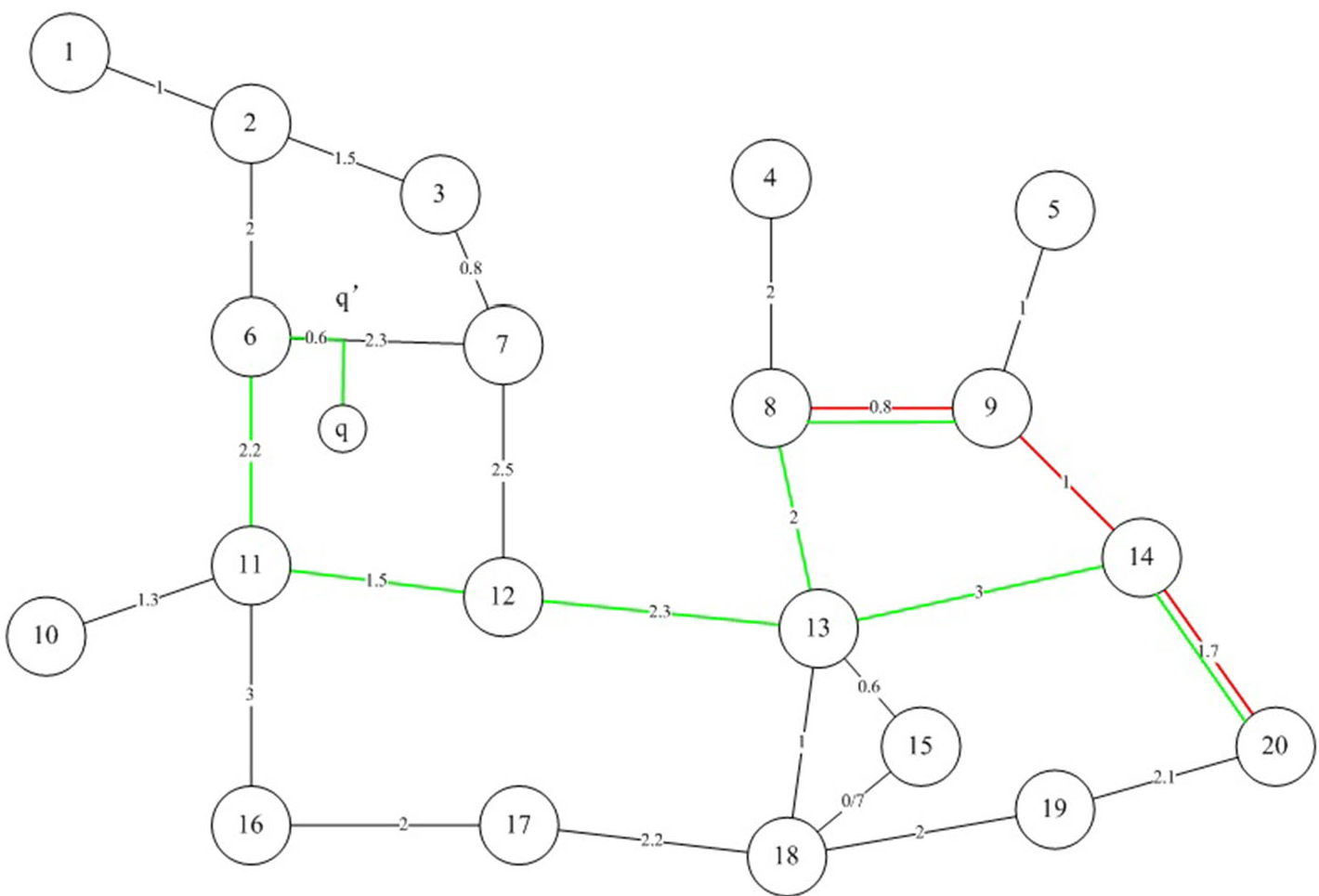
The algorithm then follows a density-based clustering approach:
- Grid Division: Splitting the map into sub-grids.
- Maximum Priority Queue: Identifying "peak" density points.
- Regional Expansion: Merging neighboring grids until the density drops below a specific threshold .
Social Discovery: kNNC-RRA
Once the ROIs are extracted, how do we find "kindred spirits"? The paper proposes kNNC-RRA, which evaluates:
- Spatial Similarity: Comparing the overlap and proximity of extracted ROIs.
- Non-Spatial Similarity: Using the Interval-Frequency Model (IFM) to see if users visit these regions at the same time of day.
Instead of simply ranking users, they apply k-Nearest Neighbor (kNN) Consistency. If User A is among User B’s top-k neighbors AND vice versa, the bond is considered strong enough for a recommendation.
Experimental Validation
Testing on large-scale road datasets (California/Gowalla), the authors found that the initial algorithm was slow due to repeated Dijkstra calculations. By pre-calculating shortest paths (Modified RAREA), they brought execution time down to baseline levels without losing accuracy.

As shown in the table above, the recommendation accuracy is highly sensitive to grid size. At a 0.1 unit interval, the system reaches an impressive 88.55% accuracy, proving that "fuzzy" road data is more than sufficient for high-fidelity social mining.
Critical Insight & Conclusion
This work highlights a shift in spatial data mining: moving away from the "more data is better" mantra toward context-aware abstraction. By treating roads as the primary carriers of human activity intent rather than just geometric lines, RAREA provides a framework that is both computationally efficient and privacy-conscious.
Limitations: The model assumes a static road network and might struggle in high-density urban "hyper-grids" where hundreds of small roads intersect, potentially requiring even finer weight tuning for the road type coefficients.