
Road to the White House: Decoding the Media Symbiosis of the 2020 Primaries
Road to the White House: Analyzing the Relations Between Mainstream and Social Media During the U.S. Presidential Primaries
This paper presents a comprehensive quantitative analysis of the symbiotic relationship between mainstream media, Twitter, and Google Trends during the 2020 U.S. Presidential Primaries. Utilizing time-series analysis and Granger Causality, it builds a framework to measure cross-media influence and topic mismatches among political candidates.
TL;DR
In a functional democracy, the flow of information shapes the rational choices of citizens. This paper investigates the 2020 U.S. Presidential Primaries to answer a critical question: Does the news tell us what to talk about, or does our social media chatter force the hand of the news? By analyzing millions of data points across Twitter, mainstream news, and Google Trends, the researchers found that while both influence each other, mainstream media still holds the crown as the ultimate agenda-setter.
Problem & Motivation: The Echo Chamber vs. The Printing Press
Historically, political communication was unidirectional—from the newspaper to the reader. Today, the landscape is a tangled web. Mainstream agencies use the internet to maximize reach, while platforms like Twitter allow everyone to be an "armchair pundit."
The researchers identified a gap in how we measure this "symbiosis." We know they are related, but we don't always know "Who leads?" and "By how much?" Moreover, do the media and the public actually talk about the same things as the candidates?
Methodology: Bridging Lags and Smoothing Signals
The authors collected data on 11 primary candidates, including Joe Biden, Bernie Sanders, and Donald Trump. To compare sparse news articles with high-frequency tweets, they employed several sophisticated techniques:
- Hawkes Process: Used to transform discrete spikes of news into a smooth, continuous "influence signal" that accounts for the "decay" of information over time.
- Windowed Cross-Correlation: Shifting time series by hours or days to see where the highest correlation peaks occur.
- Granger Causality: A statistical test to determine if one time series is useful in forecasting another.
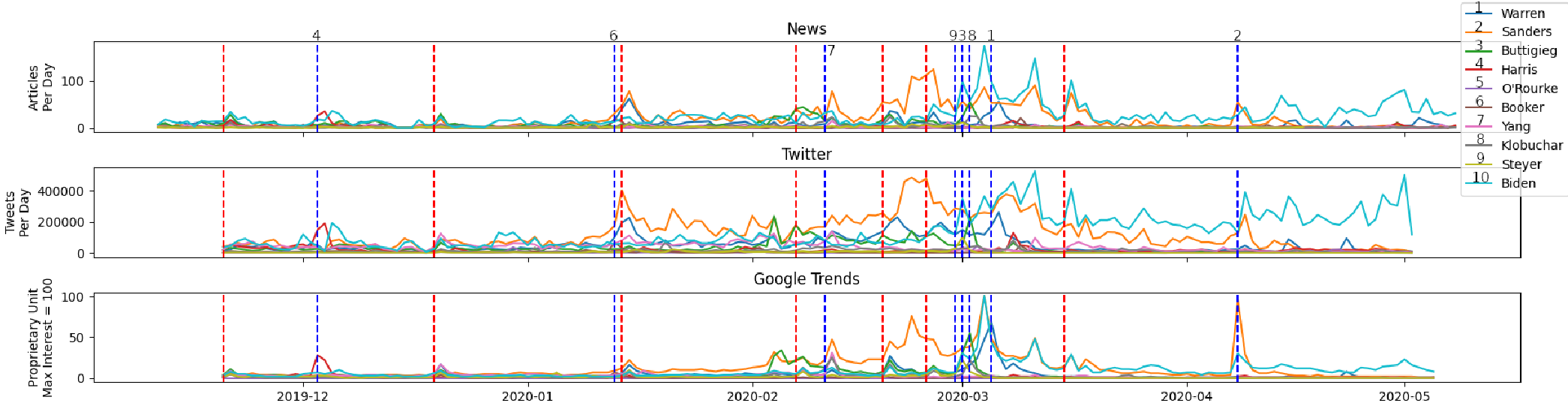 Figure: Candidates' news, Twitter, and Google Trends data showing alignment during major debates and campaign dropouts.
Key Insights: Who is Influencing Whom?
1. The Power of the News
The study found that News-to-Twitter influence is generally much stronger than the reverse. The Granger Causality F-scores and p-values were significantly more robust when predicting Twitter activity using news data.
2. Candidate-Specific Anomalies
Not all candidates follow the same rules. For example:
- Andrew Yang: His Twitter base often reacted to news faster than the mainstream outlets could report it, particularly when he ended his campaign.
- Donald Trump: Showed a "daily recurring" correlation, likely due to his consistent and frequent tweeting habits that dictated a 24-hour news cycle.
3. The Topic Mismatch
The researchers discovered a "perception gap." By using Word2Vec to map text to political topics, they found that candidates often focus on certain issues, but the media and public fixate on others.
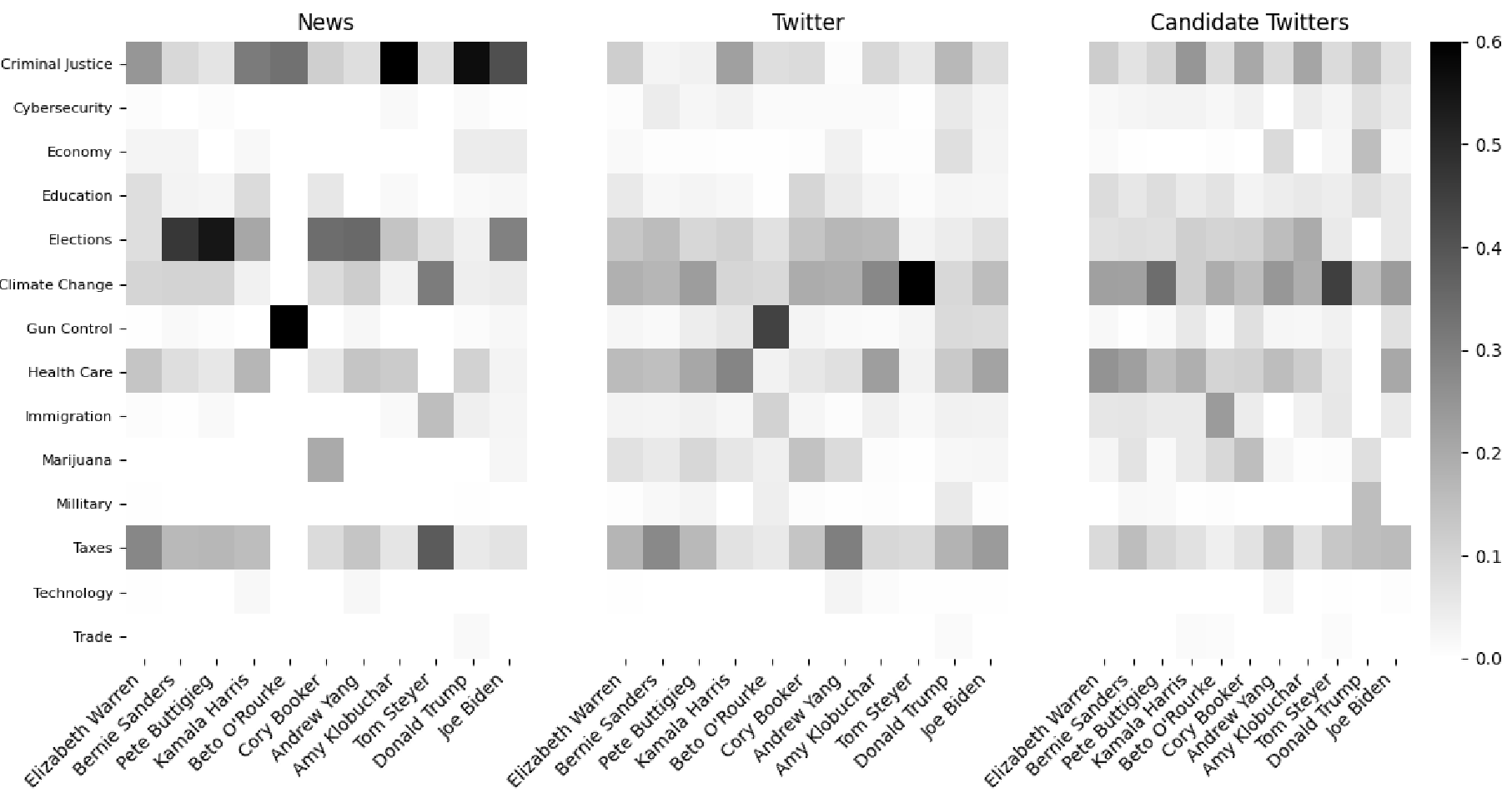 Figure: Comparisons of topic focus between a candidate's own tweets, the general news, and Twitter discourse.
Experiments & Results
- Leading/Lagging: For Andrew Yang, Twitter significantly led the news. For Elizabeth Warren, the news tended to lead Twitter conversations.
- Decay Rates: The influence of a news spike on social media typically peaks within the first 5 hours and decays rapidly thereafter.
- Grouping: Candidates like Bernie Sanders and Elizabeth Warren are often "lumped together" in both media types, potentially reducing the perceived nuances between their individual platforms.
Critical Analysis & Conclusion
This work provides a rigorous mathematical backbone to what many political observers intuitively feel: Mainstream media remains the "pulse" of our political reality.
Limitations: The study primarily focuses on volume and topic matching rather than "sentiment" (polarity). While we know they are talking about the same thing, we don't strictly quantify if the news is positive or negative.
Future Outlook: As we move into an era of AI-generated content and fragmented social platforms (like Mastodon or Threads), the dominance of mainstream news agencies may be further challenged. Applying this "Topic Mismatch" framework to identify media bias or misinformation "percolation" will be the next frontier in computational social science.