
HICHA: Bridging Swarm Intelligence and Cultural Evolution for Optimal Robot Routing
Robot Exploration Mission Planning Based on Heterogeneous Interactive Cultural Hybrid Algorithm
This paper introduces the Heterogeneous Interactive Cultural Hybrid Algorithm (HICHA), a co-evolutionary system combining Genetic Algorithms (GA) and Discrete Particle Swarm Optimization (DPSO). Designed specifically for robot exploration mission planning (modeled as a TSP), it achieves SOTA stability and solution quality on TSPLIB benchmarks compared to traditional GA and standard PSO variants.
Executive Summary
TL;DR: The Heterogeneous Interactive Cultural Hybrid Algorithm (HICHA) is a novel architecture that solves the robotic "Traveling Salesman Problem" by combining the global search strengths of Genetic Algorithms with the fast convergence of Particle Swarm Optimization. By utilizing a "Cultural" framework, the model maintains a high-level knowledge space that actively guides the lower-level swarm, preventing the common trap of local optima.
Background: Mission planning is the backbone of autonomous robotics. As the number of tasks increases, traditional linear programming fails. HICHA positions itself as a robust meta-heuristic that prioritizes "solution quality" and "stability" over raw execution speed, making it ideal for high-stakes exploration missions.
The Bottleneck of Discrete Optimization
Standard Particle Swarm Optimization (PSO) was originally designed for continuous domains. When adapted to discrete problems like robot route planning, these "particles" often lose diversity quickly. They cluster around a mediocre solution (local optima) and stall. The author identifies that current Discrete PSO (DPSO) rules lack a mechanism to preserve "cultural experience"—good patterns found in previous iterations—resulting in inconsistent performance across different mission scales.
Methodology: The HICHA Architecture
The core innovation lies in the Cultural Double Evolutionary Structure. Think of it as a society (Population Space) guided by a library of best practices (Knowledge Space).
1. The Dual-Space Framework
- Knowledge Space (Upper): Uses a Good-Point-Set Genetic Algorithm (GGA). It stores the elite "chromosomes" (routes) and evolves them to find global patterns.
- Population Space (Bottom): Uses Improved DPSO. Particles move based on their own experience and the "social" guidance from the best-performing units.
- Interaction: A top-down "Influence" mechanism injects high-quality solutions from the Knowledge Space into the swarm, while a bottom-up "Acceptance" mechanism updates the Knowledge Space with new breakthroughs from the swarm.
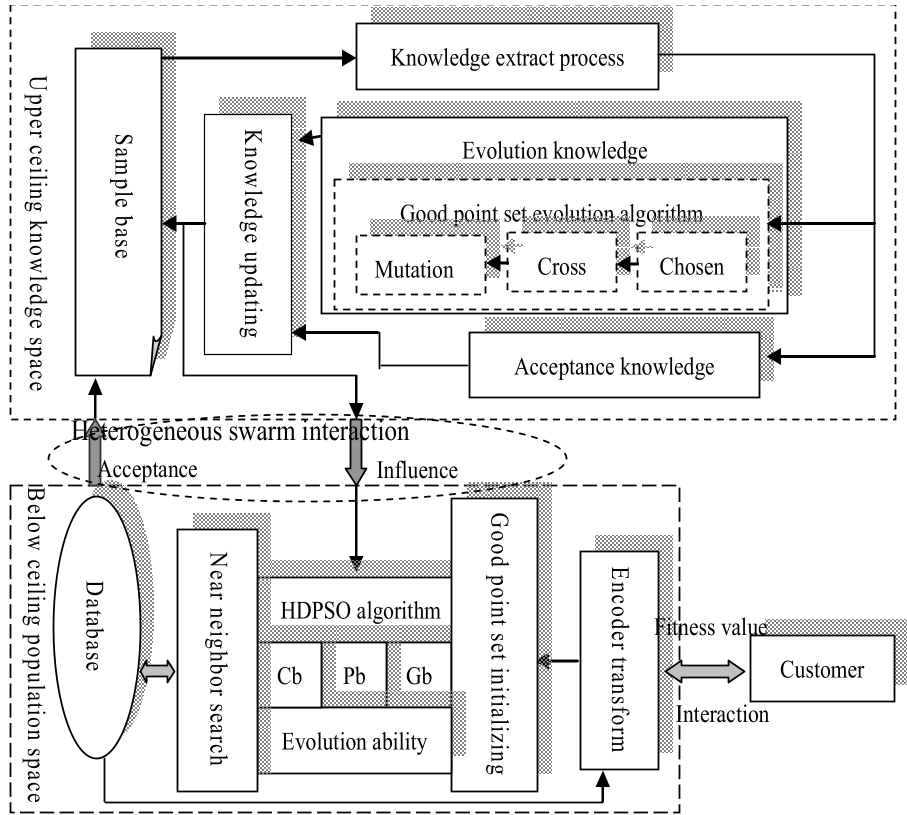 Figure 1: The interaction between Knowledge Space and Population Space creates a feedback loop for global optimization.
2. Algorithmic Enhancements
To ensure the particles don't just follow the leader blindly, the authors introduced:
- Good-Point-Set Initialization: Uses number theory to distribute initial particles uniformly across the feasible solution space, rather than clustering them randomly.
- Evolution Ability Index (Ei): A metric to monitor if a particle is stuck. If falls below a threshold, a perturbation factor (mutation) is added to force the particle to explore new territory.
- Near-Neighbor Search: A local optimization strategy that swaps routes based on physiological proximity, effectively "polishing" the final solution.
Experimental Results & Performance Analysis
The authors put HICHA to the test against standard Genetic Algorithms (GA) and PSOBA (a recent PSO variant) using the TSPLIB benchmark.
Quantifiable Gains
The results confirm that HICHA is significantly more "stable." While GA failed to find satisfactory solutions for larger maps (like tsp225), HICHA maintained a tight error margin.
| Dataset | HICHA Best | GA Best | Improvement |
|---|---|---|---|
| eil101 | 664.06 | 716.15 | ~7.3% |
| tsp225 | 4,076 | 8,041 | ~49.3% |
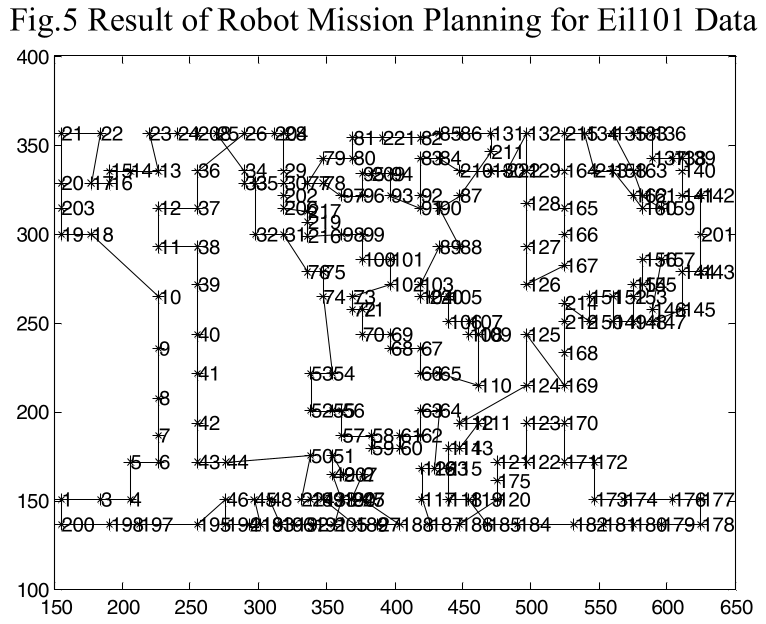 Figure 2: Final optimized robot exploration route for the TSP225 map.
The Trade-off: Time vs. Quality
As shown in the paper's time-cost analysis, HICHA is computationally heavier than basic PSO. This is the cost of maintaining two evolutionary spaces and performing neighborhood searches. However, for robot exploration where "shortest path" translates directly to "battery saved," the offline calculation time is a worthy investment.
Critical Insight & Conclusion
HICHA’s success isn't just because of a better formula; it’s because it mimics social learning. By separating "beliefs" (Knowledge Space) from "behaviors" (Population Space), it manages the balance between Exploration (finding new areas) and Exploitation (refining known paths) better than single-population algorithms.
Takeaway for Practitioners: When dealing with NP-hard combinatorial problems in robotics, don't rely on a single optimization logic. Hybridizing swarm intelligence with a "memory" or "knowledge" structure is essential for scaling to complex, real-world mission maps.
Limitations: The algorithm's time complexity makes it less suited for real-time dynamic obstacle avoidance. Future iterations could benefit from GPU acceleration or a more sparse interaction mechanism between the two spaces to reduce overhead.