
Socialized Manufacturing: Turning Machines into "Social Peers" for Autonomous Resilience
Robotics and Computer Integrated Manufacturing
This paper introduces a socialized manufacturing framework that transforms physical resources into autonomous "personified" entities within an Artificial Social Network (ASN). It utilizes Extended Finite State Machines (FSM) for service modeling and a Trie-based Peer-to-Peer (P2P) network for decentralized service discovery and management.
TL;DR
To tackle the rigidness of centralized cloud manufacturing, this research proposes a framework where manufacturing resources (lathes, 3D printers, robots) act as social entities. By using Extended Finite State Machines (FSM) and a Trie-based P2P network, machines can autonomously find "workmates" for collaboration or "backups" for substitution when things go wrong.
Perspective: From Centralized Control to Social Autonomy
Modern manufacturing is facing a data explosion. The traditional "Cloud-to-Shopfloor" hierarchy is becoming a bottleneck. When a machine breaks down, the central server must recalculate the entire schedule—a process that is often slow and computationally expensive.
The authors of this paper argue for a shift in perspective: What if machines could manage their own social circles? By personifying resources, they can handle local exceptions (like a tool break) through peer-to-peer negotiation, leaving the central system undisturbed.
Methodology: The "Social" Architecture
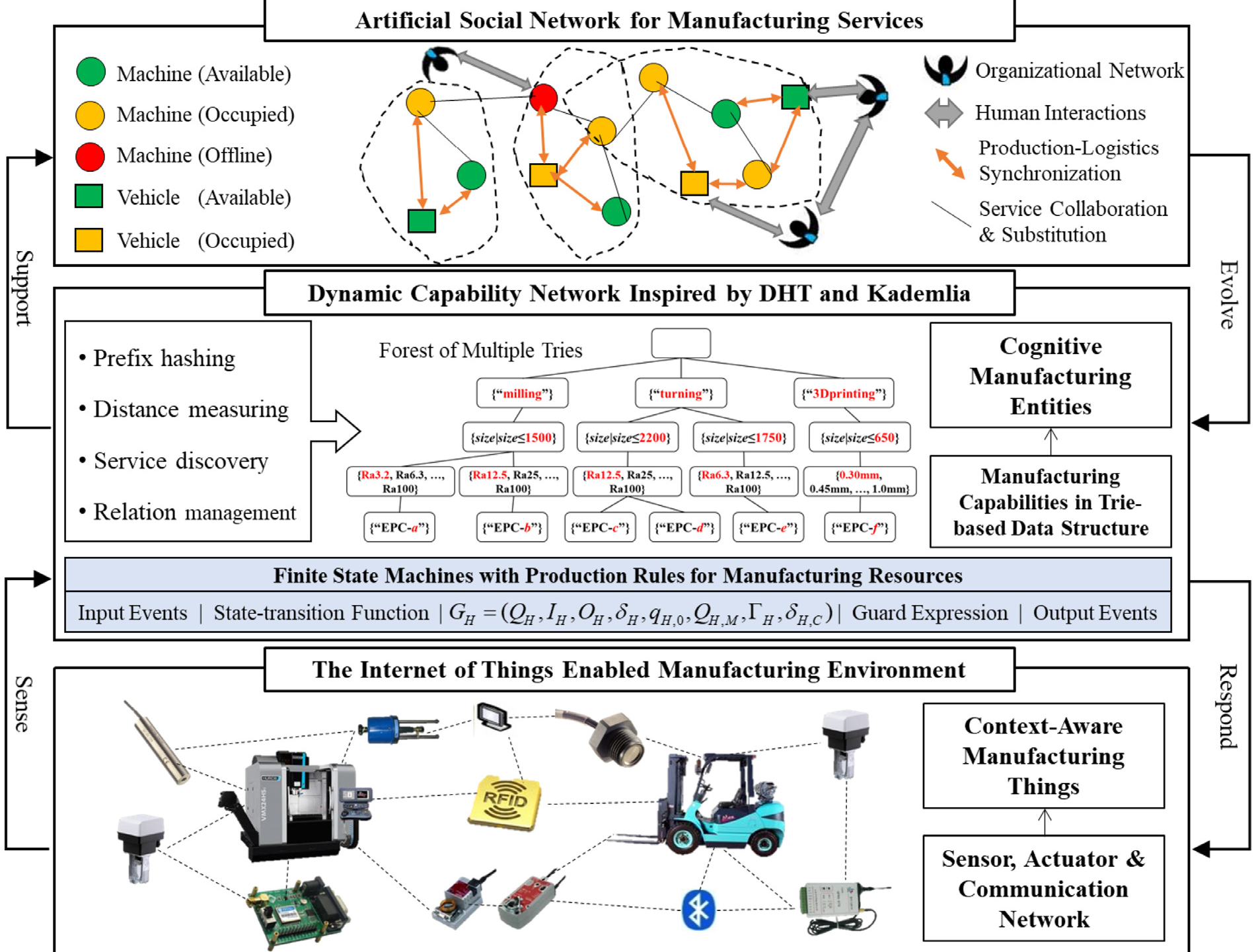
The proposed framework consists of three layers: the Physical Layer (IoT sensors), the Dynamic Capability Network (DCN), and the Artificial Social Network (ASN).
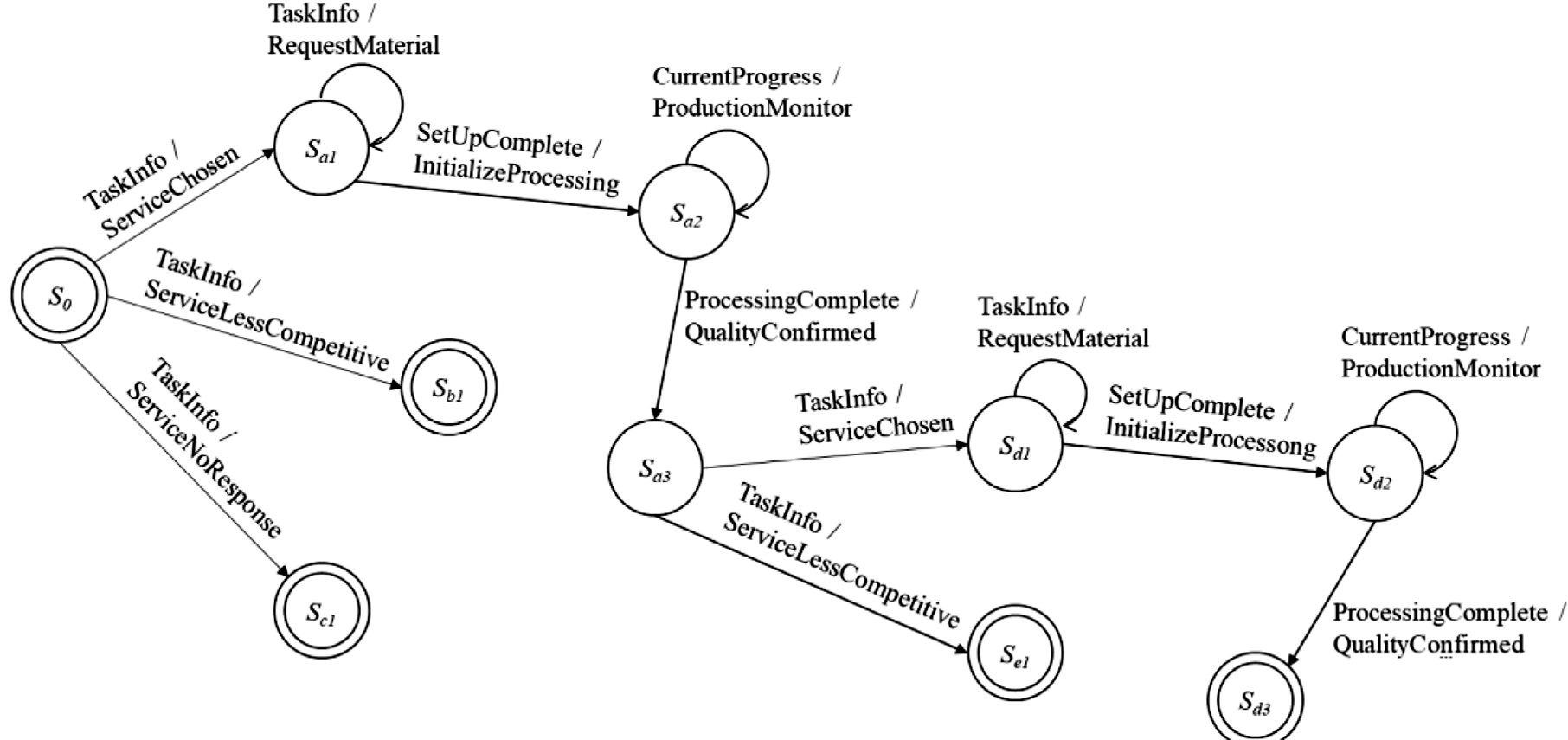
1. Modeling with Extended FSM
Every service is modeled as an 8-tuple FSM. Unlike traditional models, this "Extended" version includes:
- WIP (Work in Progress) States: Allows a task to be partially finished and handed over to a peer.
- Guard Expressions: Boolean logic that controls when a state transition (like starting a job) is permissible based on sensor data.
2. The Trie-Based P2P Network
To find the right resource without a central directory, the authors used a Trie-based data structure.
- Functional Distance: If two machines can perform the same task, their "logical distance" is zero.
- History-Based Distance: If two machines (e.g., a lathe and a robot arm) frequently work together, they become "close neighbors" in the network.
How it Works: Service Discovery and Substitution
When a task arrives, it is published to the DCN. The system calculates the distance between the task's requirements and the service's capabilities.
- Collaboration: A machine finishes its part, sets its state to
WIP, and notifies its "friends" to pick up the next process. - Substitution: If a machine enters an
Exceptionstate, it immediately searches its neighbor list for a "friend" with similar capabilities to take over.
Experimental Validation
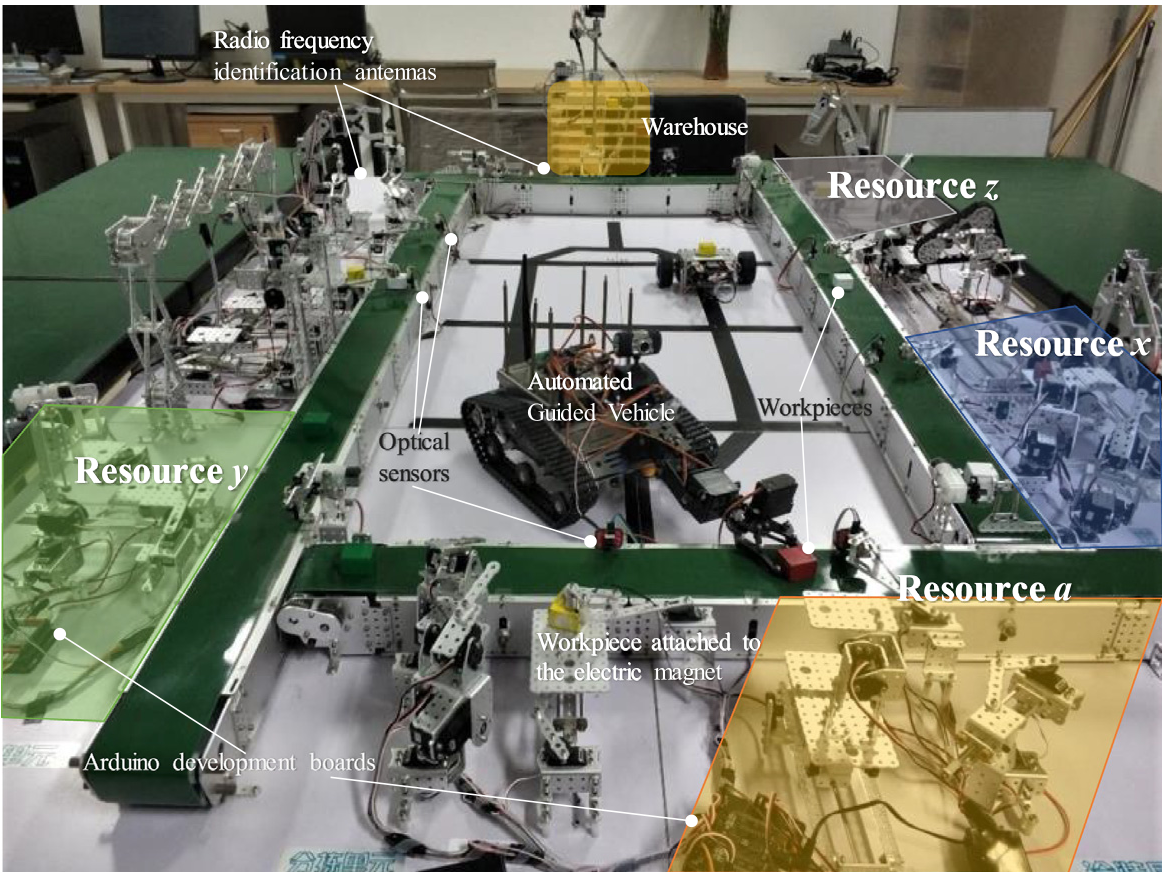
The team simulated a production line involving lathes and milling machines. They programmed the logic into Arduino boards to mimic physical resources.
The Stress Test: During execution, Resource A (a lathe) was made to "break down."
- The Result: The FSM's guard function flipped to
False, the digital twin notified the DCN, and the task was autonomously rerouted to Resource Y (a nearby available lathe) via an Automated Guided Vehicle (AGV)—all without human intervention.
Critical Insight: Small-World Reliability
A key mathematical takeaway is the use of the Small-World Network theory (k ≥ ln(A)). By ensuring each machine maintains a specific number of "close" and "distant" neighbors, the authors prove that the manufacturing network remains a connected graph. This prevents "islands" of resources from becoming unreachable, ensuring that no matter where an error occurs, a path to a solution exists.
Conclusion & Future Outlook
This work pushes the boundaries of Smart Manufacturing by moving away from "top-down" commands toward "bottom-up" social intelligence. While the current model focused on sequence and selection, future work will need to address more complex social behaviors like negotiation for limited resources (auction-based social models) and collective learning.
Takeaway: The future factory isn't just a collection of smart machines; it's a social community where autonomy is the key to resilience.