Robots-Aided Participatory Crowdsourcing: Bridging the Gap Between Human Flexibility and Robotic Precision
Robots-Aided Participatory Crowdsourcing with Limited Task Budget
This paper introduces a hybrid Participatory Crowdsourcing (PCS) framework that integrates human participants and autonomous robots to optimize environmental data collection. It addresses the budget and coverage limitations of traditional PCS by proposing collaborative strategies where robots and humans act as either primary nodes or auxiliary assistants.
TL;DR
Participatory Crowdsourcing (PCS) has long struggled with the limits of human mobility and the high costs of specialized sensors. This paper proposes a collaborative architecture that pairs ordinary citizens with autonomous robots (like UAVs). By treating robots and humans as complementary assets, the system achieves higher coverage and data trustworthiness while strictly adhering to a limited task budget.
Background: The Limits of the "Human-Only" Approach
In classic PCS, we rely on the smart devices of citizens to sense the world. While cost-effective and flexible, this model suffers from three critical failures:
- Spatial Blind Spots: Humans rarely visit dangerous or uninhabited regions, leaving massive gaps in environmental datasets.
- The Incentive Paradox: To get data, you must pay participants, which often invites "fake" or malicious data uploads just for the reward.
- Resource Exhaustion: Continuous sensing drains phone batteries and consumes mobile data, leading to high participant churn.
Robots offer a solution—they are objective, precise, and can go anywhere—but they are too expensive to deploy at scale. The authors’ core insight is: Don't replace humans with robots; use robots to augment what humans can't do.
Methodology: Two Modes of Collaboration
The paper formalizes the system using a QoI (Quality of Information) satisfaction ratio. This metric ensures that data isn't just collected, but is distributed optimally across time and space.
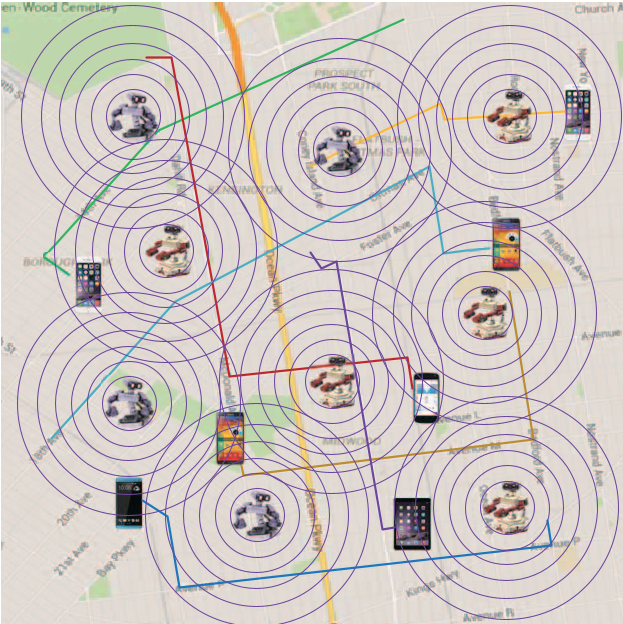
1. Robots as Main Nodes (Human-Assisted Robotics)
In this scenario, robots do the heavy lifting of sensing, but they face "backhaul" problems (how to get the data to the cloud without burning power on cellular 4G/5G).
- Data Mules: Humans passing by robots use short-range BLE (Bluetooth Low Energy) to "pick up" the data and upload it later, acting as a low-cost relay.
- Status Monitoring: Instead of expensive maintenance crews, a mobile app allows citizens to scan a robot's error codes and report its health status to the server.
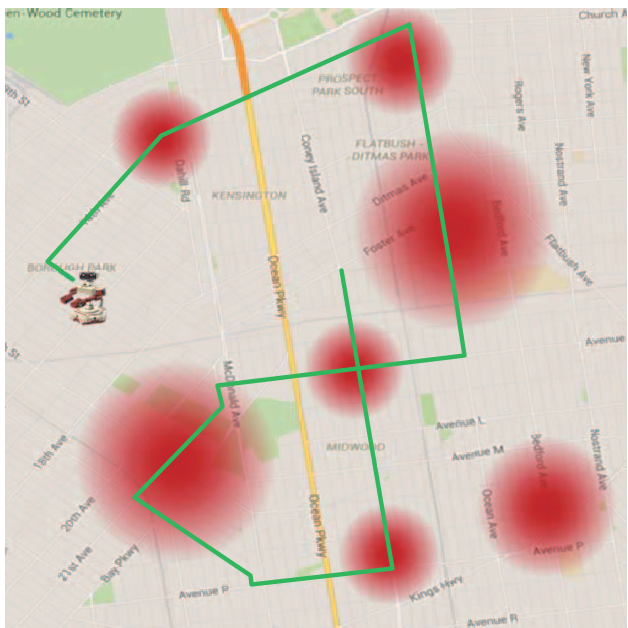
2. Humans as Main Nodes (Robot-Assisted Crowdsourcing)
Here, citizens are the primary sensors, and robots play a support role:
- Coverage Expansion: Robots are dispatched specifically to "dangerous areas" where humans won't go, ensuring a complete environmental map.
- Privacy Aggregators: To protect user privacy, humans can offload data to local robots. The robot then aggregates and anonymizes the data before the final cloud upload, masking the human's exact trajectory.
- Auxiliary Positioning: In areas with poor GPS, robots provide high-precision location beacons to help human devices calibrate their data.
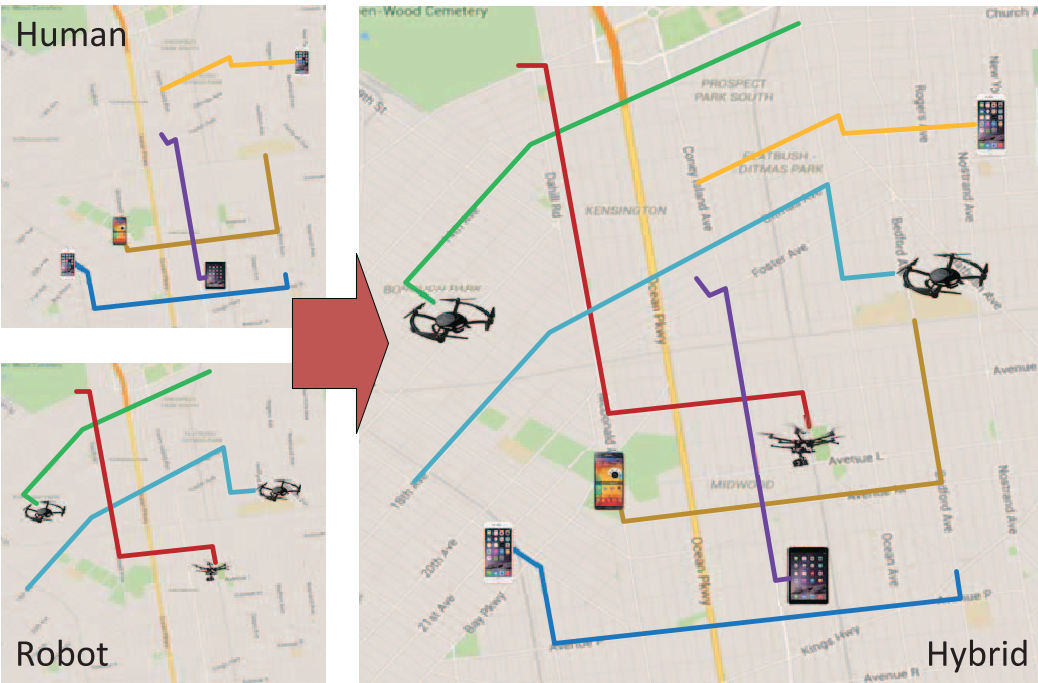
Optimization and Budget Constraints
A key challenge is the Limited Task Budget. Since robots are expensive, the system must solve a complex optimization problem: How do we select the minimum number of robots and human participants to achieve a target QoI?
The authors suggest a 3D-matrix-based approach (representing Sensing Region × Time Slots). By marking "unreachable" cells for humans, the algorithm identifies the optimal paths for a minimal fleet of robots to ensure 100% coverage without blowing the budget.
Critical Analysis & Conclusion
This work provides a strategic blueprint for the next generation of Smart City infrastructure. By moving away from a siloed "Robots vs. Humans" mindset, it creates a symbiotic loop.
Takeaways:
- Trustworthiness: Robots act as "ground truth" nodes to verify the quality of data uploaded by potentially unreliable human participants.
- Efficiency: BLE-based data offloading significantly extends the battery life of autonomous sensing units.
- Scalability: The use of 3D region-growing algorithms allows the system to scale as the sensing area expands.
Future Outlook: While the paper focuses on data collection, the next step in this field is Human-Robot-Interaction (HRI), where robots might actively nudge or guide humans to specific areas to optimize sensing in real-time.