
Robots as Social Bridges: How Embodied Agents Unlock Peer Interaction in Autistic Children
Robots as embodied beings - interactionally sensitive body movements in interactions among autistic children and a robot
This paper explores assistive robotics for autism therapy, introducing the humanoid robot "Robota" as a social mediator. It evaluates how an embodied robotic agent facilitates joint attention and social interaction among autistic children, moving beyond dyadic child-robot play to triadic child-child-robot engagement.
TL;DR
Can a robot teach a child how to interact with another human? This research from the Aurora Project demonstrates that an embodied humanoid robot, Robota, acts as a "social mediator." By serving as a shared object of attention, the robot facilitates sophisticated body movements, imitation, and even rare physical contact between children with autism, proving that the physicality of a robot is a key therapeutic asset.
Problem & Motivation: The Challenge of the "Triadic" Gap
For children on the autism spectrum, "Joint Attention"—the ability to follow a gaze or share an interest in an object with another person—is a foundational but often impaired skill. While many studies focus on the child interacting with a robot (dyadic), the real-world goal is to improve interaction with other people (triadic).
The researchers noticed that traditional screen-based tools lack the "interactional sensitivity" required for full-body social engagement. They hypothesized that a physical, embodied robot could create a shared space where children find it "safer" or more intuitive to coordinate their movements with peers.
Methodology: The Robot as a Puppeteered Mediator
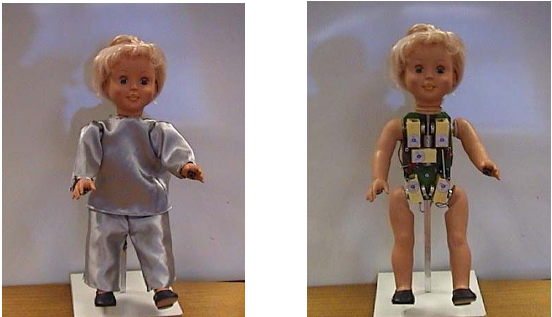
The team used Robota, a humanoid doll-like robot. To ensure the robot responded with human-level sensitivity to the children's unpredictable behaviors, they used a Wizard of Oz (WoZ) setup. An experimenter acted as a "puppeteer," controlling Robota's limbs and head via a laptop.
The researchers didn't just look at "if" the children played; they used Conversation Analysis to study "Body Kinesics"—the micro-movements and orientations that show a child is aware of another's presence.
The Breakthrough: Sophisticated Embodied Actions
The core of the findings lies in how the children used their bodies to navigate the social space.
1. Peer-to-Peer Imitation
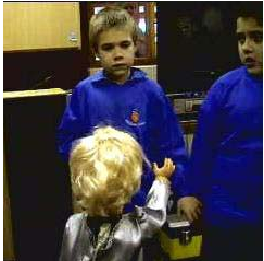
In one trial, a child named Andy didn't just watch the robot; he monitored his peer Jack. He looked at Jack's hand to ensure his own imitation was correct before glancing back at the robot to see its reaction. This is a high-level social coordination rarely seen in unconstrained settings.
2. Spontaneous Physical Contact
The most striking case involved a child named "Adam." Adam was known by his teachers to be extremely avoidant, often standing in corners with his back to others. However, in the presence of the robot, Adam not only moved closer to a peer (Rob) but spontaneously placed his hand on Rob's shoulder for several seconds.
Why This Matters: The Power of Embodiment
The study concludes that the robot's physical embodiment is its "superpower."
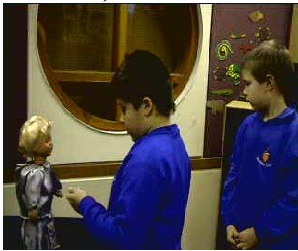
- Spatial Awareness: Children had to position themselves to avoid colliding with peers while still seeing the robot.
- The "Unusual" Effect: The robot is predictable yet novel, providing a "low-stakes" social focal point that reduces the anxiety of direct human-human contact.
Critical Analysis & Future Outlook
While the study is based on a small sample size (4 children), its qualitative depth is profound. It challenges the "asociability" stereotype of autism by showing that in the right interactional context, these children possess latent social skills that a robot can "unlock."
The Limitation: The reliance on a human "puppeteer" (WoZ) means we are still years away from a fully autonomous Robota that can react this fluidly. The next frontier is developing computer vision and AI that can mimic this "interactional sensitivity" without human intervention.
Takeaway: Robots shouldn't be designed just to talk to us; they should be designed to help us talk to each other.