
Robots Need More Than VLAs: Resolving the Grounding Bottleneck
Robots Need More than VLA and World Models
This position paper argues that current robot learning, heavily focused on scaling Vision-Language-Action (VLA) models, faces a critical grounding bottleneck. It proposes a transition from robot-native data pipelines to a physical-intelligence stack comprising a physical data engine, task-preserving retargeting, physics-grounded world models, and self-improving deployment loops.
TL;DR
Scaling Vision-Language-Action (VLA) models on robot demonstrations is hitting a diminishing return wall. The "Internet of Robotics" doesn't exist yet because most behavioral data (human video, simulation, logs) lacks grounding—the embodiment-specific actions and reward structures robots need. This paper argues for a new stack: a Physical Intelligence pipeline that converts messy, unstructured experience into grounded supervision via four core architectural pillars.
The Problem: The "Robot-Native" Trap
Current SOTA methods like RT-2 or OpenVLA are "robot-native." They require data expressed in the coordinate system of the robot: (Observation, Action, Reward).
The issue? This data is expensive and scarce. Meanwhile, the world is full of "weakly grounded" data like YouTube videos or human demonstrations. These show what to do but not how a specific robot should execute it. Without a bridge, we are stuck manually labeling every trajectory, which the authors argue is the central bottleneck preventing a GPT-level moment for robotics.
The Core Insight: Four Pillars of Physical Intelligence
To move beyond simple imitation, the paper proposes a "grounding-centric" pipeline instead of a "data-centric" one.
1. The Physical Data Engine & Autolabeling
Instead of manual segmentation, we need engines that ingest heterogeneous data (video, tactile, motion capture) and output latent physical events.
- The Goal: Turn a video of a person opening a drawer into a structured timeline of contact points, force vectors, and state changes.
2. Task-Preserving Retargeting
If a human opens a drawer with five fingers, how does a one-armed robot with a parallel gripper do it? Simple pose-matching fails. Task-preserving retargeting focuses on the effect (the drawer's displacement) rather than the motion (the joint angles).
3. Consequence Prediction (Physics-Grounded World Models)
We don't just need world models that "look" realistic (like Sora). We need models that "act" realistic.
- The Distinction: A video generator might show a cup moving. A Physically Embodied World Model predicts if the cup will slip based on friction and grasp force.
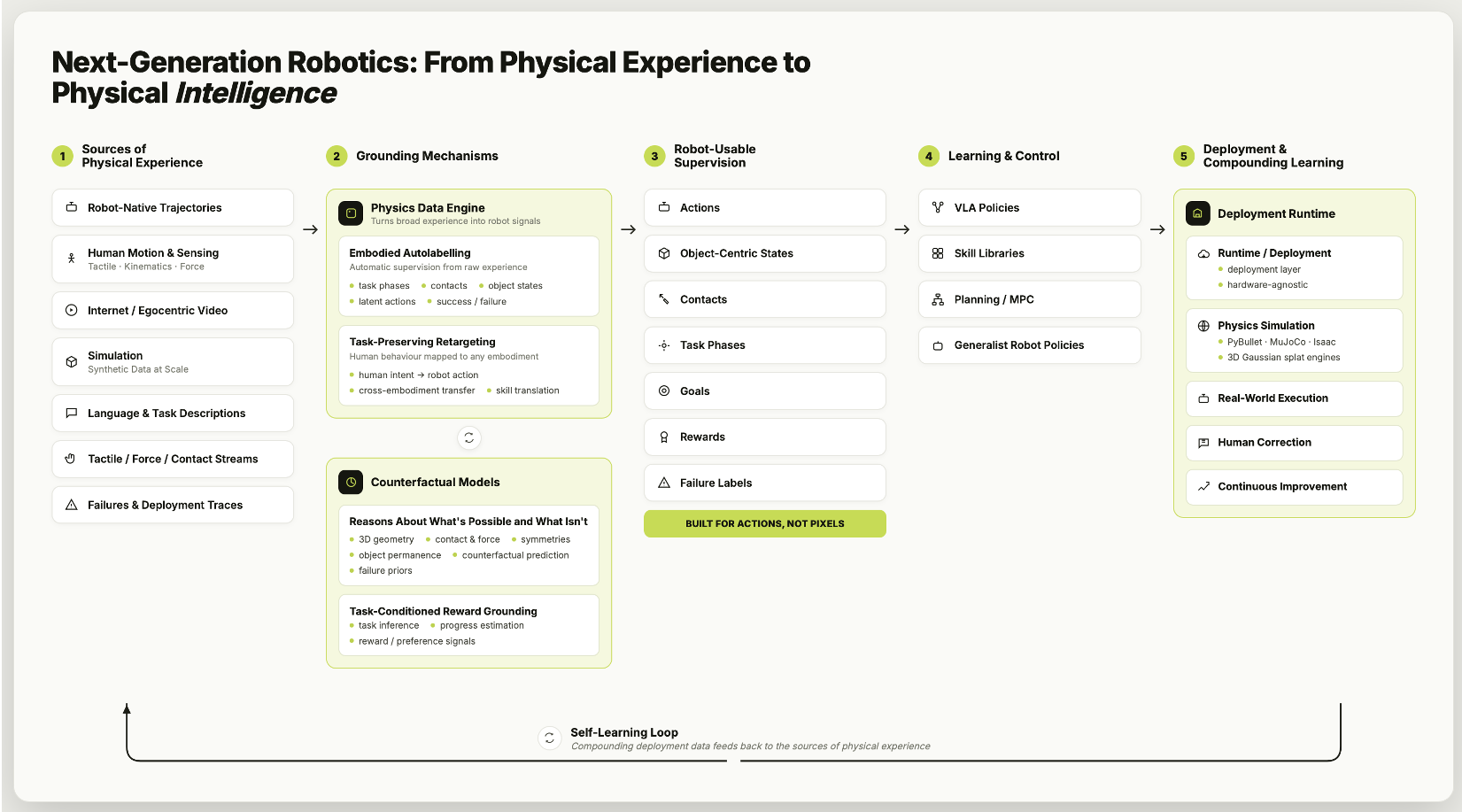 Figure 1: The proposed Physical Intelligence stack going beyond the VLA layer.
Methodology: The Grounding Pipeline
The authors formalize the data engine's task as an inference problem. Given a heterogeneous episode (video, motion, tactile), the model must infer a latent event sequence :
Where:
- : Object-centric state
- : Contact labels
- : Task phase
- : Latent physical actions
- : Progress signals
This structure allows a robot to learn from a human video by figuring out the underlying physical "why" behind every frame.
Experiments & The State of the Field
The paper surveys the current "war" between different model architectures:
- VLA Leaders: RT-X, Octo, and have shown that pooling data across embodiments works.
- Simulation Breakthroughs: MimicGen and RoboCasa are generating 100k+ demonstrations synthetically, but they still struggle with the "Sim-to-Real" gap in contact-rich tasks.
- World Models: DreamerV3 and Genies are starting to "hallucinate" physics, but the paper notes they lack the calibrated uncertainty needed for high-stakes robot autonomy.
Figure 2: Summary of current VLA performance vs. data diversity (Conceptual representation of survey findings).
Critical Analysis: A Compounding System
The paper's most salient point is the Self-Improving Deployment Loop. In the current paradigm, a robot failure is a "lost trial." In the proposed paradigm, a failure is a correction signal. If the world model predicted the drawer would open, but it jammed, that "prediction error" is high-value data to update the physics engine.
Limitations
- Computational Cost: Running a high-fidelity physical data engine and a world model in the loop is significantly more expensive than a reactive VLA policy.
- Representation Choice: The field hasn't agreed on the best way to represent 3D physics (Voxels? Point Clouds? Gaussian Splats?).
Conclusion
Robotics is not "just more data." It is about making the world's experience usable. The "Generalist Robot" will be powered by a VLA policy, yes, but it will be supported by a massive infrastructure of autolabelers, retargeting modules, and physics models. The era of pure imitation learning is ending; the era of grounded physical intelligence is beginning.