
Robust Learning in Tandems: Why Global Coordination Might Not Save You from Uncertainty
Robust Decentralized Detection and Social Learning in Tandem Networks
This paper investigates robust decentralized detection and social learning in tandem networks under distributional uncertainty. By utilizing the Huber contamination model and Least Favorable Distributions (LFDs), it establishes that minimax optimal policies consist of likelihood ratio tests based on LFDs, achieving sub-exponential error decay in specific scenarios while identifying fundamental limits of asymptotic learning.
TL;DR
The paper Robust Decentralized Detection and Social Learning in Tandem Networks explores how uncertainty in data distributions affects collective decision-making. By applying minimax theory to a chain of agents, the authors prove that when sensors or people are unsure about the reliability of their information (the "contamination" effect), the dream of absolute accuracy () usually dies. Interestingly, the research shows that in high-noise environments, agents acting purely in their own self-interest perform almost as well as those trying to help a global center.
Background: The Tandem Trap
In a "tandem network," information flows like a game of telephone. Agent 1 makes a call, Agent 2 listens to Agent 1 and checks their own data, then passes a new decision to Agent 3. Historically, researchers assumed we knew the exact probability distribution of the data. This paper shatters that assumption, introducing robustness—the idea that our data comes from a "nominal" distribution mixed with unknown "noise" (contamination).
The Problem: The Limit of Knowledge
Prior work in decentralized detection (where agents collaborate) and social learning (where agents are selfish) showed that if you have enough agents, you can eventually know the "truth" with zero error.
The Catch: This paper proves that if there is even a tiny, fixed amount of uncertainty () in how observations are generated for both possible truths (hypotheses), the error probability will never go to zero, no matter how many agents you add.
Methodology: The Power of Least Favorable Distributions (LFDs)
To handle this uncertainty, the authors use a Minimax approach: prepare for the worst-case scenario. The core insight is the use of Least Favorable Distributions (LFDs).
The LFDs are a pair of distributions within the uncertainty range that are the hardest to tell apart. The authors prove a fundamental result:
- Optimal Strategy: Even in a complex chain, every agent should behave as if they are facing the LFDs and use a specific Likelihood Ratio Test (LRT).
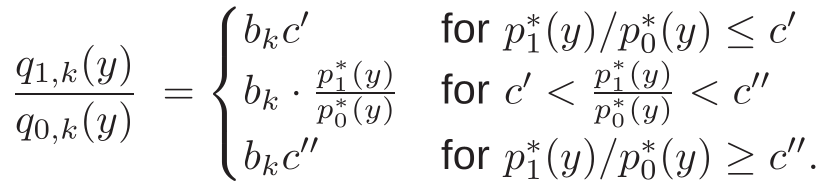 The mathematical core: The ratio of LFDs (q1/q0) which caps the influence of extreme observations to maintain robustness.
Key Results & Insights
1. The Death of Asymptotic Learning
When agents know their position, learning is only possible if the "contamination" of the uncertainty decreases as you go further down the chain. If the noise is constant, the information eventually saturates.
2. Unknown Positions
In real social networks, you don't know if you are the 5th person to hear a rumor or the 500th. The authors model this by forcing all agents to use the same rule. They found that in this case, the error is dominated by either the very first agents or the long-term "limit" of the chain.
3. Numerical Evidence
The study used exponential distributions to show that as uncertainty (contamination) increases, the gap between "collaborative" and "selfish" agents disappears.
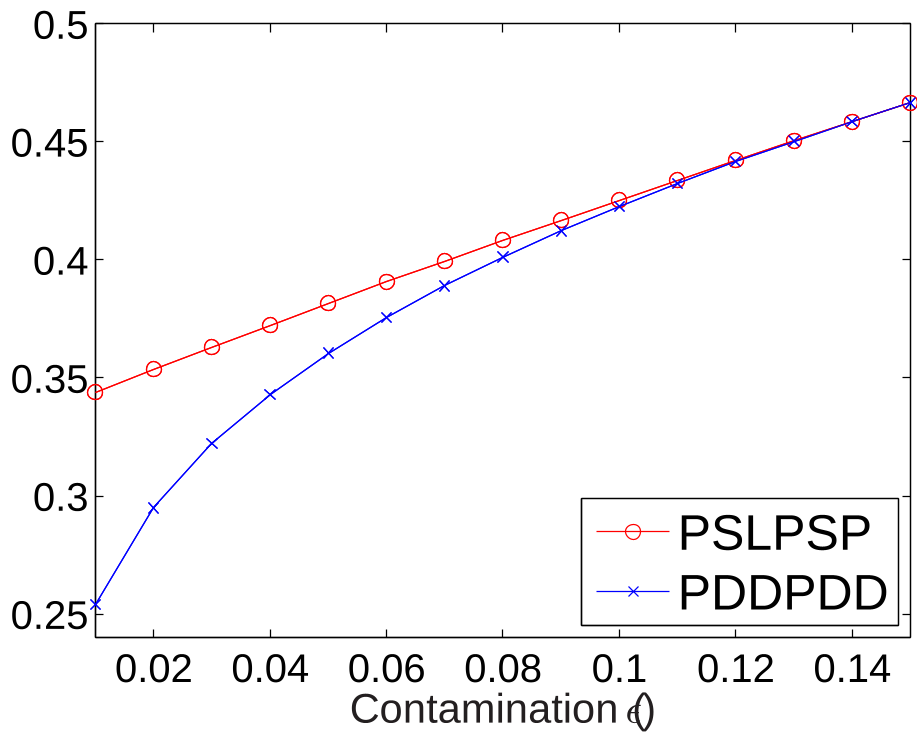 Figure 4 from the paper: As contamination increases, the error probability rises sharply, illustrating the diminishing returns of scaling a network under high uncertainty.
Critical Analysis: Takeaways for the Future
This paper provides a sobering reality check for IoT and social sensing designers. More sensors do not always lead to better truth discovery if the sensors themselves have an unknown bias or noise profile.
Limitations:
- The model is a "tandem" (a line). Real-world networks are "loopy" (like Twitter or Mesh networks).
- It only considers two possible truths (Binary Hypothesis).
Future Work: The authors suggest that the next frontier is applying these LFD-based rules to loopy graphs and multi-hypothesis scenarios where agents have partial knowledge of their network position.
Conclusion
Robustness is not just a "nice-to-have"; it changes the fundamental limits of what a network can learn. If you can't guarantee the purity of your data, even an infinite number of collaborators can't reach perfection.