
DINO-MAC and Beyond: Modern Strategies for Robust Deepfake Detection
Robust Deepfake Detection, NTIRE 2026 Challenge: Report
This report summarizes the NTIRE 2026 Challenge on Robust Deepfake Detection, which introduced the DINO-MAC method as the winner. The challenge focused on maintaining detection performance under severe image degradations using high-capacity foundation models like DINOv3 and CLIP.
TL;DR
The NTIRE 2026 Robust Deepfake Detection Challenge marks a shift from detecting "perfect" fakes to handling "real-world" degradation. The core insight: Foundation models like DINOv3, when fine-tuned via LoRA and paired with aggressive degradation-aware training, can finally bridge the gap between lab performance and real-world deployment.
Problem & Motivation: The "Fragility" of Current Detectors
Most deepfake detectors are trained on pristine, high-resolution datasets. However, in the wild, images are subjected to JPEG compression, resizing, and sensor noise. These degradations act as a "natural low-pass filter," destroying the subtle, high-frequency artifacts (like checkerboard patterns) that traditional CNN-based detectors rely on.
The challenge authors argue that robustness is an "overlooked problem." If a malicious actor can bypass a detector simply by adding a slight Gaussian blur or a social-media-style compression, the detector is effectively useless for security applications.
Methodology: The Power of Foundation Models
The report highlights 14 top methods, with the most successful models (ShallowReal, INTSIG, Ant International) moving away from training small models from scratch. Instead, they leverage the internalized structural priors of massive foundation models.
1. DINO-MAC (The Winner)
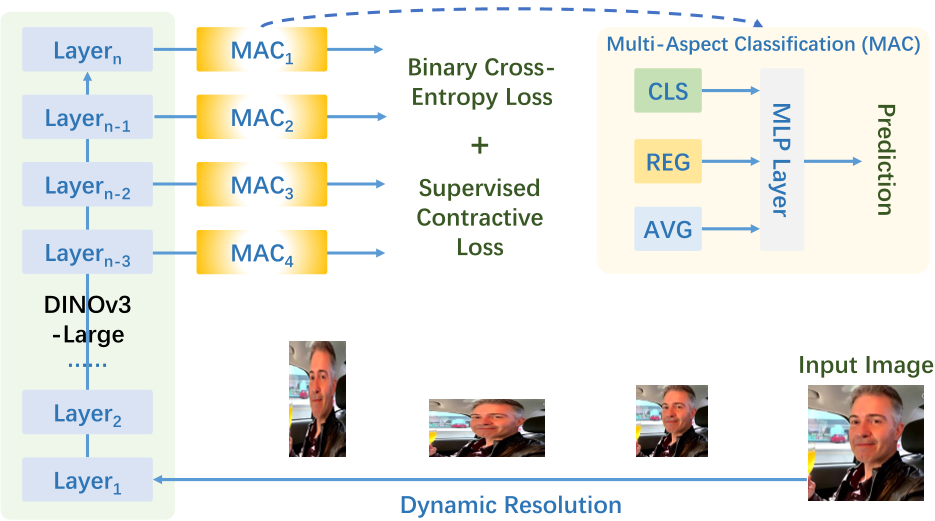
Team ShallowReal utilized DINOv3-Large with a unique Multi-Aspect Classification (MAC) head. Instead of just looking at the [CLS] token, they aggregated information from:
- The
[CLS]token (Global context). - Register tokens (Spatial anchors).
- An
[AVG]token (Mean patch features).
This 6144-dimensional feature vector was then fine-tuned using LoRA, allowing the model to adapt to forgery-specific features without losing the robust general features learned during pre-training on billions of images.
2. LOGER: Local-Global Ensembles
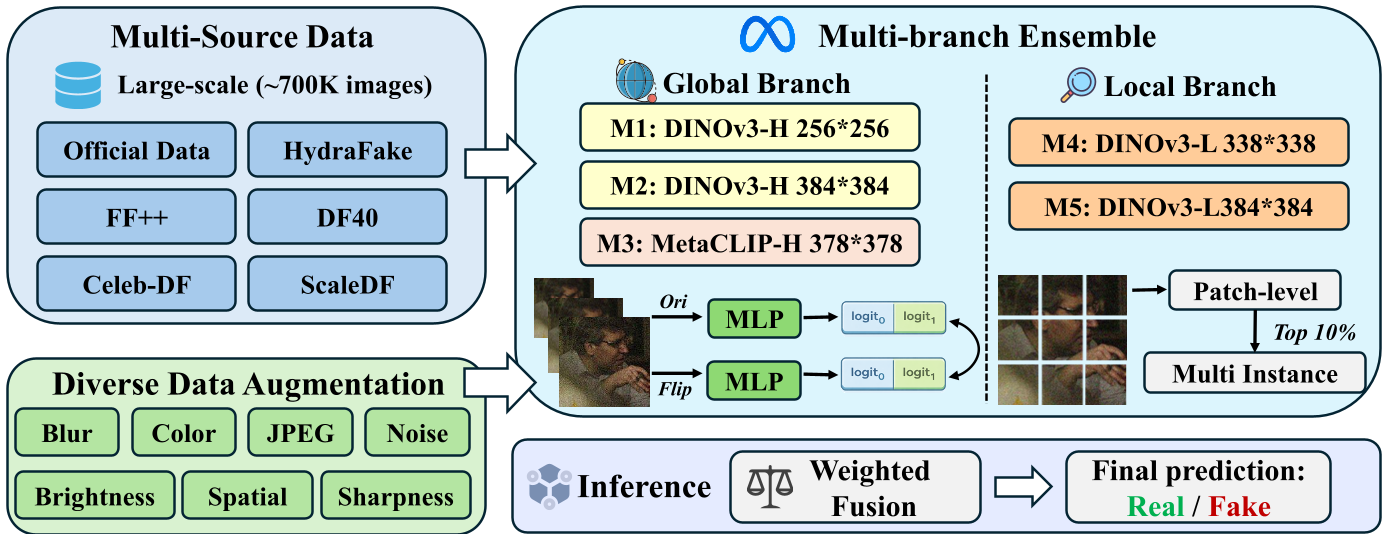
Team INTSIG (Rank 2) introduced the LOGER framework. Their insight was that fakes often have two types of flaws:
- Global Semantic Inconsistencies: Illumination mismatches between the face and background.
- Local Forensic Artifacts: Blending boundaries or warping around the eyes/mouth.
They used a hybrid of DINOv3 and MetaCLIP2, using Multiple Instance Learning (MIL) to pick out the "hardest" 10% of patches effectively focused on forgeries.
Experiments & Results: Resilience Under Pressure
The participants were tested on a "Private Test Set" containing unknown degradations and fake methods (like FSGAN and StyleFeatureEditor).
| Rank | Team | Public Test AUC | Private Test AUC |
|---|---|---|---|
| 1 | ShallowReal | 0.9218 | 0.9168 |
| 2 | INTSIG | 0.8901 | 0.8824 |
| 3 | AntInternational | 0.9234 | 0.8691 |
The small drop between Public and Private scores (e.g., ShallowReal dropping only 0.005) indicates that these models successfully learned generalizable forensic features rather than just overfitting to specific noise patterns.
Key Breakthroughs:
- Resolution Invariance: Training with "Dynamic Resolution" (resizing from 384 to 1152) made models robust to scaling operations.
- Cross-Domain Logic: Models that incorporated CLIP (Vision-Language) were better at detecting "logical impossibilities" (e.g., mismatched accessories) that pure texture-based models missed.
Critical Analysis & Conclusion
The NTIRE 2026 report proves that "Scaling Laws" apply to forensics too. The heavy reliance on DINOv3 and CLIP confirms that the future of deepfake detection lies in adapting large-scale vision priors rather than inventing smaller, specialized architectures.
Limitations: Despite the high AUC, "Extreme Compound Degradation" (e.g., heavy noise + compression + blur) still poses a threat. The computational cost of these ensembled foundation models (some reaching 4.2B parameters) is another hurdle for real-time edge deployment.
Future Work: Watch for the integration of "Symptom-aware" models that explicitly predict the type of degradation before classifying, and further research into Parameter-Efficient Fine-Tuning (PEFT) to make these 7B-parameter giants run on consumer hardware.