
BD: Robust Worldwide Earthquake Detection via Log-Normal Citizen Sensors
Robust Detection of Extreme Events Using Twitter: Worldwide Earthquake Monitoring
The paper introduces BD (Burst Detection), a semi-supervised online method for detecting extreme events like earthquakes using Twitter. By modeling the arrival rate of "citizen sensor" data as a log-normal stochastic process, it achieves a high-performance, worldwide monitoring system that outperforms existing supervised baselines.
TL;DR
Researchers have developed BD (Burst Detection), a lightweight, online algorithm that transforms Twitter into a global seismographic network. By treating tweets as a statistical signal rather than just text, the system achieves 100% precision in detecting felt earthquakes. Unlike previous models that required millions of labeled examples, BD is semi-supervised and scales effortlessly across languages and borders.
Background: Tuning into the "Citizen Sensor"
When an earthquake strikes, the first reaction for many isn't to check a government website—it's to post on social media. This "citizen sensor" activity is faster than traditional sensors in many parts of the world. However, the Twitter stream is notoriously "noisy." Terms like "shaking" could refer to an earthquake, or just someone's anxiety. Previous attempts to solve this involved building massive supervised classifiers for every specific region (Italy, Japan, USA), making them impossible to deploy worldwide.
The Core Insight: The Weber-Fechner Law
The brilliance of the BD method lies in its physical intuition. The authors posit that human reaction to stimuli (like the intensity of a quake) follows the Weber-Fechner Law, suggesting that our perception is logarithmic. Consequently, they model the frequency of earthquake-related terms as a Log-Normal distribution.
Methodology
Instead of complex Deep Learning, the researchers used a robust statistical approach:
- Normalization: They calculate the relative arrival rate () by taking the log-frequency of terms divided by the total volume of the Twitter stream to account for time-of-day fluctuations.
- Adaptive Z-Score: The system tracks the mean () and standard deviation () of the signal in real-time. A "burst" is triggered when the Z-score exceeds a threshold (typically 1.5).
- Window Selection: They use a stability metric called Relative Standard Deviation (RSD) to determine the optimal time window (around 5 minutes), balancing detection speed with statistical significance.
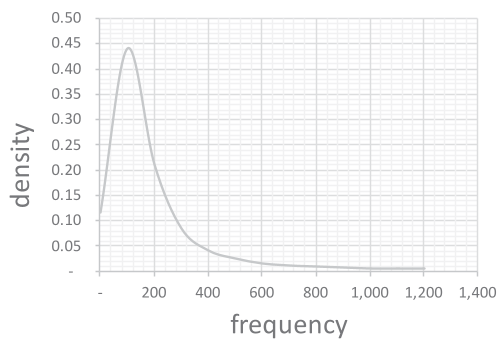 Fig 1: Smoothed histograms confirming that while raw frequency is skewed, the log-transformed frequency follows a Gaussian (Normal) distribution.
Global Performance vs. Local Precision
The authors tested BD against both global catalogs (USGS) and dense local networks (GUC Chile).
- Vs. Global SOTA: Compared to the previous leading worldwide system (Earle et al.), BD improved the F-measure from a measly 0.02 to a robust 0.66.
- Vs. Local Experts: Even without region-specific training, BD outperformed localized systems like Sakaki et al. (Japan) and EARS (Italy) in their own territories.
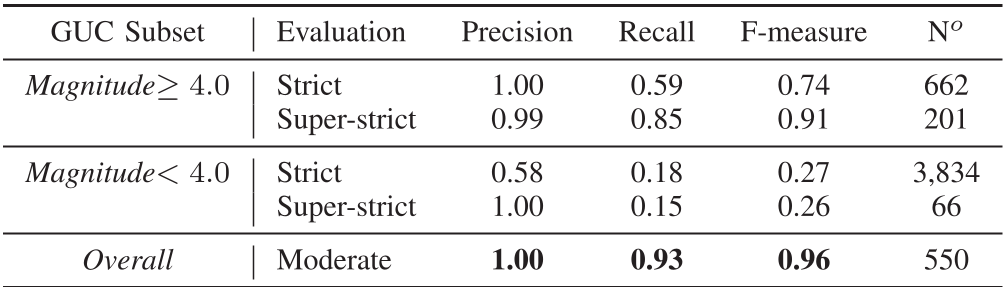 Table 1: BD's performance in Chile showing near-perfect precision for perceived quakes.
Why It Works: Resilience to Noise
Because BD looks for unusual deviations relative to a learned statistical baseline, it naturally ignores "static noise." If the word "quake" is used commonly in a certain region as slang, the model incorporates that into its and . Only a sudden, collective spike—the signature of a real-world event—triggers the Z-score alarm.
Conclusion and Future Outlook
The BD system is currently used by the National Seismology Center in Chile via an online tool called Twicalli. It represents a shift in event detection: from complex, "black-box" classifiers to "white-box" statistical models that are faster, cheaper, and more explainable.
While modern LLMs might eventually provide better semantic filtering, the computational simplicity of BD ( complexity) ensures it can run on a standard PC while monitoring the entire global Twitter firehose in real-time.
Limitations
- Dependency on Connectivity: In areas with poor internet or censorship, the system's "recall" drops significantly.
- Low Magnitude Sensitivity: Quakes below a magnitude of 4.0 are rarely "felt," making human-based detection nearly impossible for minor seismic activity.