
BD: Leveraging the "Citizen Sensor" for Worldwide Earthquake Detection
Robust Detection of Extreme Events Using Twitter: Worldwide Earthquake Monitoring
The paper introduces BD (Burst Detection), a robust online method for detecting extreme events like earthquakes using Twitter as a "citizen sensor" network. Based on a log-normal generative model, it achieves state-of-the-art performance in worldwide earthquake monitoring, reaching an F-measure of 0.96 for felt events.
TL;DR
Researchers have developed BD (Burst Detection), a semi-supervised online algorithm that transforms the chaotic firehose of Twitter data into a reliable, global earthquake monitoring system. By modeling tweet frequencies using a log-normal distribution, the system achieves 100% precision in detecting "felt" earthquakes, offering a low-cost alternative to expensive physical sensor networks.
The Problem: The High Cost of Silence
Seismology suffers from a "completeness" problem. While countries like Japan or Chile have dense sensor networks, much of the world lacks the expensive infrastructure required to detect mid-to-low magnitude earthquakes.
Social media, specifically Twitter, offers a solution: millions of "human sensors" who post updates the moment they feel the ground shake. However, the data is incredibly noisy. People use the word "earthquake" metaphorically or in casual conversation, leading to false positives that plague previous detection systems.
Methodology: The Logic of the Log-Normal
The core insight of the BD method is the adoption of a log-normal generative model. The authors argue that human perception follows the Weber-Fechner Law—our response to stimulus is logarithmic. Consequently, the arrival rate of tweets about a physical event is best described not by a standard Gaussian distribution, but by a log-normal one.
The Workflow:
- Normalization: The system tracks the relative arrival rate () of specific keywords, normalizing them against the total volume of the Twitter stream to account for daily activity fluctuations.
- Adaptive Learning: Instead of static thresholds, BD uses recursive estimators to update the mean () and variance () of the stream in real-time.
- Burst Detection: A "burst" is identified when the Z-score of the current window exceeds a specific threshold (typically 1.5), signifying a statistically significant deviation from the norm.
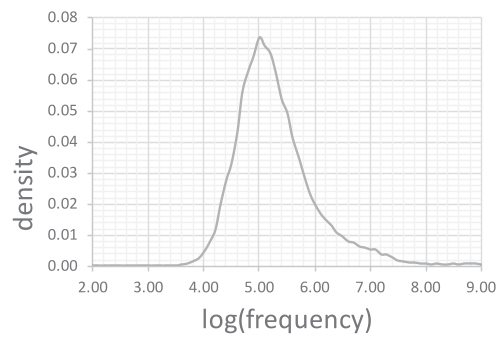 The figure shows how the logarithm of tweet frequency follows a normal distribution, justifying the log-normal approach.
Experimental Results: Performance Breakdown
The researchers compared BD against several SOTA systems, including supervised models like EARS and Japan-specific trackers.
- Global Coverage: While previous global systems (like Earle et al.) achieved high precision but dismal recall (0.01), BD maintained a recall of 0.53 with an F-measure of 0.66.
- Local Precision: In Chile, for earthquakes with a magnitude , BD achieved an F-measure of 0.91.
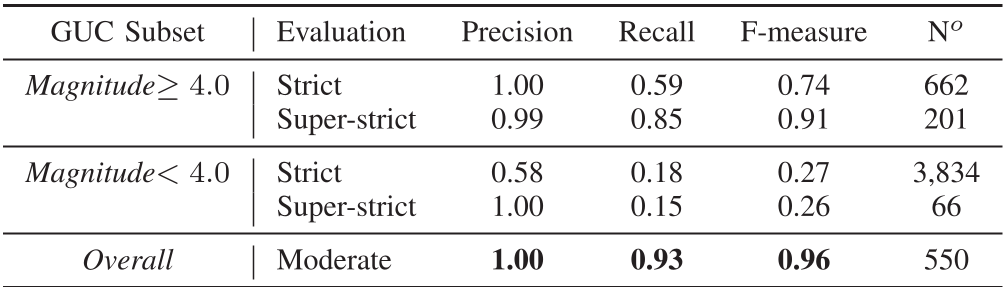 Experimental results highlight the superior recall and precision compared to the GUC catalog.
Critical Insight: Simplicity Scales
What makes BD particularly impressive is its semi-supervised nature. Unlike prior SOTA methods that require training local-language classifiers (requiring thousands of labeled tweets), BD only needs a list of keywords and a one-off initialization.
Because the model is statistically adaptive, it "learns" the background noise level of any language or region automatically. This allows the system to scale worldwide—from Italy to New Zealand—without manual recalibration.
Conclusion & Future Work
The BD method proves that "less is more" when dealing with massive data streams. By focusing on the underlying statistical properties of human communication rather than complex linguistic features, the authors have built a system that is currently used by the National Seismology Center in Chile.
Looking ahead, the authors suggest exploring the Box-Cox transformation to create even more expressive statistical descriptions, potentially further reducing the latency of detection below the current 2.5-minute mark.