
Robust Emotion Navigation: Solving Few-shot Sentiment Analysis with Noisy Guidance
Robust Emotion Navigation: Few-shot Visual Sentiment Analysis by Auxiliary Noisy Data
The paper introduces a "Robust Emotion Navigation" framework for few-shot visual sentiment analysis. It leverages large-scale noisy auxiliary datasets (like Sentibank) to guide learning on small, precise emotion datasets through a novel re-weighting loss and a prototype-based feature clustering mechanism.
TL;DR
Recognizing emotions in images is difficult because it requires high-level semantic understanding. This paper proposes a Robust Emotion Navigation framework that uses small amounts of high-quality data to "navigate" and clean large-scale noisy datasets from social media. By combining a Robust Re-weighting Loss and Prototype Loss, the authors achieved over 30% accuracy improvement on few-shot benchmarks.
The Core Challenge: Sentiment is High-Level and Noisy
Unlike object detection (e.g., "is this a cat?"), visual sentiment analysis (e.g., "is this image 'sad' or 'peaceful'?") depends on subtle cues of color, texture, and composition.
- Data Scarcity: Getting humans to accurately label emotions is expensive and subjective.
- Label Noise: Massively crawled sets like Sentibank use "Adjective-Noun Pairs" (ANP) which are often inaccurate (e.g., a "beautiful flower" in a tragic context).
The authors' insight is inspired by human learning: we learn specific emotional concepts from a few "textbook" examples and then generalize that knowledge to the messy, noisy world.
Architecture and Methodology
The framework operates in a "Navigation" paradigm where precise samples act as the North Star for noisy bulk data.
1. Robust Re-weighting Loss (Noise-Robustness)
The authors extend the mathematical theory of re-weighting to multi-class real-world noise. They estimate a Noise Matrix () which represents the probability of a label being flipped. By embedding this matrix into the loss function, the network can down-weight samples that are likely to be mislabeled.
2. Prototype Loss (Guided Clustering)
To prevent overfitting on the few-shot samples, the authors use them as "Prototypes." The Prototype Loss forces the deep features of the large noisy dataset to aggregate around the precise feature centers of the few-shot samples.
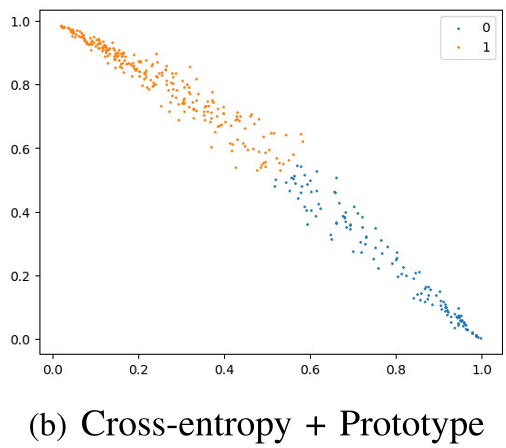 Visual distribution of 2-D deep features showing improved separability and cohesion.
3. Training Workflow
- Step 1: Pre-train on noisy data to estimate the noise structure.
- Step 2: Jointly train with few-shot data using the re-weighting and prototype losses.
- Step 3: Re-label the noisy dataset using the now-refined model and retrain from coarse to fine.
Experimental Results
The framework was tested on three major datasets: Sentibank (Auxiliary), Twitter, and Emotion6 (Targets).
| Method | Twitter (10% samples) | Emotion6 |
|---|---|---|
| Baseline (Cross-Entropy) | 0.528 | 0.341 |
| Our Final Framework | 0.822 (+29.4%) | 0.458 (+11.7%) |

The results show that even with very few samples (10% of Twitter), the "Navigation" approach allows the model to find the signal within the noise, significantly outperforming standard fine-tuning which almost fails (52.8% is close to random guess for binary tasks).
Conclusion and Future Outlook
This paper proves that we don't always need "clean" big data. By using a small amount of "gold standard" data to navigate "dirty" big data, we can achieve SOTA performance in subjective tasks like affective computing. This opens doors for Visual Emotion Migration and Emotion-Aware Generation, where models can be fine-tuned to specific user tastes with minimal feedback.
Limitations: The reliance on a Noise Matrix assumes that noise is somewhat "reasonable" and random. In cases of adversarial or highly biased noise, the clustering might still struggle.