
Robust Ensemble Learning: Optimizing Healthcare Workload Forecasting with Hybrid Neural Networks
A robust ensemble technique in forecasting workload of local healthcare departments
This paper introduces a novel robust ensemble framework for forecasting the daily workload of local healthcare departments using a large-scale e-health dataset. By combining tree-based models (XGBoost, Random Forest) and deep learning (LSTM) via a hybrid neural network "Combiner," the method achieves SOTA performance in short-term medical service demand prediction.
Executive Summary
TL;DR: The paper presents a sophisticated stacking ensemble framework designed to predict the daily demand for medical services (ECG, Diabetes, Orthopedics). By leveraging a "Combiner" network that fuses CNN and LSTM layers, the authors successfully mitigated the forecasting errors typically seen in single-model approaches during irregular periods like holidays.
Positioning: This work is an applied SOTA implementation. It moves beyond theoretical modeling by utilizing a massive real-world dataset (20M+ records) to solve a critical operational bottleneck in the Italian public health system.
The Challenge: Why Healthcare Workload is Hard to Predict
Predicting daily appointment volumes isn't just about general trends; it’s about navigating multi-level periodicity.
- Weekly Patterns: Drastic drops during weekends.
- Yearly Seasonality: Resource shifts during August (summer holidays) and December.
- Non-Stationarity: Sudden spikes or dips caused by public holidays that standard models often "smooth over," leading to resource mismanagement.
The authors argue that a single "best" model doesn't exist; instead, different algorithms (Trees vs. RNNs) grasp different nuances of the signal.
Methodology: The Two-Layer Architecture
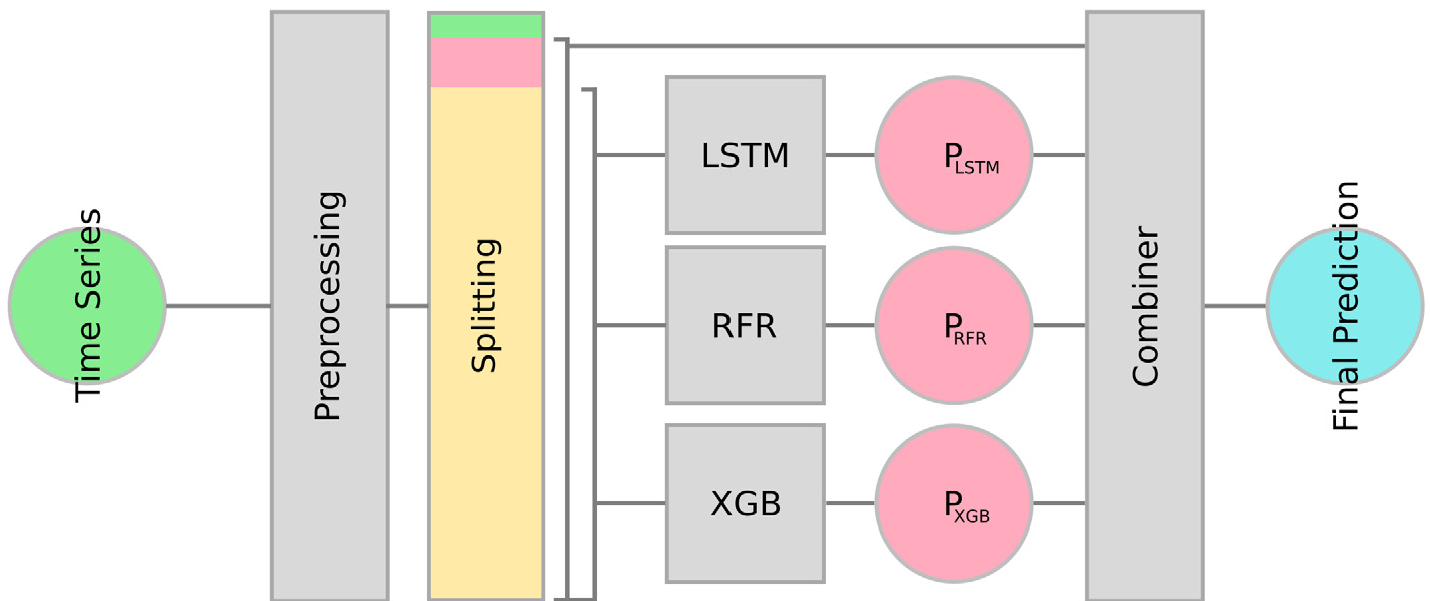
The core innovation lies in the Hybrid Neural Network Combiner. Unlike a simple average where every model gets an equal vote, this framework treats first-layer predictions as "raw features."
Layer 1: The Specialized Predictors
- Random Forest (RFR): Handles non-linear feature interactions well.
- XGBoost: Captures residuals and provides high-efficiency gradient boosting.
- LSTM: Dedicated to learning long-range temporal dependencies.
Layer 2: The Hybrid Combiner
The metadata, lagged variables, and first-layer outputs are fed into a dual-path network:
- CNN Branch: Uses 1D convolutions to extract local relations and short-term periodicity.
- LSTM Branch: Focuses on the broader temporal context.
Experimental Battleground: Real-World Results
The model was tested on five years of data from the Campania Region. The most striking result was the error correction capability.
Quantitative Edge
In the ECG service category, the "COMB" (Combiner) reached an R² of 0.92, significantly higher than the Vanilla LSTM (0.70) or the standard Mean Ensemble (0.87).
Qualitative Win: The Holiday Effect
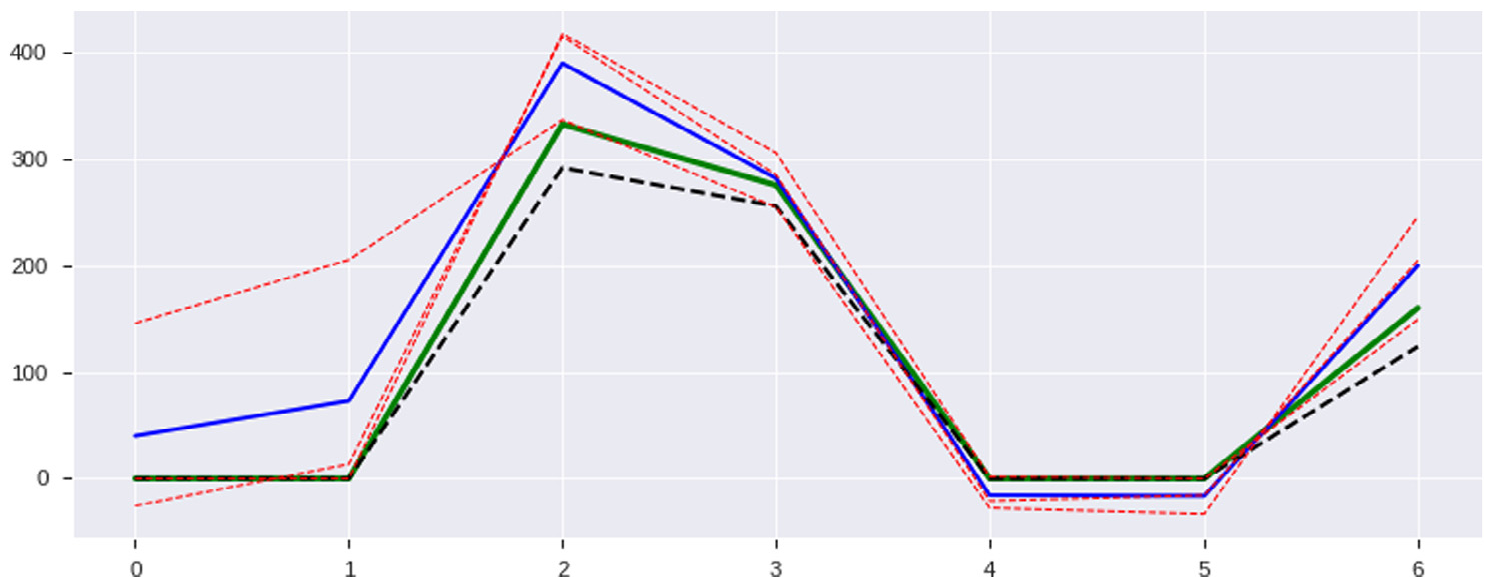
As shown in the charts below, during the Christmas week (Dec 24-31), individual predictors struggled to identify the sudden zero-load on holidays. The Combiner (Green Line) was the only model that accurately "corrected" the trajectory to zero, preventing the system from over-allocating staff during closures.
Critical Analysis & Future Outlook
Why it Works
The "Inductive Bias" of the Combiner is its strength. By seeing the errors of the Random Forest and XGBoost during training, the CNN-LSTM second layer learns when to trust a specific model and when to override it based on the calendar (e.g., "It's Christmas, ignore the XGBoost's non-zero prediction").
Limitations
- Univariate Limitation: While the model uses exogenous variables (holidays), it doesn't fully explore cross-service correlations (e.g., does a spike in Cardiology lead to a spike in some other department?).
- Computational Cost: Running a three-model ensemble plus a hybrid neural network for every medical service is computationally heavier than a single ARIMA or Prophet model.
Conclusion
This study serves as a blueprint for smart healthcare management. It proves that robustness in time-series forecasting comes not from a single "silver bullet" algorithm, but from a hierarchical structure capable of learning the strengths and weaknesses of an entire ensemble.