
Robust CNN-Based Gender Classification: Why Alignment Still Matters in the Wild
Robust gender classification on unconstrained face images
This paper introduces a robust framework for gender classification on unconstrained face images, combining multi-view face detection with a deep Convolutional Neural Network (CNN). By integrating a "weak calibration" strategy via affine transformation, the method achieves a state-of-the-art accuracy of 98.8% on the challenging Labeled Faces in the Wild (LFW) dataset.
Executive Summary
TL;DR: The paper presents a high-precision gender classification system designed for "unconstrained" images—photos from the real world with varying angles, lighting, and expressions. By combining a potent face detector, a simple yet effective affine calibration method, and a deep CNN trained on 300,000+ images, the authors achieved an unprecedented 98.8% accuracy on the LFW dataset.
Academic Positioning: This work bridges the gap between traditional geometric preprocessing and modern deep learning. Published in 2015, it was a pivotal "SOTA challenger" that proved massive data and spatial normalization could overcome the limitations of early deep gender classifiers.
The Problem: The "Wild" is Unforgiving
While humans find gender identification trivial, computer vision systems struggle with "unconstrained" images. Prior works often succeeded on the FERET dataset, which consists of "mugshot-style" controlled images. However, when applied to the Labeled Faces in the Wild (LFW) dataset, these systems often fail due to:
- Pose Variations: Profile views or tilted heads confuse standard filters.
- Occlusions: Sunglasses, hair, or hands blocking parts of the face.
- Shallow Features: Hand-crafted descriptors like LBP (Local Binary Patterns) are too brittle to capture the complex distribution of "male" vs "female" across different ethnicities and ages.
The authors observed that even previous CNN attempts (e.g., Levi et al.) lacked a robust alignment phase, limiting their effectiveness on non-frontal faces.
Methodology: Calibration Meets Deep Learning
The core of the paper is a pipeline that respects both geometry and feature hierarchy.
1. Face Detection and "Weak" Calibration
Instead of complex 3D face reconstruction (which can distort the image), the authors use Affine Transformation.
- Logic: Detect two eye points ().
- Transformation: Rotate the image based on the angle between eyes to ensure a horizontal orientation.
- Benefit: This reduces intra-class variance, making the CNN's job significantly easier as it doesn't have to learn "tilted" versions of gender-specific features.
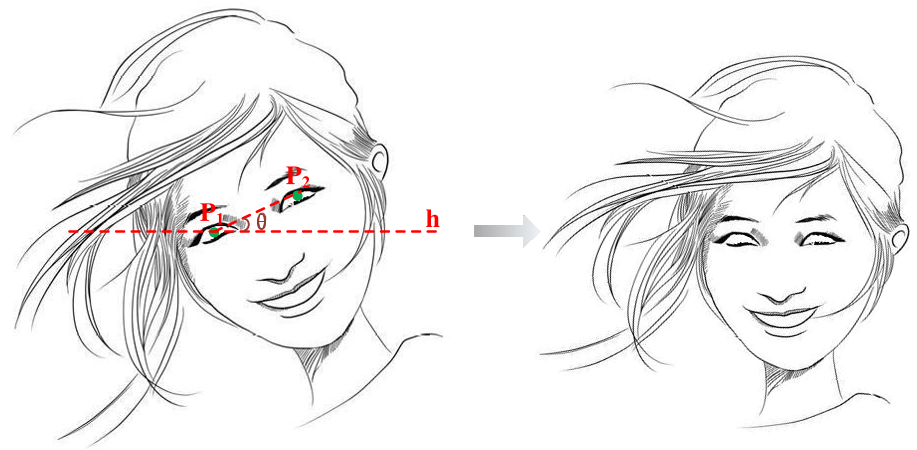 Figure 2: From raw unconstrained image to a calibrated face sub-image.
2. Deep CNN Architecture
The model utilizes a 180x180 RGB input. Key technical choices include:
- Structure: 4 Convolutional layers followed by 2 Fully Connected layers.
- Small Filters: Using smaller kernels to increase non-linearity while reducing parameters.
- Regularization: Dropout (50%) in fully connected layers to prevent memorization of the training celebrities.
- Scaling: Training on 300,804 images (a scale significantly larger than previous academic benchmarks of ~20k).
| Layer Type | Filter Size | Output Size |
|---|---|---|
| Input | - | 180x180x3 |
| Conv 1 | 9x9 | 58x58x96 |
| Conv 2 | 5x5 | 25x25x256 |
| Fully Connected | - | 512 |
Experiments and Results: Setting a New Standard
The authors tested the model on 12,982 images from the LFW dataset. The results were clear:
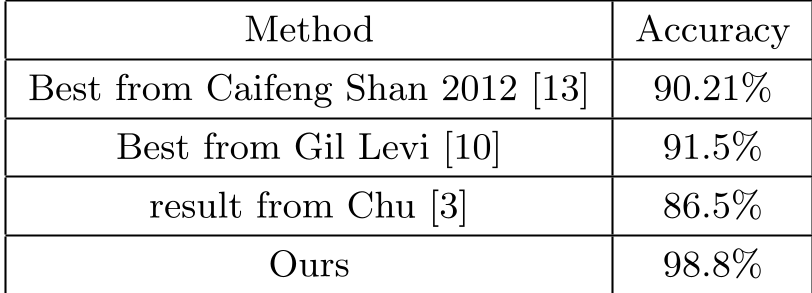 Table: The proposed method vs. existing SOTA.
The 98.8% accuracy is a massive leap from the previous 91.5%. Why such a big jump?
- Calibration: Previous models were often "guessing" when faces were tilted.
- Data Volume: By scraping and cleaning a dataset of 300k images, the model saw a much wider variety of gender expressions.
- Optimization: Using the Xavier-style initialization and Mean-image subtraction ensured the network converged on meaningful features (edges and colors) rather than noise.
Critical Analysis & Conclusion
Summary: This paper solidifies the importance of preprocessing-in-the-loop for deep learning. While the current trend (in 2024/2026) is toward "end-to-end" learning with Transformers, this work highlights that providing the model with a "spatially normalized" view (Inductive Bias) drastically reduces the learning difficulty.
Limitations:
- Detection Dependency: If the Face++ API (or eyes detector) fails, the entire pipeline fails.
- Binary Bias: The paper treats gender as a binary classification (Male/Female), which is a common technical simplification but lacks the nuance of modern demographic analysis.
Future Outlook: This methodology paved the way for modern facial analytical tools used in social media and security. It suggests that for edge computing, where models must be small, "weak calibration" is a much more efficient route than building massive, pose-invariant models.