
Beyond Big Data: A Robust Framework for Real-Time Emotional Recognition
A Robust Learning Framework Using PSM and Ameliorated SVMs for Emotional Recognition
The paper introduces a robust facial expression recognition framework based on Ameliorated Support Vector Machines (SVMs). By integrating the Perturbed Subspace Method (PSM) and SURF features, the system achieves state-of-the-art accuracy while significantly reducing the required training data and time.
TL;DR
Researchers have developed a facial expression recognition framework that breaks the dependency on large-scale datasets. By combining Perturbed Subspace Method (PSM) for data augmentation, Ameliorated SVMs, and SURF features, the system achieves high accuracy and real-time speeds (39.4 FPS) with a training time of under 50 minutes—nearly 30x faster than traditional K-means approaches.
Problem & Motivation: The "Large Data" Bottleneck
The current renaissance in AI often assumes an infinite supply of labeled data. However, in specialized fields like facial expression recognition, gathering thousands of diverse samples (varied lighting, angles, ethnicities) is a critical bottleneck. Existing methods like AdaBoost or SIFT-based SVMs are either too slow for real-time use or require massive preparations. The authors' insight was to shift the focus from collecting more data to extending the information density of existing samples through subspace perturbation and refined visual descriptors.
Methodology: The "One-to-Many" Paradigm
The core of the framework is built on three pillars:
1. PSM-based Sample Normalization
Unlike previous many-to-one mappings, this work uses PSM as a one-to-many mapping. It reconstructs 3D facial models from 2D images to simulate different yaw angles () and applies Principal Component Analysis (PCA) to simulate varying illumination. This creates a "virtual" expansion of the training set without manual labeling.
2. Fast Feature Description (8-bin T2 SURF)
To achieve real-time performance, the authors customized the SURF (Speeded Up Robust Features) descriptor. By using an 8-bin T2 descriptor inspired by integral images and Haar wavelet responses, they achieved a balance between SIFT-level accuracy and a much higher frame rate.
 Figure: The 8-bin T2 SURF descriptor utilizes Haar wavelet responses to capture local spatial information rapidly.
3. Region Attributes for Error Correction
The most unique aspect of the "Ameliorated SVM" is the use of Region Attributes. The face is divided into a grid. If the visual-feature-based SVM is uncertain, the system calculates a distance score in the attribute subspace to prune "miss-detections."
Experiments & Results: Efficiency Redefined
The framework was tested against CK+ (training) and JAFFE (testing) datasets, as well as real-world soap opera clips.
- Training Speed: The proposed method finished training in 49.8 minutes, while traditional K-means methods took over 26 hours (1,589 minutes).
- Accuracy Results: Even with a "mini-sized" database, the system reached 86.3% accuracy for "Surprise" and over 78% for "Neutral" expressions in real-life video sets.
- Inference Speed: The optimized SURF version reached 39.4 FPS, comfortably meeting real-time requirements, whereas the SIFT version lagged at 16.8 FPS.
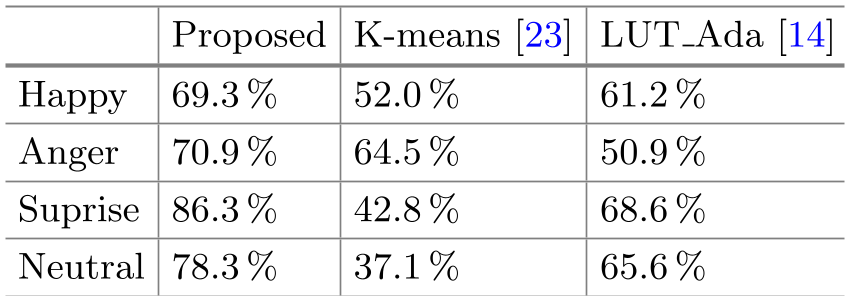 Table: Comparison of the proposed method against K-means and AdaBoost baselines across different emotions.
Critical Analysis & Conclusion
Takeaway
The paper proves that a "Robust Learning Framework" doesn't always need "Big Data." By mathematically simulating the physical variations of a face (orientation and light), we can build high-utility classifiers from sparse data.
Limitations
Despite the robustness, the model still struggles with extreme cultural and racial variations in facial expressions, as evidenced by lower scores on Test Set B (JAFFE) compared to Test Set A. The reliance on 3D reconstruction as a pre-processing step also adds a layer of geometric complexity that might fail on heavily occluded faces.
Future Outlook
The authors suggest evolving the Region Attributes into binary latent variables within the SVM model itself—potentially moving toward a more "probabilistic" or "Latent SVM" approach that could generalize across even more complex object recognition tasks.