
Robust Online Social Network Inference: Deciphering the Hidden Structure from Incomplete Traces
Robust Online Social Network Inference
This paper introduces a robust framework for Online Social Network (OSN) inference using incomplete information cascades. By leveraging low-rank matrix completion and Expectation-Maximization (EM) algorithms, the authors successfully reconstruct missing activation timestamps to accurately infer underlying network transmission rates across large-scale synthetic and real-world platforms like Facebook and Twitter.
TL;DR
This study tackles a critical bottleneck in social computing: how to map the "hidden" skeleton of a social network when the data we have about information spread (cascades) is full of holes. By combining Matrix Completion and Expectation-Maximization (EM), the researchers provide a mathematical bridge to reconstruct missing data and infer network connectivity with high precision.
Background: The Fog of Information War
In Online Social Networks (OSNs), we rarely see the "edges" (the actual influence channels). Instead, we see the "smoke"—timestamps of when a user retweets or shares a post. This is a Cascade. Traditional SOTA models like NetRate assume we have every timestamp. In reality, privacy blocks and sampling errors leave us with fragmented traces. As the paper points out, even a small fraction of missing data can "blind" traditional inference algorithms.
The Core Insight: Cascades are Low-Rank
The most striking observation of this work is that cascade matrices are not purely chaotic. By analyzing singular value distributions, the authors prove that cascade data resides in a low-dimensional subspace.
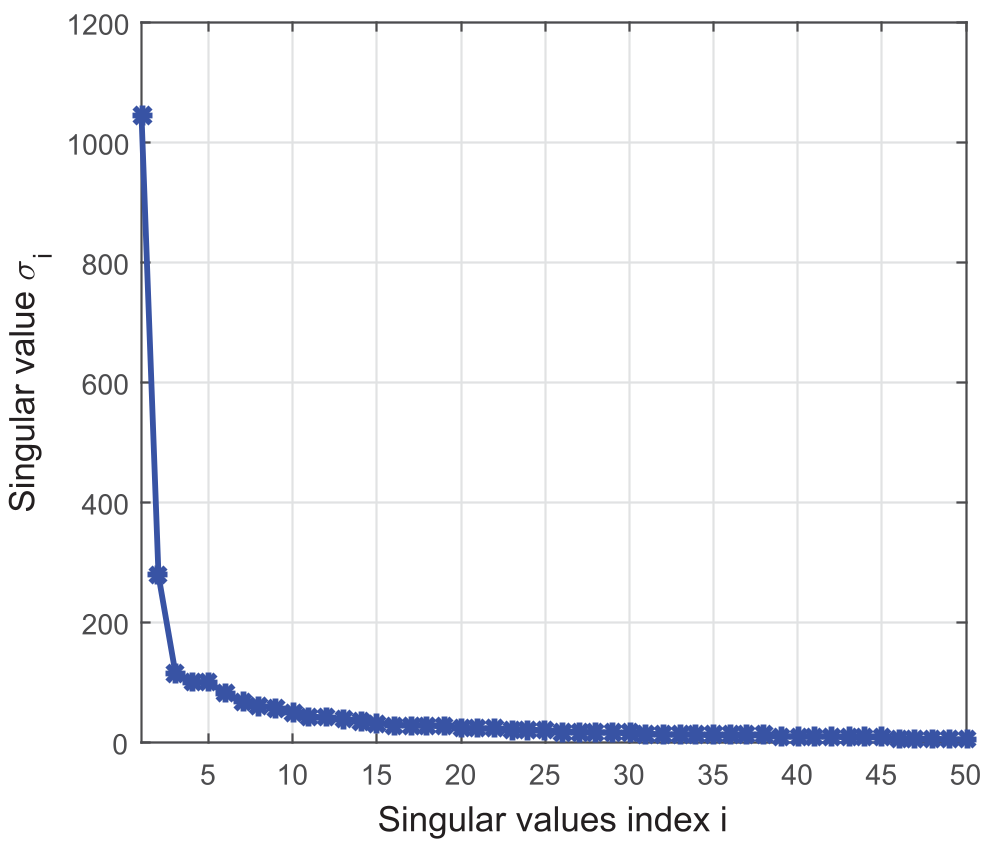 Fig 1. The "Scree Plot" of cascade singular values demonstrating that a few dimensions capture most of the diffusion dynamics.
Methodology: Two Paths to Reconstruction
1. The Two-Step Matrix Completion (MC)
This approach treats the missing timestamps as a "blind" matrix completion problem. The objective is to find a low-rank matrix that minimizes the error over the observed set : Once the timestamps are "hallucinated" back into existence, a standard MLE is used to find the transmission rates .
2. The Joint EM Iteration
For more complex scenarios, the authors propose a joint estimation. The EM algorithm iteratively:
- E-Step: Estimates the expected log-likelihood of the complete data given the current network model.
- M-Step: Updates the transmission rates to maximize that likelihood. This "self-correcting" loop allows the model to learn the network while simultaneously refining its guesses about the missing data.
Experimental Battleground
The researchers tested their methods against massive real-world datasets from Facebook (4,039 nodes) and Twitter (81,306 nodes).
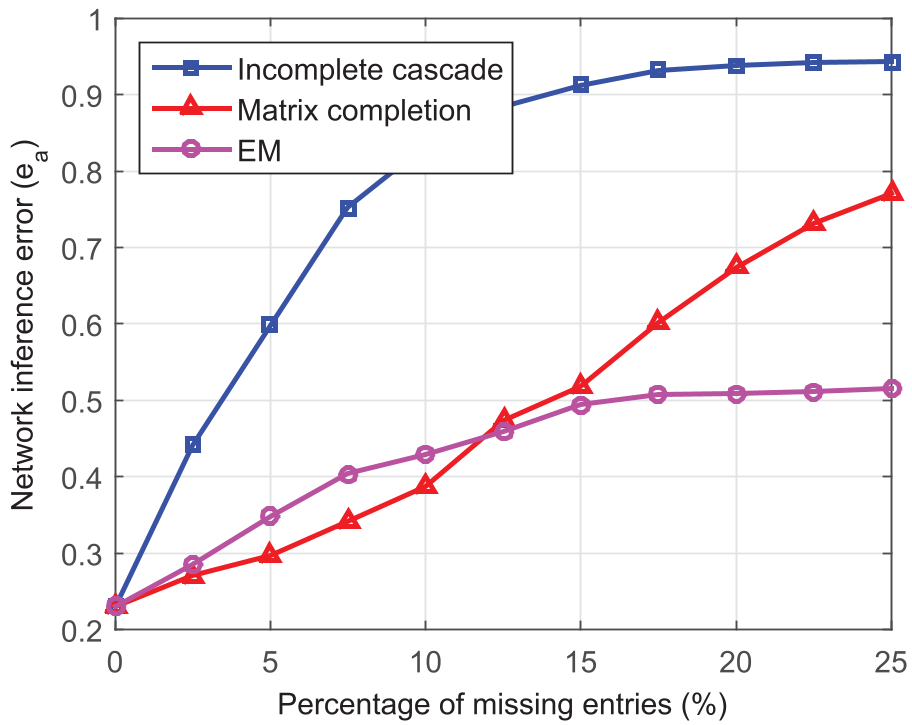 Fig 2. Network inference error vs. Percentage of missing data. Note how the EM and MC methods stay significantly lower than the baseline.
Key Findings:
- Complementary Strengths: Matrix Completion is the "surgical" tool—superior when missing data is sparse. EM is the "rugged" tool—more robust when the data is heavily fragmented.
- Convergence: The EM approach is remarkably efficient, typically converging in just 5 iterations, making it feasible for large-scale social graphs.
Critical Insight & Future Outlook
This work shifts the paradigm from "better data collection" to "better algorithmic resilience." By proving that Diffusion Dynamics (the "How") is intrinsically linked to Subspace Geometries (the "What"), it opens the door for influence maximization even in "dark" social networks where user privacy is paramount.
However, a limitation remains: the model assumes a static network. Future iterations will need to address temporal drift, where the influence between users changes as their social relationships evolve over time.