
Robust Session Key Generation: Balancing Security and Efficiency in the Social IoV
Robust session key generation protocol for social internet of vehicles with enhanced security provision
This paper proposes a robust session key generation protocol for Social Internet of Vehicles (SIoV) and Vehicle-to-Grid (V2G) networks. It utilizes Elliptic Curve Cryptography (ECC) and a two-message exchange to establish secure communication between Electric Vehicles (EVs) and Aggregators (AGGs), achieving SOTA efficiency with an 84% improvement in execution time over prior secure schemes.
TL;DR
As Electric Vehicles (EVs) become integral nodes in the Social Internet of Vehicles (SIoV), securing the communication between vehicles and the power grid (V2G) is paramount. This paper introduces an ECC-based key exchange protocol that fixes critical vulnerabilities in previous lightweight designs while being 84% faster than heavy-duty cryptographic alternatives. Tested on actual ARM microcontrollers, it establishes a secure session key in as little as 265ms.
The Motivation: Why Current V2G Security is Failing
The Vehicle-to-Grid (V2G) ecosystem relies on Aggregators (AGGs) to manage charging plans and energy flow. This communication happens over public wireless networks, making it a prime target for attackers. Previous research followed two paths, both flawed:
- Ultra-lightweight schemes (Hash/XOR only): These are fast but fail to provide Perfect Forward Secrecy (PFS). If a long-term key is stolen later, all past conversations can be decrypted. They are also susceptible to Offline Password Guessing Attacks.
- Heavyweight schemes (Bilinear Pairings): These are secure but "heavy." They consume too much power and time on the resource-constrained Onboard Units (OUs) of vehicles.
The authors' primary insight was that ECC-based digital signatures and point multiplications could bridge this gap, providing the security of asymmetric encryption with the speed required for mobile vehicular hardware.
Methodology: The Core Architecture
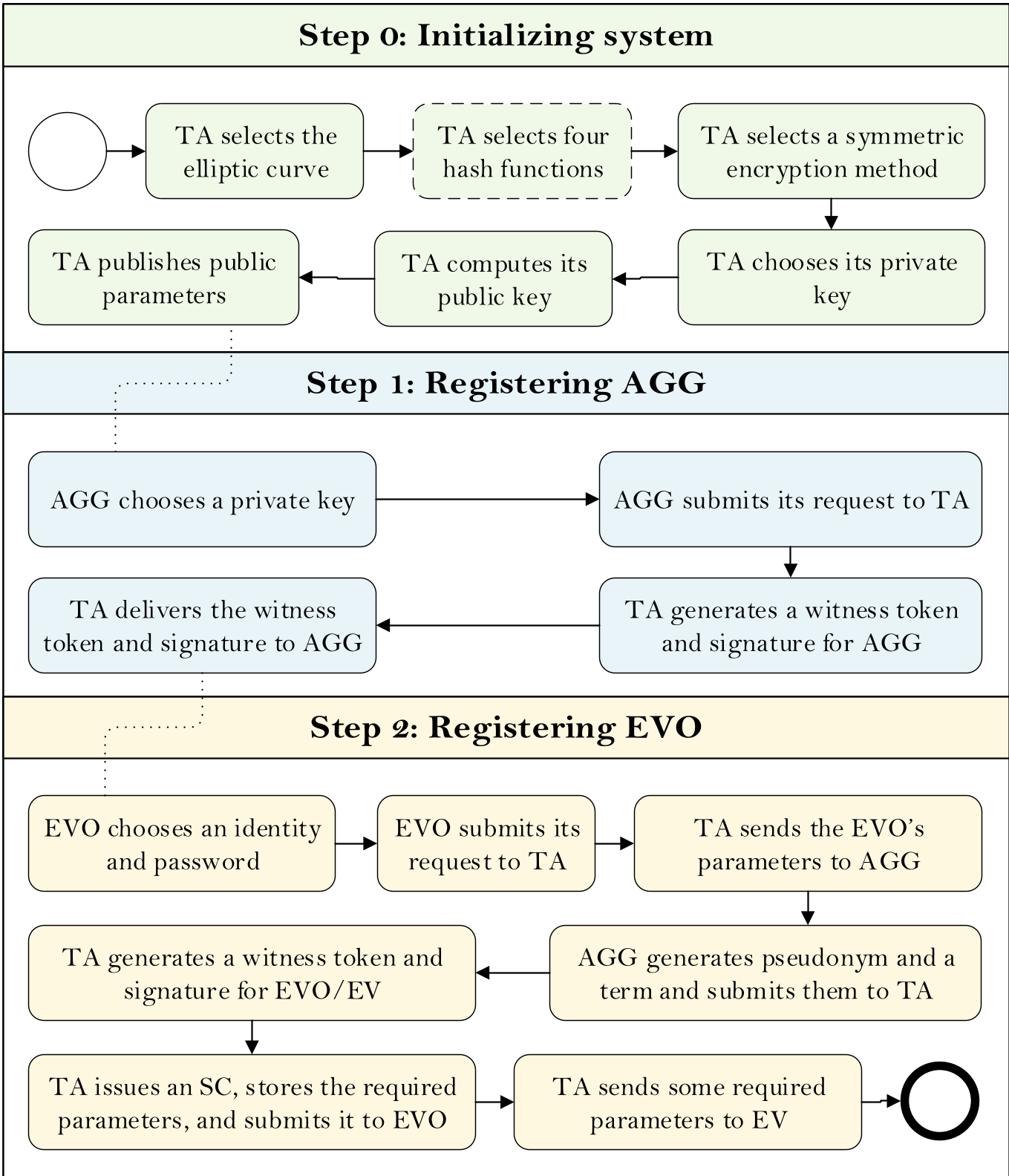
The protocol is divided into three main phases: Initialization, Authentication & Key Agreement, and Password Update. It operates under the CK (Canetti-Krawczyk) Model, the gold standard for key exchange security, which assumes the adversary can learn not just the long-term keys but even temporary (ephemeral) session state.
System Architecture
The entities involved include the Electric Vehicle Owner (EVO), the Onboard Unit (EV), and the Aggregator (AGG).
The Key Exchange Logic
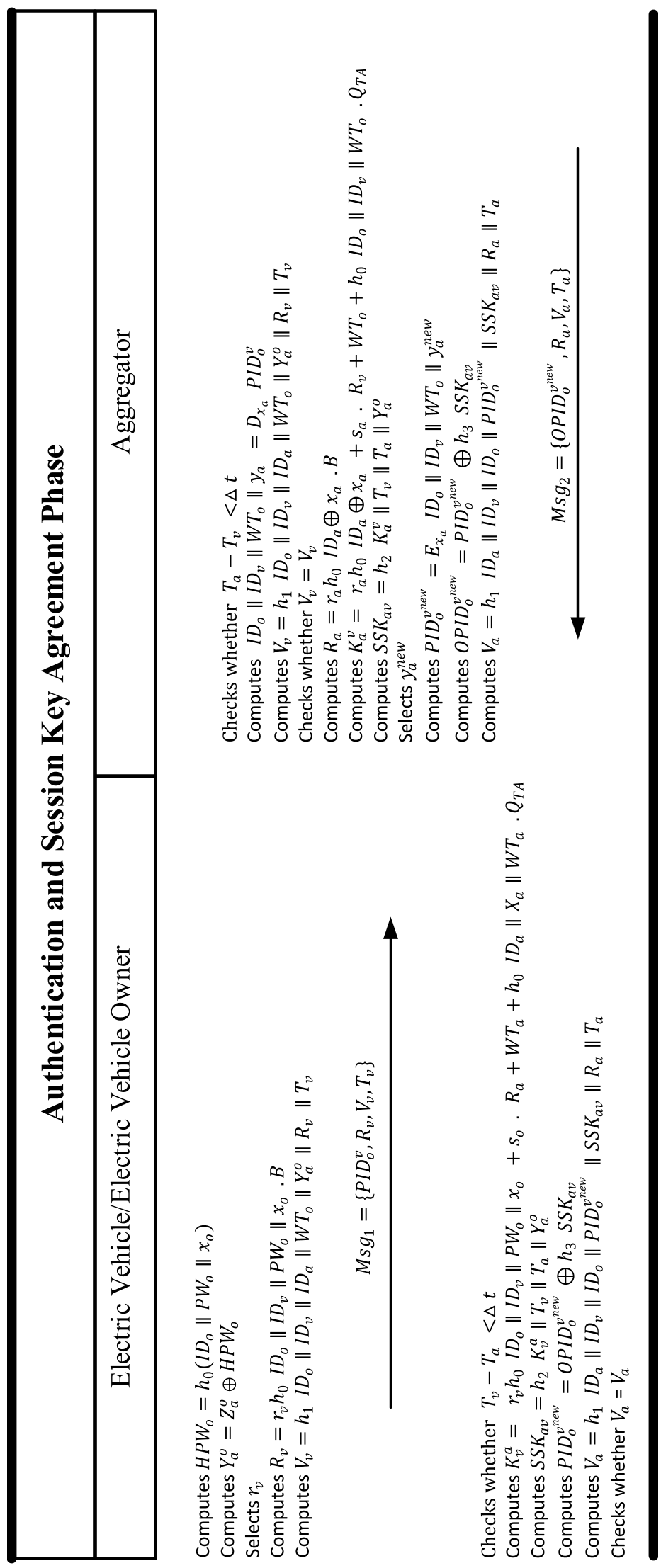
Unlike older protocols that sent pseudonyms in plain text, the proposed method uses symmetric encryption (AES) and ECC point multiplication to "blind" the identity. The session key () is derived from a complex mix of local secrets, random nonces, and the current timestamp, ensuring that even if one session's temporary secrets are leaked, the others remain secure.
Performance & SOTA Comparison
The researchers didn't just stop at theoretical math; they performed formal verification using ProVerif (a tool for automated cryptographic proof) and conducted hardware experiments.
Quantitative Improvements:
- Execution Time: Compared to Li et al. (2019), it is 57% faster. Compared to the pairing-based Wang et al. (2015), it is 84% faster.
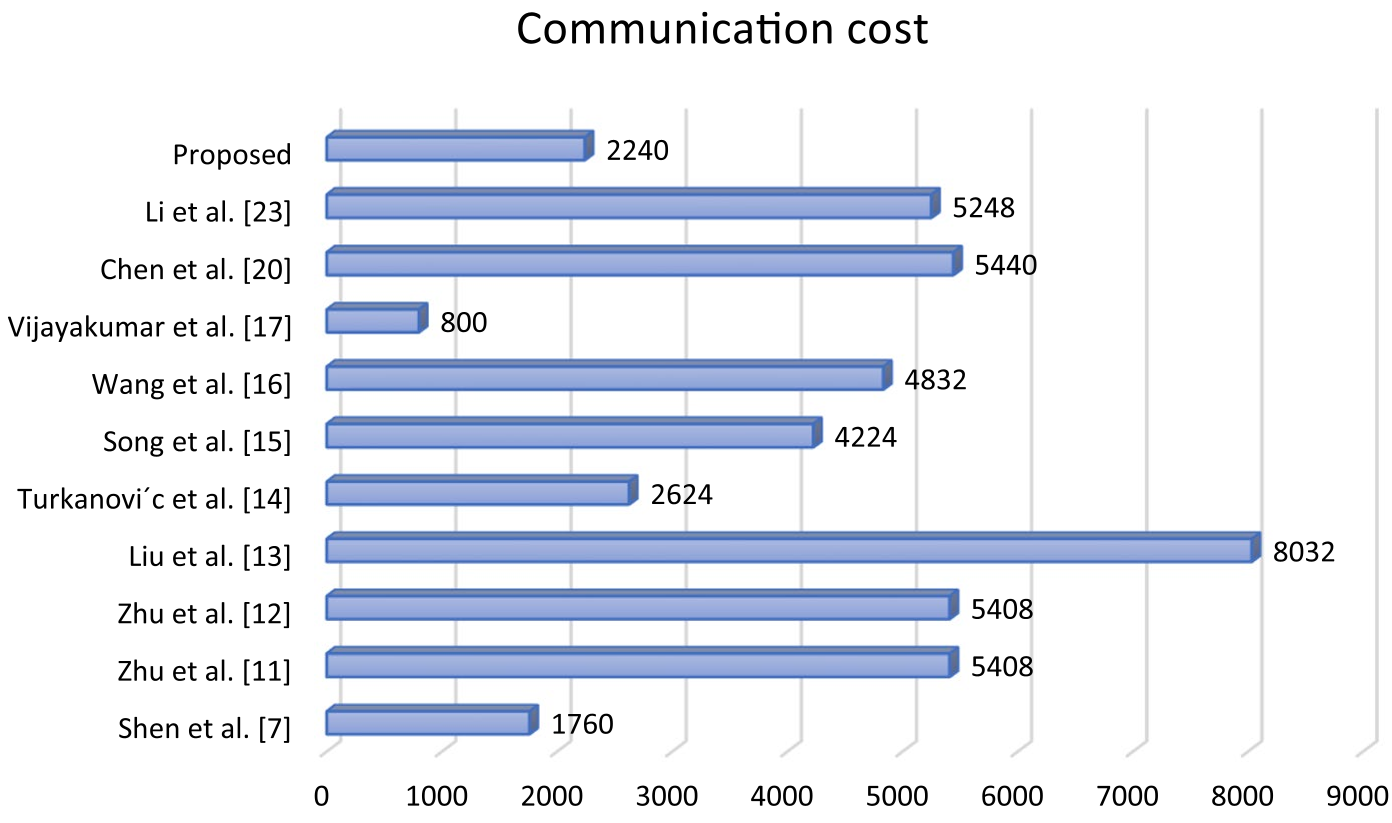
- Communication Overhead: It generates significantly smaller messages (2240 bits) compared to most competitors, reducing the latency on high-speed vehicular networks.
| Operation | Time on ARM (Curve25519) |
|---|---|
| ECC Point Mult | 85.4 ms |
| SHA-256 Hashing | 0.1 ms |
| Total EV Side | 265 ms |
Experimental Evidence
By implementing the protocol on an STM32F303 Nucleo board, the team proved that EVs don't need expensive Intel-grade processors to run state-of-the-art security.
Critical Insights & Conclusion
The standout feature of this protocol is its resistance to the Known Session-Specific Temporary Information Attack. In the world of IoV, where physical devices might be tampered with, assuming the security of ephemeral data is a mistake. By integrating these vulnerabilities into their design from day one, the authors created a protocol that is "future-proof" for the smart grid.
Future Outlook: While the protocol is highly efficient, its reliance on a Trusted Anchor (TA) for initial registration suggests a centralized dependency. Future iterations could explore decentralized identity (DID) to further align with the autonomous nature of the SIoV.