
SocialTrust: Engineering Tamper-Resilient Reputation in Social Networks
Towards robust trust establishment in web-based social networks with socialtrust
The paper introduces SocialTrust, a framework for robust trust establishment in online social networks that defends against malicious infiltration and misinformation. It combines relationship quality, historical behavior, and personalized feedback into a dynamic reputation score using a PID-controller-inspired approach.
TL;DR
SocialTrust is a framework designed to secure online social networks (OSNs) against malicious actors and misinformation. By treating trust as a dynamic signal—modeled after feedback control systems (PID controllers)—it distinguishes between who you know and how you behave. Unlike structural models like PageRank, SocialTrust remains robust even when the network is heavily infiltrated by malicious users.
Context & Motivation: The Illusion of Social Security
In 2008, social networks like MySpace and Facebook were exploding in scale. However, the researchers identified a critical vulnerability: structural trust is not behavioral trust.
Existing systems faced three terminal threats:
- Malicious Infiltration: Standard email registration provides zero security against sophisticated attackers.
- Nearby Threats: The "Small World" phenomenon means a malicious actor is often only 2-3 hops away from a victim.
- Limited View: Users cannot manually verify the trustworthiness of the millions of participants outside their immediate circle.
The authors argue that simply looking at the link structure (topology) is insufficient because a high-reputation user might still engage in low-quality or malicious relationships.
Methodology: The PID Control of Trust
The core innovation of SocialTrust is its mathematical formulation of a user's score using three components:
- Proportional: The current trust quality.
- Integral: The average historical performance (to prevent "exit scams" or sudden betrayal).
- Derivative: The rate of change in behavior (to detect and amplify sudden fluctuations).
Closing the Loop with Feedback
To calculate the base trust , the model combines two distinct signals:
- Relationship Link Quality (): Not all "friends" are equal. A recommendation from a user with high relationship quality carries more weight.
- Personalized Feedback (): Actual user interactions (positive or negative) are fed back into the system, "closing the loop" between network structure and real-world behavior.

Experiments: Performance under Attack
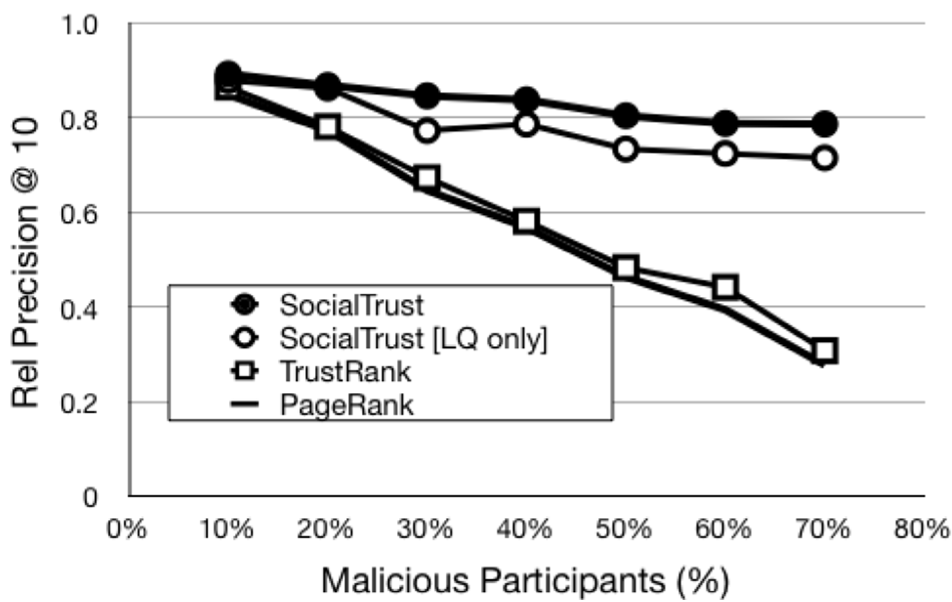
The researchers tested SocialTrust using a massive dataset of ~19 million links from MySpace. They simulated a search task where users look for information (e.g., job leads) and encounter "malicious" responders who disseminate misinformation.
Key Findings:
- PageRank & TrustRank Failure: These models showed a sharp decline in precision as the number of malicious users grew. They lack a mechanism to "unlearn" trust once a node becomes compromised.
- SocialTrust Resilience: By incorporating link quality and feedback, SocialTrust successfully filtered out malicious responses, maintaining high precision levels where others failed.
Critical Insights & Future Outlook
SocialTrust represents a shift from static graph analysis to dynamic signal processing in the social domain.
Why it works:
The separation of "Link Quality" and "User Trust" is genius. It recognizes that a trustworthy person can be a "bad judge of character" (low link quality), and their recommendations should be discounted accordingly without nuking their individual trust score.
Limitations & Complexity:
While robust, the model requires a continuous stream of feedback. In real OSNs, "feedback fatigue" is real—users rarely rate every interaction. Furthermore, the 2008 computational cost of running daily PID updates on 250 million users was non-trivial, though modern distributed graph databases have since mitigated this.
Future Impact:
Today, this logic underpins modern algorithmic feeds and shadow-banning mechanisms. The transition toward "Context-Aware" trust—where you might be trusted for "tech advice" but not "medical advice"—remains the next frontier for this framework.