
Robust Video Watermarking: When Crowdsourcing Meets Multi-Frequential Mosaicing
A robust video watermarking based on feature regions and crowdsourcing
The paper introduces a robust video watermarking framework that integrates "Crowdsourcing" and "Mosaic generation" to identify feature regions for signature embedding. Utilizing a multi-frequential scheme (DWT-DCT-SVD), the method achieves high invisibility and exceptional resilience against collusion and geometric attacks.
TL;DR
This research presents a novel video watermarking approach that solves the "collusion attack" problem—the Achilles' heel of video security. By combining human-selected interest regions (Crowdsourcing) with automated motion tracking (Mosaic generation) and a triple-transform embedding scheme (DWT-DCT-SVD), the authors achieve a watermark that is both invisible to the naked eye and nearly impossible to strip away through conventional editing or malicious attacks.
Problem & Motivation: The Invisible War of Collusion
In the world of digital rights management, video watermarking is notoriously difficult. Unlike static images, videos are susceptible to Collusion Attacks. In this scenario, an attacker compares or averages multiple frames to isolate and remove the watermark without damaging the video quality.
The authors identify a critical gap: current automated ROI (Region of Interest) detection often focuses only on "moving things." But what if the most important part of the video is a static face or a significant background element? If the watermark isn't there, the video remains vulnerable. This motivated the team to leverage Crowdsourcing—using collective human intelligence to pinpoint "important" regions that machines might miss.
Methodology: The Hybrid Defense
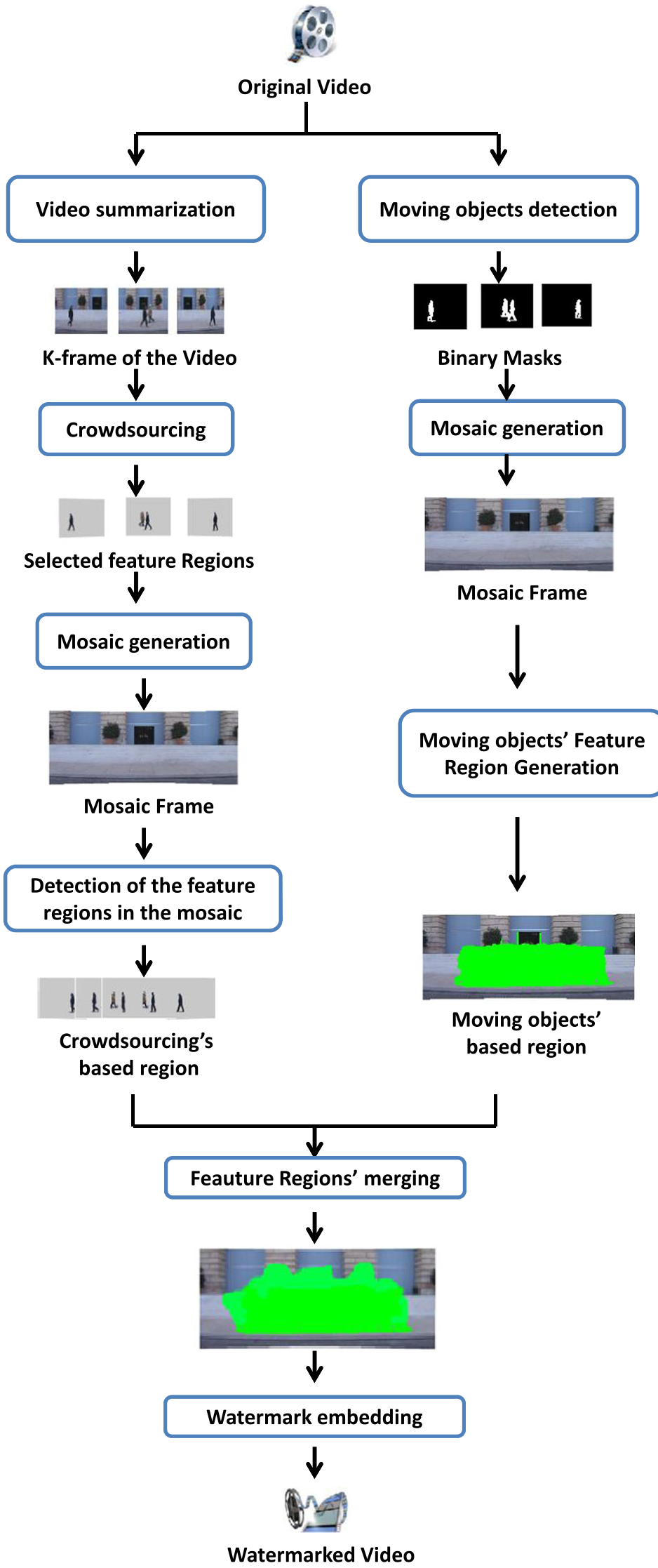
The proposed system architecture is a sophisticated pipeline consisting of four main phases:
1. Dual-Path Feature Region Detection
- Path A (Moving Objects): The system generates a background mosaic and uses subtraction to mask moving objects. This ensures the "action" is always protected.
- Path B (Crowdsourcing): To avoid privacy issues, a video summary is generated. Fifty participants used an interactive interface to select viewports of interest. These inputs were modeled using a Gaussian Mixture Model (GMM) to create a "User Interest Map."
2. Mosaic-Based Integration
The system merges these regions into a single mosaic image. By embedding the watermark in a mosaic rather than individual frames, every physical point in the video is marked identically. This is the "magic bullet" against collusion; since the mark is consistent across the timeline, averaging frames won't erase it.
3. Multi-Frequential Embedding
To balance the classic "Robustness vs. Invisibility" trade-off, the authors used a triple-transform:
- DWT (Wavelet): Provides the structural framework and noise resilience.
- SVD (Singular Value): Applied to the LL band for high invisibility.
- DCT (Cosine): Applied to the HH band to ensure stability against geometric distortions like rotation.
Experiments & Results: Setting New Benchmarks
The approach was tested on standard sequences and modern HD content like Big Buck Bunny.
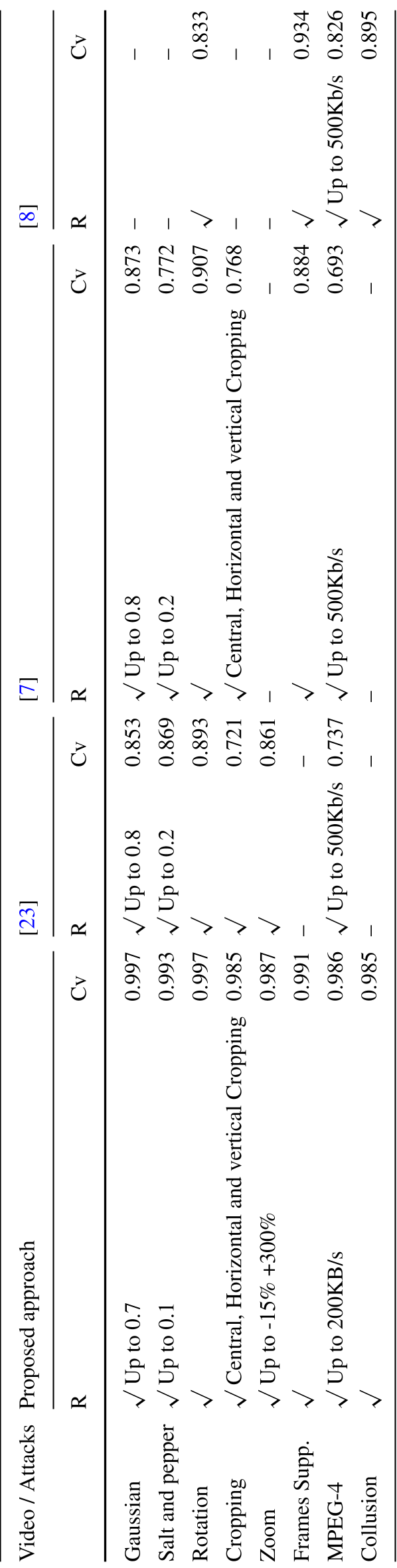
- Imperceptibility: With a PSNR of 57.82 dB to 58.95 dB, the watermark is mathematically and visually distinct from the original while remaining essentially invisible.
- The Collusion Test: While most methods crumble under frame averaging, this approach maintained a correlation value of 0.985, proving the effectiveness of the mosaic-based insertion.
- Compression Resilience: The watermark survived MPEG-4 compression at rates as low as 200kb/s—a significant lead over existing methods that fail at 500kb/s.
Critical Insight: Why Crowdsourcing Works Here
The "secret sauce" isn't just the math—it's the Inductive Bias provided by humans. By marking what humans perceive as important, the watermark resides in regions that a malicious actor cannot simply crop or blur without rendering the video useless to the viewer. This creates a psychological and technical barrier: to destroy the watermark, you must destroy the video's value.
Conclusion
This paper successfully bridges the gap between human perception and signal processing. While the dependency on human workers (Crowdsourcing) might seem like a bottleneck for real-time applications, for high-value asset protection (like Hollywood releases or legal evidence), the added layer of "Human Importance" offers a level of security that automated systems cannot yet replicate.
Future Outlook: The next frontier will likely involve using these human-derived interest maps to train Deep Neural Networks to "predict" human ROI, automating the human element while retaining the robustness benefits.