
Decoding Information Flow: Why We Retweet to Endorse but Reply to Argue
Role of Sentiment in Message Propagation: Reply vs. Retweet Behavior in Political Communication
This paper investigates how sentiment and linguistic features drive two distinct modes of message propagation on Twitter: retweets and replies. Using a large-scale dataset of UK political communications, it reveals that while negative emotions generally boost propagation, structural content features like URLs and mentions have diametrically opposite effects on endorsement (retweets) versus conversation (replies).
TL;DR
Not all social media "shares" are created equal. This research analyzes UK political tweets to prove that the psychological triggers for a Retweet (social endorsement) are often the exact opposite of those for a Reply (interactive conversation). While negative emotions like anger fuel both, structural elements like URLs and personal pronouns act as a "toggle" between broadcast reach and community dialogue.
Background: The Misconception of Propagation
In the world of social media analytics, "virality" is often treated as a single score. However, this paper positions itself at a critical junction: distinguishing between diffusion by endorsement and diffusion by discussion. The authors argue that a message's success shouldn't just be measured by how far it travels, but by how the audience interacts with it.
The "Why": Motivations Behind the Click
The authors identify a fundamental tension:
- Retweets are low-effort signals of agreement or information dissemination.
- Replies require higher cognitive load and often signal a desire for debate or personal connection.
Why does a tweet with a link go viral via retweets but die in the comments? The researchers suspected that sentiment and linguistic "cues" were the hidden architects of these different behaviors.
Methodology: Peering into the Linguistic Engine
The study utilized the LIWC (Linguistic Inquiry and Word Count) framework to categorize tweets into specific psychological buckets:
- Affective Processes: Positive vs. Negative emotions (Anger, Anxiety, Sadness).
- Linguistic Styles: Use of pronouns (1st, 2nd, 3rd person).
- Content Features: Hashtags, URLs, mentions, and punctuation.
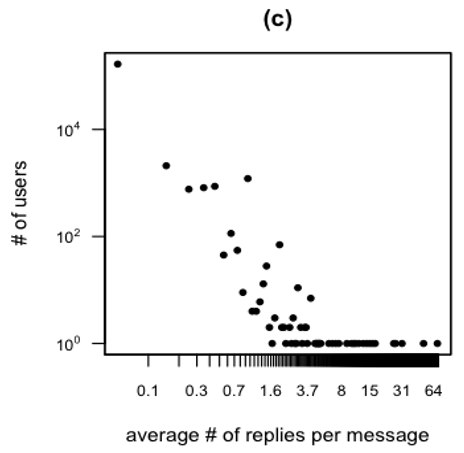 Figure 1: The distribution of both replies and retweets follows a Power Law, where a few "super-tweets" dominate the conversation.
Key Insights: The Great Divide
The regression analysis (Table 4 in the paper) reveals fascinating contradictions in how we communicate:
1. The Power of Negativity
Negative emotions—specifically Anxiety and Anger—are the "high-octane fuel" of political Twitter. They positively correlate with both retweets and replies. Interestingly, Sadness tends to decrease engagement, suggesting that "high-arousal" negative emotions are the true drivers of propagation.
2. The Link Paradox (URLs)
Perhaps the most striking finding is the role of URLs.
- URLs = High Retweets: Links provide "factual" utility, making the message worth sharing as news.
- URLs = Low Replies: Links often signal a "closed" statement or report, which discourages users from starting a conversation.
3. The Personal Touch (Pronouns)
Tweets using "I" or "We" (1st person pronouns) are magnets for Replies. They signal personal opinion or experience, inviting others to respond. Conversely, these personal markers actually reduce retweet rates, as users are less likely to "endorse" someone else's purely personal narrative.
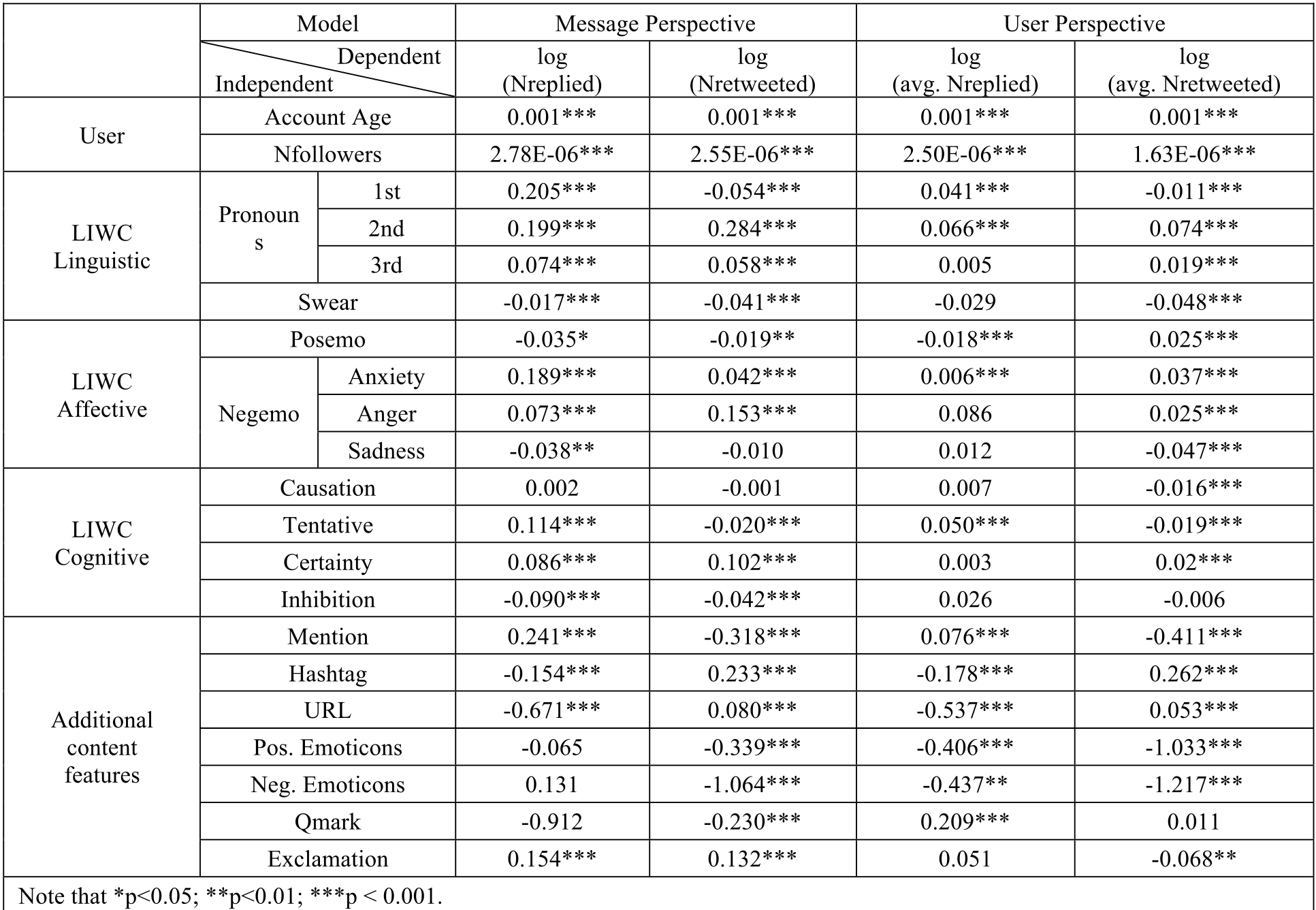 Table 4: Regression coefficients showing the starkly opposite effects of variables like "Mention," "URL," and "1st Person Pronouns" on Replies vs. Retweets.
Critical Analysis & Future Outlook
Takeaway for Practitioners: If your goal is broad awareness (Retweets), keep it objective, use links, and lean into high-arousal news. If your goal is community engagement (Replies), use personal pronouns, ask questions, and avoid external links that "leak" the user away from the thread.
Limitations: The study relies on a 2010 dataset. In the modern era of "Quote Tweets" (which didn't exist in its current form during the study), the line between a reply and a retweet has blurred. Furthermore, the reliance on LIWC lexicons may miss the nuance of sarcasm or complex political irony that modern Transformer-based models (like BERT or GPT) might capture.
Conclusion: This paper serves as a foundational reminder that sentiment is not just "positive or negative"—it is a functional tool that determines whether a message becomes a banner for others to carry or a campfire for others to sit around.