
Beyond the Inner Circle: How Weak Ties Secretly Power Information Diffusion
The Role of Social Networks in Information Diffusion
This seminal large-scale field experiment on Facebook (253M subjects) quantifies social influence in information diffusion using a randomized controlled trial. By selectively hiding friends' shared links (URLs) from users' News Feeds, the study isolates causal interpersonal influence from homophily-driven correlations, concluding that while strong ties are more influential per contact, weak ties collectively drive the majority of information spread.
TL;DR
In one of the largest social experiments ever conducted, researchers at Meta (Facebook) and the University of Michigan demonstrated that while your best friends have the most influence over you, your distant acquaintances (weak ties) are actually the ones responsible for the majority of the information you spread online. By using a randomized control trial on 253 million users, the study successfully disentangled causal influence from homophily.
The Problem: The "Echo Chamber" of Observational Data
In social network science, there is a fundamental hurdle known as the Reflection Problem. If you and your best friend both post a link to a specific news article, is it because you influenced them, or because you both read the same newspaper every morning?
Traditional observational studies struggle here. We see "clusters" of behavior, but we don't know the why. High tie strength (closeness) is naturally correlated with similar interests (homophily), making it look like strong ties are the only ones that matter.
Methodology: The Ultimate A/B Test
To solve this, Bakshy et al. created two parallel worlds on Facebook:
- Feed Condition: You see your friend’s post about a URL as usual.
- No Feed Condition: The system hides that specific post from your feed.
If you still share the link despite not seeing it in your feed, that's homophily at work—you found the content elsewhere. If you share it only when exposed, that's social influence.
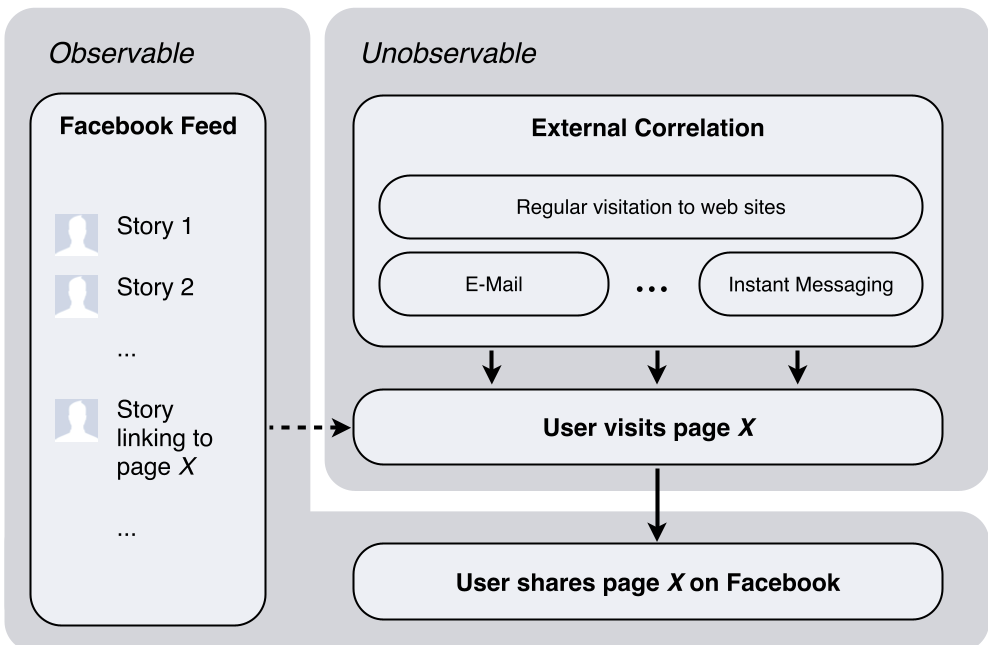 Figure 1: The experimental design blocks the causal arrow of the Facebook UI to isolate external correlations.
Key Findings: The Paradox of Tie Strength
1. The Power of Exposure
Seeing a friend share something makes you 7.37 times more likely to share it yourself. Furthermore, it acts as an accelerant: the median time to re-share drops from 20 hours (finding it yourself) to just 6 hours (seeing it on your feed).
2. Strong Ties vs. Weak Ties
The study defined tie strength using interaction frequency (messages, comments, and tagged photos).
- Individually: A "Strong Tie" is more influential. You are more likely to trust or act on a recommendation from a spouse than a high school acquaintance you haven't spoken to in 5 years.
- Collectively: Because "Weak Ties" are so much more numerous (the long tail of your friend list), they provide the vast majority of your new information.
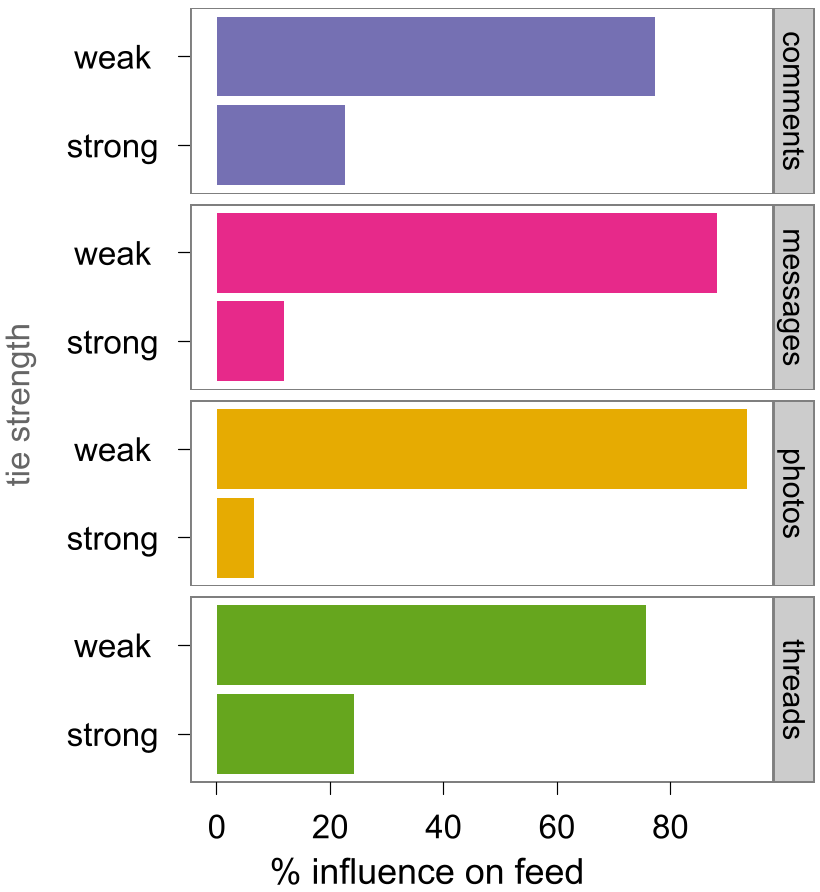 Figure 2: Distribution of influence. While the probability of influence per contact is higher for strong ties, the sheer volume of weak ties means they dominate total diffusion.
Deep Insight: The Diversity Engine
The most striking takeaway is that Weak Ties are the bridges to novelty. The risk ratio (the relative boost in sharing probability provided by the feed) is significantly higher for weak ties.
Why? Because your strong ties are likely in the same information bubble as you. You probably would have found that "viral" video your best friend shared eventually anyway. But your weak ties live in different social circles; they bring you the information you would never have seen otherwise.
Critical Analysis & Conclusion
This study validates Mark Granovetter’s 1973 "Strength of Weak Ties" theory in the digital age. It proves that social networks aren't just echo chambers; they are vast discovery engines.
Limitations: The study is confined to "simple contagion" (sharing a link). "Complex contagions" (like changing political views or adopting a new lifestyle) might still require the reinforcement of multiple strong ties.
Takeaway for Practitioners: If you want to go viral, don't just target "influencers" with tight-knit followings. Aim for the "bridging" individuals who can carry your message across disparate social clusters via the Power of Weak Ties.