
Identifying the Architects of Virality: The Role of Network Communities in Social Diffusion
The roles of network communities in social information diffusion
This paper investigates how network community structures influence information diffusion on a million-scale Twitter dataset. By defining six community-aware node roles and proposing the Diffusion Cover Ratio (DCR), the authors reveal that "community bridges" excel at cross-community spread while "community cores" dominate within-community diffusion.
TL;DR
Why do some hashtags go viral across the globe while others stay trapped in niche circles? This paper moves beyond simple follower counts to look at Network Communities. By analyzing millions of Twitter interactions, the researchers identified that Community Bridges (nodes connecting different groups) and Community Cores (nodes at the heart of groups) play distinct, critical roles in how information moves. Most importantly, they proved that we can predict who will be a "super-diffuser" just by looking at the network structure, without needing any past retweet history.
Problem & Motivation: Beyond the "Million Follower Fallacy"
In the early days of social media analysis, "influence" was often equated with degree (follower count). However, information doesn't move in a vacuum; it moves through communities—groups of users more densely connected to each other than to the rest of the network.
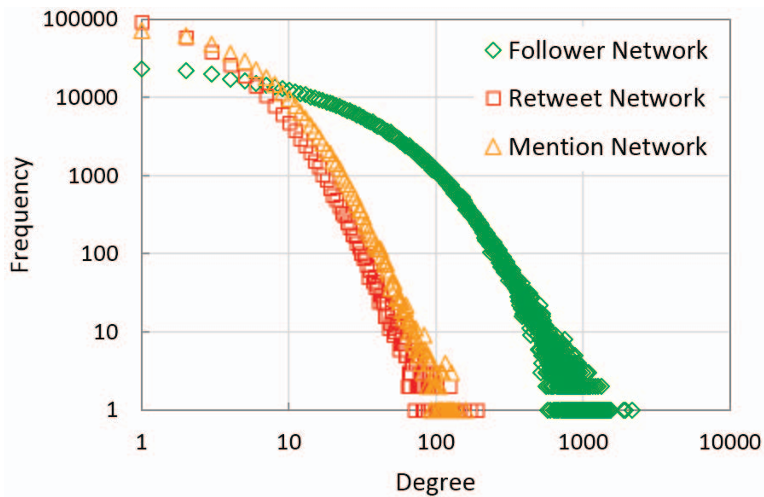
Existing research had a gap: it either focused on link strength (Weak Ties) or theoretical simulations (IC/LT models) that don't always match real-world data. The authors noticed that diffusion networks (who actually retweets whom) look very different from social networks (who follows whom). They set out to find the "hidden relationship" between a node's position relative to communities and its actual capacity to spread information.
Methodology: The Six Faces of Influence
The authors identified six specialized community-aware roles:
- Structural Hole (SH): Nodes that sit between communities.
- Diverse Actor (DA): Nodes connected to many different social contexts.
- Community Bridge (CB): Nodes that act as bridges between multiple groups.
- Opinion Leader (OL): High-status nodes (measured by PageRank).
- Community Core (CC): Nodes at the dense center of a single community.
- Max Influencer (MI): Nodes traditionally identified by influence maximization algorithms.
To measure their power, they introduced the Diffusion Cover Ratio (DCR), which quantifies the percentage of all diffusion pathways (Trees and Paths) that pass through a specific node.
Key Insights: Bridges vs. Cores
The findings challenge some common assumptions in viral marketing:
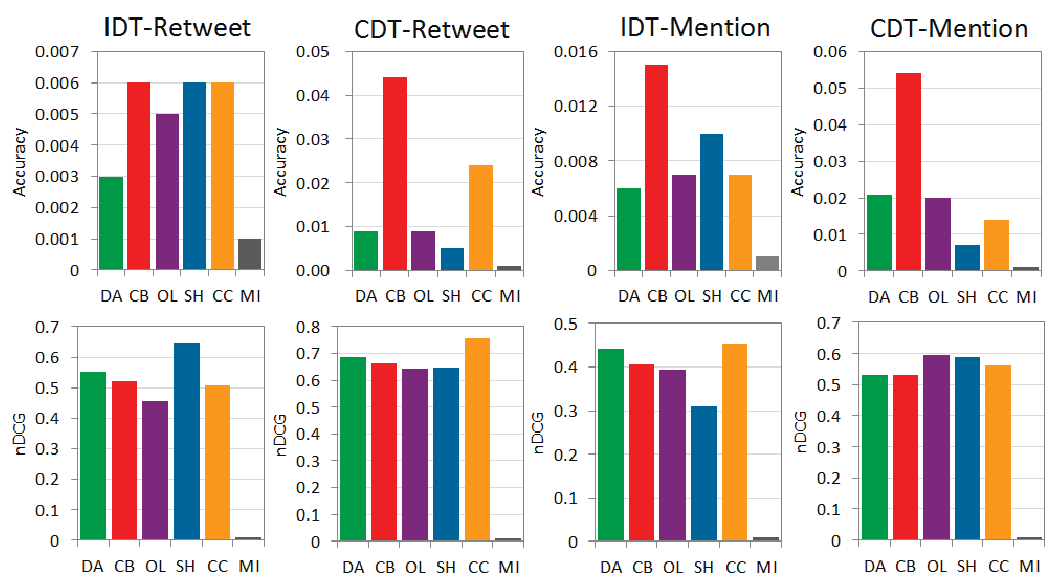
- The Bridge Advantage: Community Bridges (CB) and Diverse Actors (DA) are exposed to the most diverse information. Because they sit at the intersections of social circles, they act as "sensors" for what's trending.
- The Bottleneck Effect: Community Bridges are the undisputed masters of cross-community diffusion. If you want a message to jump from "Tech Twitter" to "Political Twitter," you need these bridges.
- The Core Strength: Conversely, Community Cores (CC) are more effective at within-community diffusion. They are the hubs that ensure a message saturates a specific niche.
- The Failure of Simulation: Interestingly, the "Max Influencers" (MI) chosen by traditional algorithms performed the worst in real-world Twitter data. This suggests that theoretical influence models (like IC/LT) may be oversimplified for real human behavior.
Deep Dive: Predicting the Future of a Hashtag
One of the most impressive feats of this study is the application of Supervised Learning. The authors used node features (like their "Bridge-ness" or "Core-ness") to train models (SVR and RankNet) to identify top diffusers.
The results showed that RankNet could identify top diffusers with ~73% accuracy without ever seeing a single retweet or mention record. This has massive implications for Computational Advertising and Viral Marketing: brands can identify key advocates just by mapping the follower network, significantly reducing the cost of data analysis.
Critical Analysis & Conclusion
Takeaway
This work provides a vital "community-aware" lens to information diffusion. It teaches us that where you are in the community structure is often more important than how many followers you have.
Limitations
The study relies on the Louvain method for community detection. While effective, the authors note that diffusion communities are often more "loose" than social ones, suggesting that communities are dynamic and might shift based on the topic of the information being shared.
Future Outlook
The ability to detect super-diffusers using only structural features opens the door for real-time influence tracking in rapidly evolving networks like TikTok or Mastodon. Future research could investigate if these roles change when the information being spread is a "rumor" versus "innovation."