
RoPE is Provably Broken: Why Your Long-Context LLM is Just Guessing
RoPE Distinguishes Neither Positions Nor Tokens in Long Contexts, Provably
This paper identifies fundamental theoretical limits of Rotary Positional Embeddings (RoPE) in long-context Transformers. It proves that as context length increases, RoPE-based attention becomes unpredictable, leading to a failure to distinguish both positions and token identities, with performance in real-world models like Llama 3.1 dropping to random-guess levels beyond a few thousand tokens.
TL;DR
The dominant method for encoding position in LLMs today, Rotary Positional Embedding (RoPE), contains a theoretical "self-destruct" mechanism. New research proves that as context length grows, RoPE enters a state of chaos where it can no longer distinguish between a token at position 100 and position 10,000, nor can it tell different tokens apart. Increasing the "RoPE Base" (a common industry fix) is merely a "whack-a-mole" strategy—fixing token identification while simultaneously breaking positional logic.
The Illusion of Infinite Context
We are living in an era of "Context Length Inflation." Model providers boast 128K, 1M, or even 10M token windows. However, practitioners often find that these models fail at simple tasks—like retrieving a value from a list—long before the limit is reached.
The researchers behind this paper asked a critical question: Is this an engineering bug, or is the math of RoPE fundamentally flawed? Their conclusion is sobering: It's the math.
The Normal Distribution Insight
The core of RoPE involves rotating 2D segments of query and key vectors at different frequencies. Traditionally, researchers only looked at the "low-frequency" part, which creates the nice property of Locality Bias (nearby tokens get more attention).
This paper introduces a new perspective: they treat the unnormalized attention score as a normal random variable.
- Mean (): Decided by low-frequency terms (the "decay").
- Variance (): Decided by high-frequency terms (the "noise/oscillation").
As the context grows, the variance explodes. The signal-to-noise ratio collapses, leading to four distinct failure modes.
The Four Horsemen of RoPE Failure
1. Position Inversion
RoPE is supposed to favor closer tokens. However, the paper proves that as context grows, the probability that a model "prefers" a distant token over a near one approaches 0.5. It becomes a coin flip.
2. Position Aliasing
Because of limited numerical precision (BF16), two different positions can end up with the exact same attention score. The model literally cannot tell the difference between two locations in the text.
 In the heatmap above, the bright spots represent thousands of "aliasing pairs" where the model treats different positions as identical.
3. Token Inversion
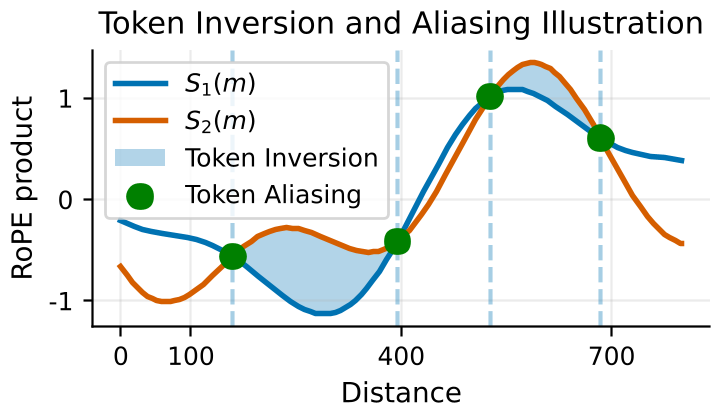
If Token A is more relevant to your query than Token B at distance zero, RoPE can actually reverse this relevance at distance . Relevant information is suppressed while irrelevant noise is promoted.
4. Token Aliasing
At certain distances, swapping one token for a completely different one results in the same attention output. The "meaning" of the token is lost to the math of the rotation.
The "RoPE Base" Trap
The industry standard to "fix" long context is to increase the RoPE Base (e.g., from 10k to 500k). The authors prove this is a trade-off:
- Increasing Base: Helps distinguish tokens better but breaks position identification even faster.
- This explains why "Retrieval" (finding a needle) works in long context, but "Reasoning" (using the needle's location/logic) fails.
Experimental Proof: The Indexing Task
The researchers tested SOTA models (Llama 3.1, Qwen 3, DeepSeek V3) on a simple task: find the value at arr[i] in a list of 4 integers.
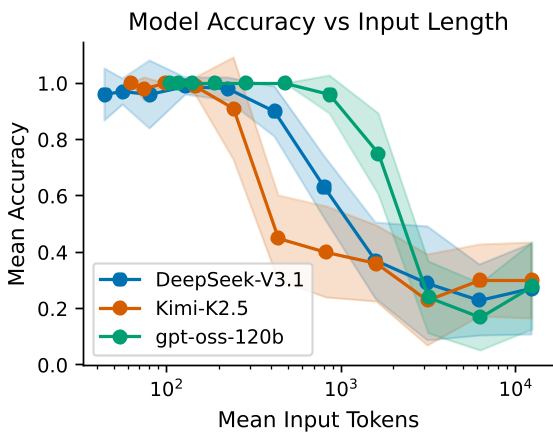
The results are catastrophic. Despite "128K" claim limits, most models' accuracy plummeted to 25% (random guessing) as the list approached only 4,000 to 8,000 tokens.
Conclusion: Beyond RoPE
This paper serves as a "funeral" for the idea that we can simply scale RoPE to infinity. The redundancy of multiple transformer layers and heads provides "limited protection," but the fundamental mechanism eventually yields to entropy.
The Takeaway: If we want true "Million-Token" intelligence that can reason and not just retrieve, we need a new way to tell the model where it is and what it's looking at. The "Rotary" era may be reaching its mathematical limit.