
Rough Set Theory: Mastering Uncertainty in Medical Intelligence
Rough Set Classifications and Performance Analysis in Medical Health Care
The paper proposes a hybrid medical classification framework integrating Rough Set Theory (RST) for feature selection and Neural Networks (NN) for predictive modeling. Utilizing the LEM2 algorithm for data preprocessing and the REDUCT mechanism for dimensionality reduction, the authors achieve high-accuracy classifications across several UCI medical datasets.
TL;DR
The integration of AI into Medical Health Care (MHC) is often hindered by "vague" data—incomplete records or noisy clinical observations. This paper introduces an RST-NN hybrid framework that leverages Rough Set Theory (RST) to identify core diagnostic features and Neural Networks to classify diseases. The result? Accuracies exceeding 98% in critical domains like Breast Cancer and Hepatitis diagnosis.
Contextual Positioning
In the landscape of medical informatics, this work acts as a bridge between Classical Set Theory (which struggles with ambiguity) and Modern Machine Learning. It advocates for a transition from simple data cleaning to "Knowledge-Preserving Preprocessing," positioning RST as a vital tool for Smart Clinical IoT environments.
Motivation: The Problem of Discarded Data
Standard clinical data pipelines often treat missing values as "trash," simply deleting rows that are incomplete. In medicine, this is dangerous. A missing lab result is often as informative as a present one. The authors argue that:
- Dimensionality is too high, leading to the "Curse of Dimensionality."
- Data Loss during preprocessing weakens the model's inductive bias.
- Uncertainty in patient symptoms requires a mathematical framework designed for "granularity."
Methodology: The Core of Rough Sets
The brilliance of Rough Set Theory (RST) lies in its ability to handle Indiscernibility. If two patients have the same symptoms but different outcomes, RST doesn't force a guess; it categorizes knowledge into three regions:
- Lower Approximation (LA): The "certain" positive region.
- Upper Approximation (UA): The "possible" positive region.
- Boundary Region: The area of vagueness where UA ≠ LA.
Architecture Overview
The proposed workflow follows a three-stage pipeline: Preprocessing (LEM2) -> Feature Selection (Reducts) -> Classification (BPNN).
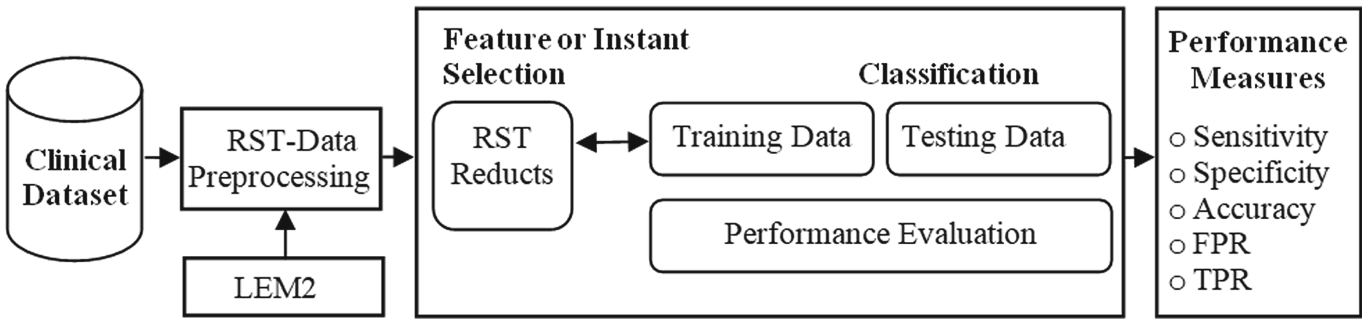
The REDUCT algorithm is the star here. It identifies the "Core"—the minimal set of attributes (symptoms/tests) that provide the same classification power as the full, expensive-to-collect dataset.
Experiments & Results
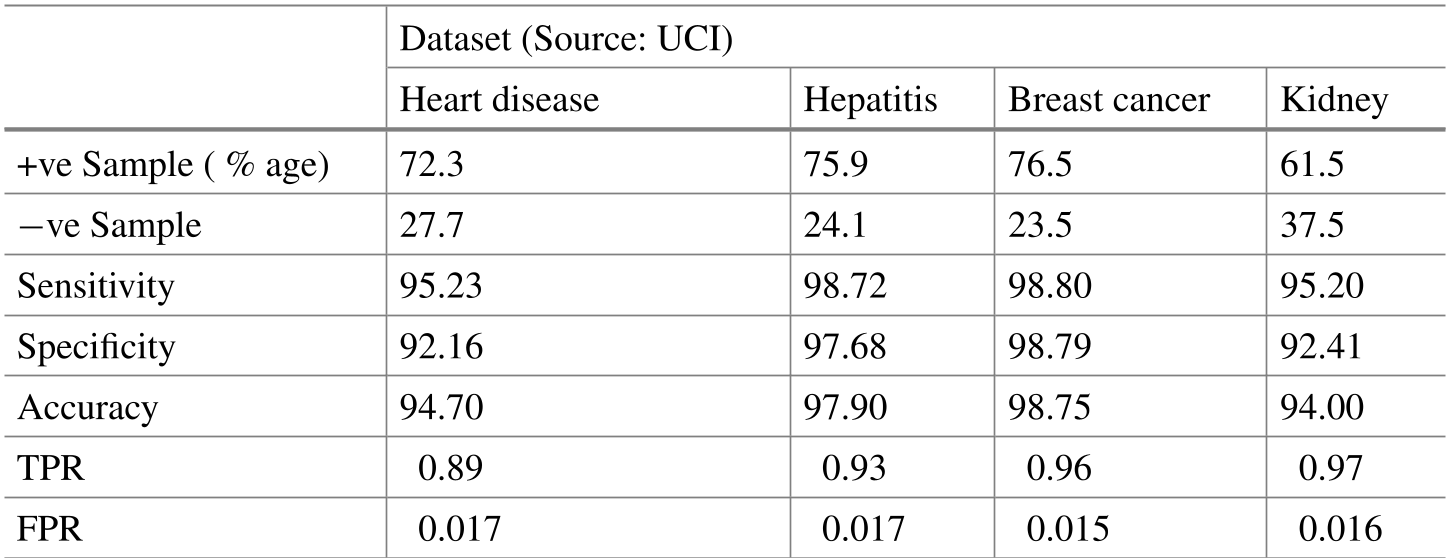
The authors validated their approach using four major UCI Machine Learning Repository datasets. By reducing the attributes to optimized Reducts, the neural network was able to converge faster and more accurately.
Performance Metrics Across Datasets
The results show that the model excels in Sensitivity (identifying the sick), which is the most critical metric in healthcare to avoid "Type II errors" (overlooked danger).
Key Benchmarks:
- Breast Cancer: 98.75% Accuracy.
- Hepatitis: 97.90% Accuracy.
- Heart Disease: 94.70% Accuracy.
The False Positive Rate (FPR) remained remarkably low (around 0.015), ensuring that patients are not subjected to unnecessary, stressful diagnostic procedures.
Critical Insight & Future Outlook
While the paper demonstrates the power of RST, it primarily focuses on discrete or discretized data. The current frontier in medical AI—Radiology and Real-time IoT—requires handling continuous, high-frequency signals.
Takeaway: The "Reduct" philosophy is a precursor to modern Sparse Learning. By focusing on the "Boundary Region" of medical knowledge, we can build AI that doesn't just predict, but understands the limits of its own certainty. Future work should look toward Game-Theoretic Rough Sets to optimize the cost-benefit ratio of clinical tests.
Conclusion
This study proves that by combining the mathematical rigor of Rough Sets with the predictive power of Neural Networks, we can achieve a highly reliable "Clinical Intelligence" that outperforms traditional statistical models.