
Beyond Greedy Forwarding: Balancing Energy and Latency in Mobile Social Networks
Routing protocols for mobile social networks achieving trade-off among energy consumption, delivery ratio and delay
This paper introduces an threshold-based extension for Mobile Social Network (MSN) routing protocols (SCPR, Bubble, and Prophet) to achieve a balanced trade-off among Energy Consumption, Delivery Ratio, and Delay (EC/DR/D). By introducing the ESCPR, EBubble, and EProphet variants, the authors demonstrate that energy efficiency can be significantly improved by avoiding inefficient multi-hop paths.
TL;DR
Mobile Social Networks (MSNs) have long prioritized getting data to its destination at any cost. This paper argues that the "at any cost" approach is killing device batteries. By introducing a simple yet effective threshold mechanism to existing protocols like Bubble Rap and Prophet, the authors demonstrate how to achieve a tunable trade-off between energy consumption, delivery ratio, and delay (EC/DR/D).
The Problem: The "Greedy" Energy Trap
Most MSN routing protocols operate on a Greedy Principle: if you meet a node that is even slightly better than you at reaching the destination, you hand off the message.
While this sounds logical, it often leads to what the authors describe as inefficient routing hops. Imagine a scenario where Node A is 45% likely to deliver a message, and it meets Node B, which has a 46% likelihood. In a greedy system, Node A passes the message to B. However, this one-percent gain costs the network energy for transmission and discovery, and might actually lead to a longer path if a 90% likely node was just around the corner.
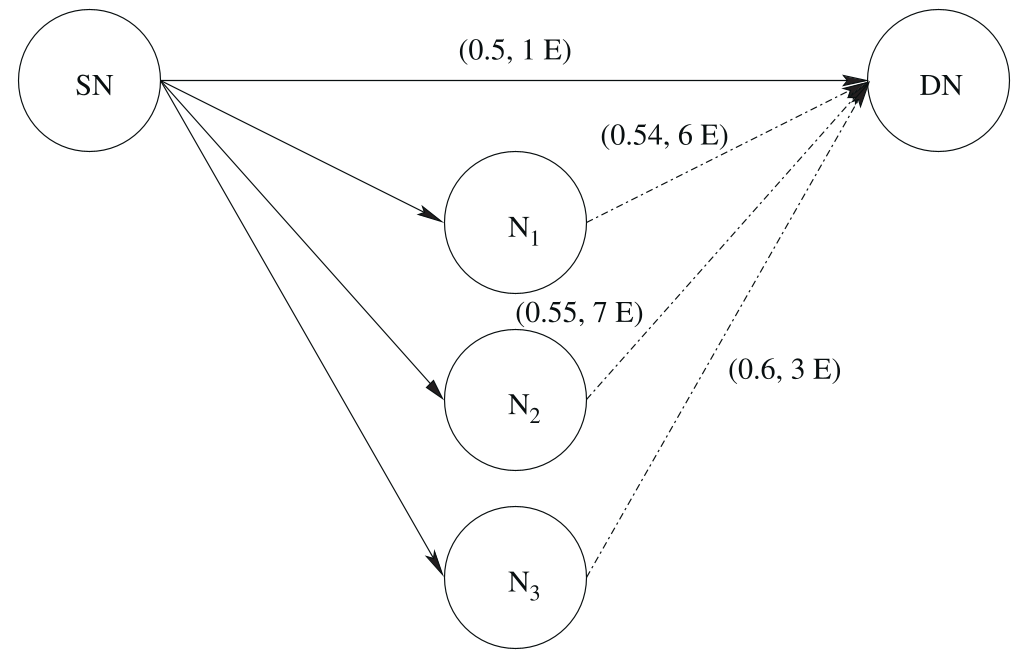 Fig 1: The greedy approach often chooses "Route 2" because is encountered first, despite it being less efficient than the direct path or higher-probability alternatives.
Methodology: The Power of the Threshold ()
The authors propose an elegant solution: Conditional Forwarding. Instead of forwarding whenever , a node only forwards if:
Where:
- : Delivery probability of the current carrier.
- : Delivery probability of the encountered node.
- : The control threshold.
By adjusting , the protocol can be tuned:
- : The standard "Greedy" approach (High delivery, High energy).
- : "Direct Delivery" only (Low delivery, Lowest energy).
- Intermediate values: The "Sweet Spot" for real-world applications.
The authors applied this logic to three pillars of MSN routing: SCPR (Social Contact Probability), Bubble Rap (Social Hierarchy), and Prophet (Probabilistic Routing).
Experimental Insights
Using a community-assisted mobility model, the researchers simulated 150 nodes over a 30-day period. The results reveal a clear Pareto frontier between energy and performance.
1. The Energy-Delay Relationship
As the threshold increases, the average energy per packet drops significantly. However, this comes at the cost of "Average Delay." In ESCPR (Extended SCPR), the energy consumption shows an approximately exponential decrease as delay increases.
2. The Curious Case of EProphet
Perhaps the most surprising finding was in the EProphet protocol. Usually, we expect a trade-off (improving one thing hurts another). However, for EProphet, increasing the threshold from 0 to 0.02 improved all metrics: higher delivery ratio, lower delay, and lower energy. This proves that the original Prophet's greedy nature was actively choosing "bad" routes that were both slow and energy-expensive.
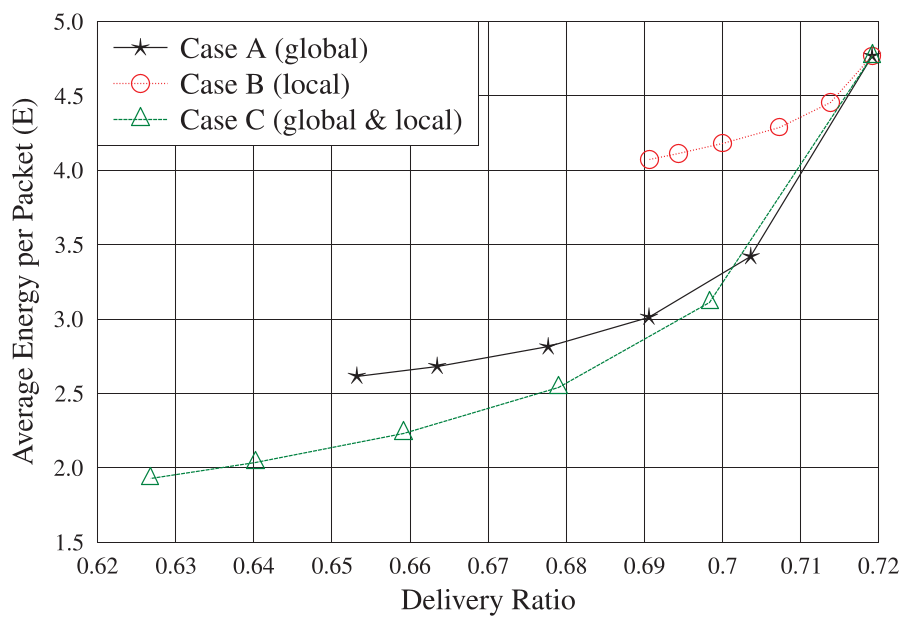 Fig 2: Performance of the EBubble protocol across different cases, showing the impact of thresholds on the Energy-to-Delivery ratio.
Critical Analysis & Conclusion
Takeaway
This work demonstrates that "more hops" do not always equal "better delivery." In decentralized, intermittent networks like MSNs, being "picky" about who you forward to (via a threshold) is a necessary survival strategy for battery-powered devices.
Limitations
The study assumes a constant energy cost per packet transmission. In reality, energy consumption varies based on signal strength, interference, and retransmission attempts. Furthermore, the "optimal" threshold is likely dynamic, varying as the network density changes.
Future Outlook
The next step for this research involves Adaptive Thresholding. Instead of a fixed set by a human, models could use local context—like remaining battery percentage or current network congestion—to dynamically adjust the forwarding threshold in real-time.