
Selective Trust: Navigating the Privacy-Utility Balance in Rumor Propagation
A rule-based policy language for selective trust propagation in social networks
The paper introduces a rule-based policy language for "Rumor Propagation" in Online Social Networks (OSNs). It leverages the outcome of past trust negotiations (virtual edges) to facilitate future access control decisions while allowing users to selectively disclose these interactions to their neighbors.
TL;DR
In the world of Online Social Networks (OSNs), a "rumor" isn't just gossip—it's valuable metadata about past successful trust negotiations. This paper presents a formal rule-based language that allows users to selectively propagate these rumors to their friends. By doing so, they help their network discover reliable nodes while maintaining strict privacy via a dual-policed enforcement mechanism.
Context: Why "Rumors" Matter
When Alice successfully accesses a private resource from Bob, a "virtual edge" is created representing their mutual trust. In a blind network, Charlie (Alice's friend) has no idea Bob is a reliable source for that resource. If Alice could "spread the rumor" of this success to Charlie, Charlie could navigate the network more efficiently.
However, the Problem is twofold:
- Privacy: Alice might not want her colleagues to know she’s interacting with Bob.
- Noise: Broadcasting every interaction "vibration" would overwhelm the network and reveal sensitive access control logic.
The Methodology: Granular Control
The authors solve this by introducing a Policy Language based on three pillars:
- Propagation Conditions: Constraints on the graph (e.g., "only share with nodes that have a trust level > 0.7").
- History Conditions: Logic based on past events (e.g., "only share if the recipient has also accessed resource X").
- Dual-Party Consent: For a rumor to spread, it must pass Alice's Propagation Set and Bob's Limitation Set.
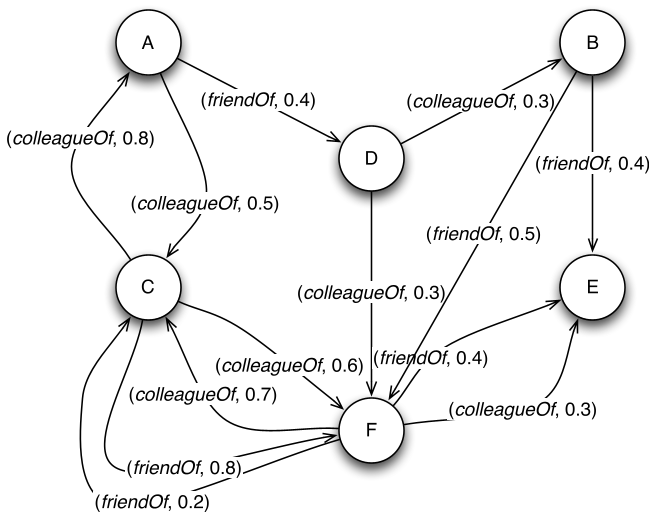 Figure 1: Visualizing the OSN as a labeled graph where edges represent trust levels and relationship types.
Hierarchical Logic & Conflict Resolution
To prevent policy management from becoming a nightmare, the system uses a hierarchy:
- Default Rules: General preferences.
- Class-level Rules: Exceptions for types of resources (e.g., "Work Documents").
- Instance-level Rules: Specific overrides for a single file.
The algorithm employs a "Most Specific First" priority, ensuring that a rule for a specific file always overrides a general "allow all" default.
Experimental Insight: Efficiency at Scale
A critical concern for any social network algorithm is computational overhead. The authors demonstrate that their Limitate function is remarkably efficient.
 The complexity is formally derived as , meaning the time to decide who receives a rumor grows linearly with the number of your friends and the number of rules you’ve set.
Critical Analysis & Future Outlook
Strengths: This work moves away from "post-hoc" rumor control (trying to kill a leak after it happens) to a "proactive" source-control model. It respects the sovereignty of both the resource owner and the requester.
Limitations: Currently, the model only supports "one-hop" propagation (direct neighbors). In a real-world scenario, trust often needs to travel through chains (friends of friends). The authors acknowledge this, noting that multi-hop propagation introduces significant complexity regarding "trust decay" and rule-forwarding overhead.
Conclusion: As OSNs move into professional and governmental spheres, the "share everything with everyone" paradigm is dead. Languages like the one proposed here are the blueprint for a more mature, privacy-aware social web where information spreads with purpose, not by accident.