
RRPSN: Empowering Users with Rule-Based Personalized Social Recommendations
A Rule-Based Recommendation for Personalization in Social Networks
The paper introduces RRPSN (Rule-based Recommendation for Personalization in Social Networks), a framework that allows users to explicitly define or implicitly mine personalized recommendation strategies using logical rules. It moves beyond "one-size-fits-all" uniform strategies by employing a reasoning mechanism to resolve rule conflicts and generate tailored recommendations.
TL;DR
Social recommendation systems often suffer from a "black-box" approach where a single algorithm is applied to everyone. RRPSN (Rule-based Recommendation for Personalization in Social Networks) breaks this mold by allowing users to define their own recommendation logic through a series of if-then rules. By transforming user preferences into executable atomic rules and resolving conflicts through specialized algorithms like RTG (Rule Table Generating), the system achieves higher precision and transparency compared to traditional uniform strategies.
The "Strategy Gap" in Social Networks
Most current recommendation engines assume that if two users share a hobby or a friend, they should be connected. However, this ignores Strategy Preference.
- User A might only want recommendations based on deep mutual interests.
- User B might prefer recommendations based on popular social activity or geographical proximity.
Current SOTA methods focus on optimizing the accuracy of a fixed strategy but fail to give the user the "steering wheel" to choose the strategy itself. This paper addresses the lack of programmability and explainability in personalized social discovery.
Methodology: From Natural Language to Executable Logic
The RRPSN framework follows a sophisticated pipeline to turn vague human preferences into mathematical scores.
1. The Multi-Layered Social Graph
The system models social networks as a directed, weighted graph , which is further split into specialized subgraphs like , , and . This allows rules to target specific types of relationships.
2. The Rule Pipeline
- Initial Rules: Natural language preferences (e.g., "Recommend popular users").
- Atomic Rules: Quantified logical expressions (e.g.,
if in_degree(v) > 0.6, then score = in_degree(v)/max_degree). - Conflict Resolution: When multiple rules apply, the system uses strategies like Strict-Match (merging conditions) or Loose-Match (prioritizing simpler rules) to build a consistent Rule Table.
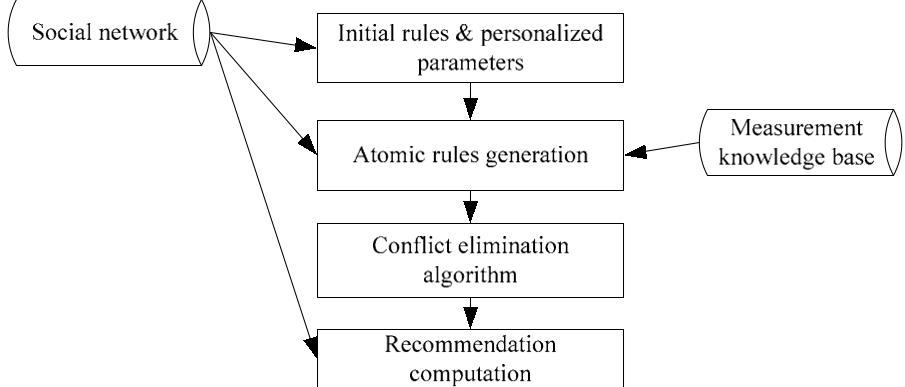 Figure 1: The RRPSN framework, showing the progression from user preferences to final recommendations.
The RTG Algorithm: Solving Logic Conflicts
A core contribution is the Rule Table Generation (RTG) algorithm. In a complex social environment, rules often overlap or contradict.
- Loose-Match (RTG-1): Resolves conflicts by selecting the rule with the minimum number of conditions, assuming broader rules are safer.
- Strict-Match (RTG-2): Creates a new, composite rule by logically conjoining the conditions of all overlapping rules and averaging their recommendation values.
Experimental Validation: The Speed Dating Test
The authors tested RRPSN on a real-world Speed Dating dataset (539 nodes, 8078 edges). The experiment introduced a personalization parameter , representing the weight of the user's custom rules versus a global uniform strategy.
Key Findings:
- Personalization Wins: As (the personalization weight) increased from 0 to 1, the average precision of the system rose significantly.
- Stability: Unlike uniform strategies which peaked and then fluctuated based on attribute weights (), the personalized strategy () remained robustly superior once key features were identified.
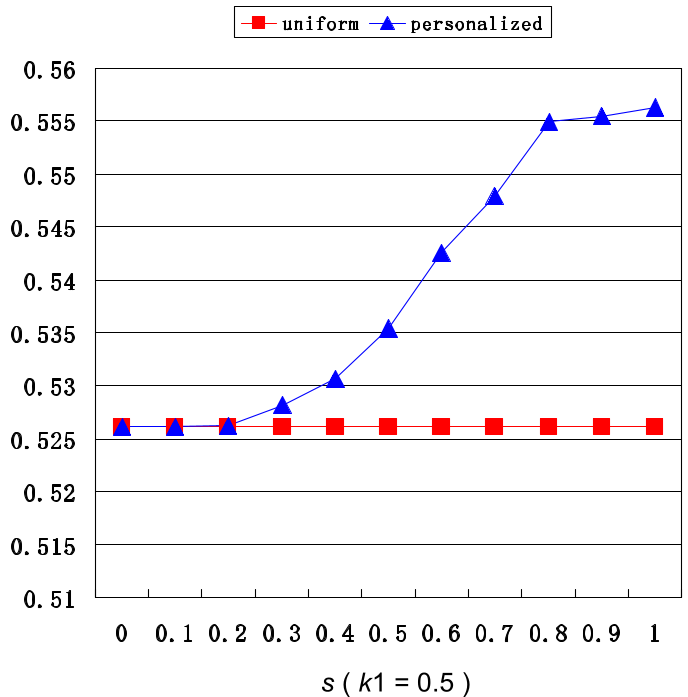 Figure 2: Performance comparison showing that increased personalization () leads to higher precision.
Critical Analysis & Takeaways
The strength of RRPSN lies in its transparency. By using a rule-based approach, the system provides an inherent "justification" for every recommendation—answering the "Why?" that plagues many deep learning models.
Limitations:
- Rule Fatigue: Manually setting rules might be burdensome for average users.
- Scalability: The computational complexity of the RTG algorithms in extremely dense networks with thousands of rules per user needs further exploration.
Future Outlook: The integration of this rule-based approach with modern Graph Neural Networks (GNNs) could combine the powerful representation learning of GNNs with the explicit control and explainability of RRPSN.