
Geosocial SPLIS: Bringing Dynamic Rule-Based Intelligence to Social Maps
Using Rules to Develop a Personalized and Social Location Information System for the Semantic Web
This paper presents "Geosocial SPLIS," a context-aware location-based social networking service (LBSNS) that integrates Semantic Web technologies. It enables users and POI owners to define personalized preferences and marketing offers using a rule-based framework (RuleML and Jess) mapped to the schema.org ontology.
TL;DR
Geosocial SPLIS is a next-generation social networking service that moves beyond simple "check-ins." By combining Semantic Web ontologies (schema.org) with dynamic rule engines (Jess/RuleML), it allows users to program their own preferences (e.g., "Find me a quiet cafe if it's Sunday morning") and matches them with real-time business offers and friend locations.
Academic Positioning: This work bridges the gap between static expert systems and dynamic social media, transforming users from passive data consumers into active knowledge creators within a Recommender System (RS) framework.
The Bottleneck: The "Developer-Defined" Trap
Most personalization engines suffer from the "Frozen Logic" problem. Developers hard-code rules like If User=Student, Then Discount=10%. This approach is brittle; it can't scale to the infinite nuances of human preference or the rapid change of local business environments.
The authors argue that for a Location-Based Service (LBS) to be truly "intelligent," the knowledge base must be dynamic and decentralized. The challenge lies in allowing non-technical users to write complex logic without breaking the underlying system.
Methodology: Rules as Social Currency
The core innovation of Geosocial SPLIS is its Runtime Rule Integration.
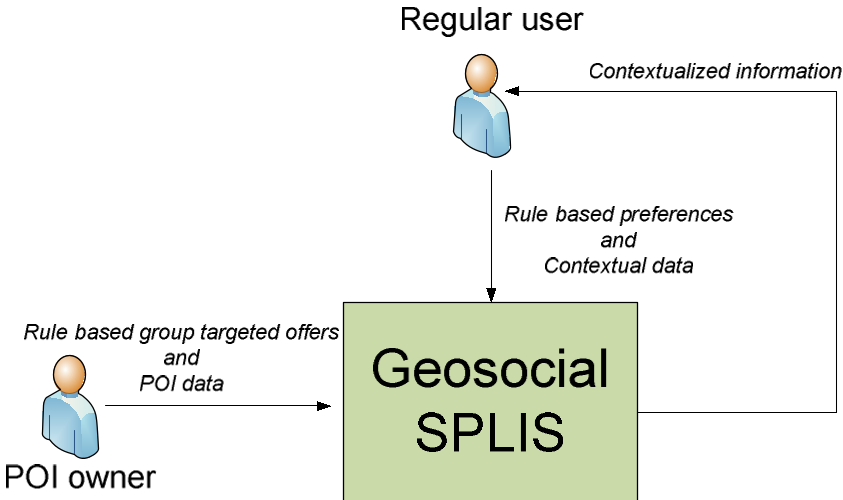
1. The Architecture
The system utilizes a multi-layered stack:
- Data Layer: Uses Sesame (an RDF triple store) to store POI data and user profiles compliant with schema.org.
- Logic Layer: Converts user-inputted forms into RuleML (for interoperability) and then into Jess (for high-speed execution).
- Context Engine: Automatically pulls variables like weather, time, and GPS coordinates to evaluate rules on the fly.
2. User-Driven Knowledge Creation
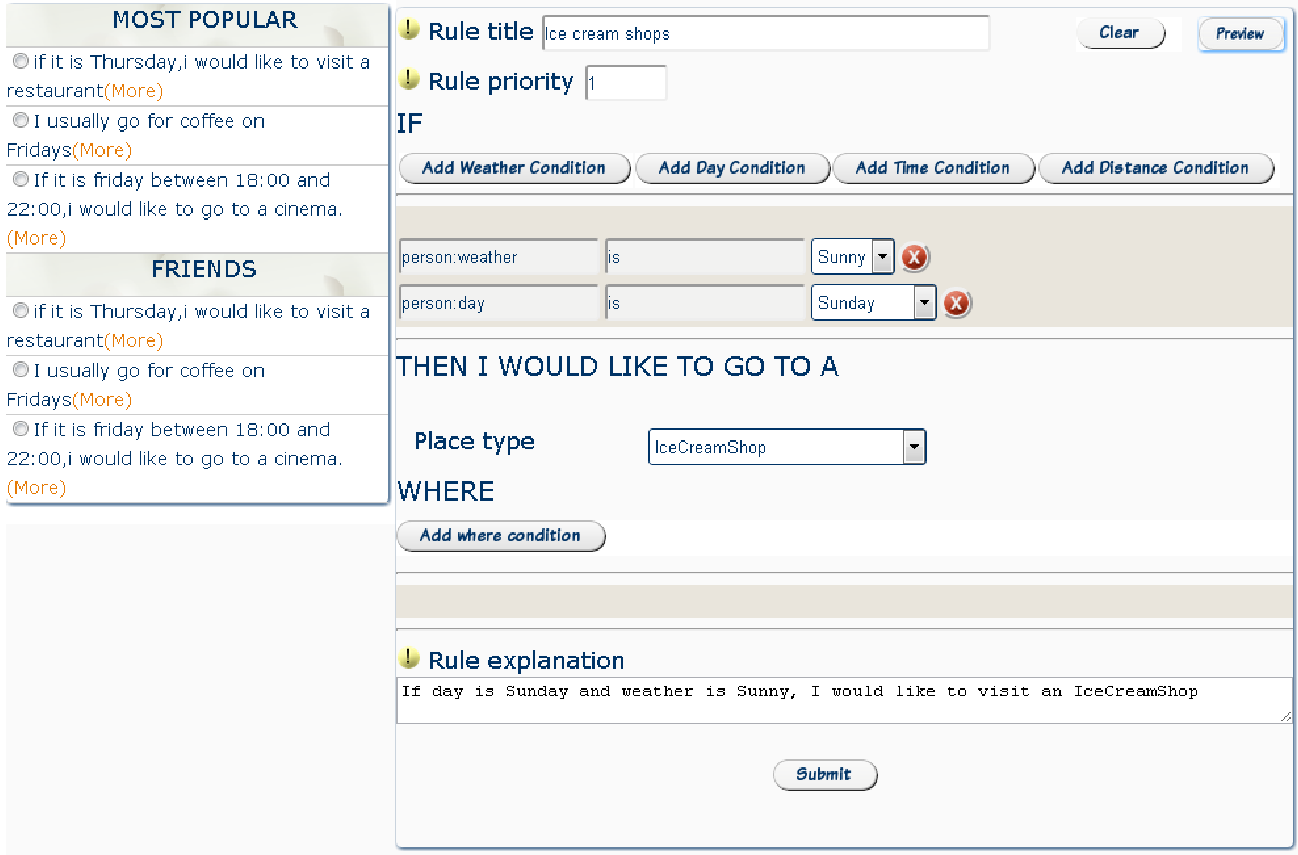
Instead of writing code, users utilize a "Condition-Operator-Value" editor. For example, a user can define:
IF Day is Sunday AND Weather is Sunny THEN I want an IceCreamShop.
This rule is immediately usable by the engine to filter the map view.
Experiments & Social Dynamics
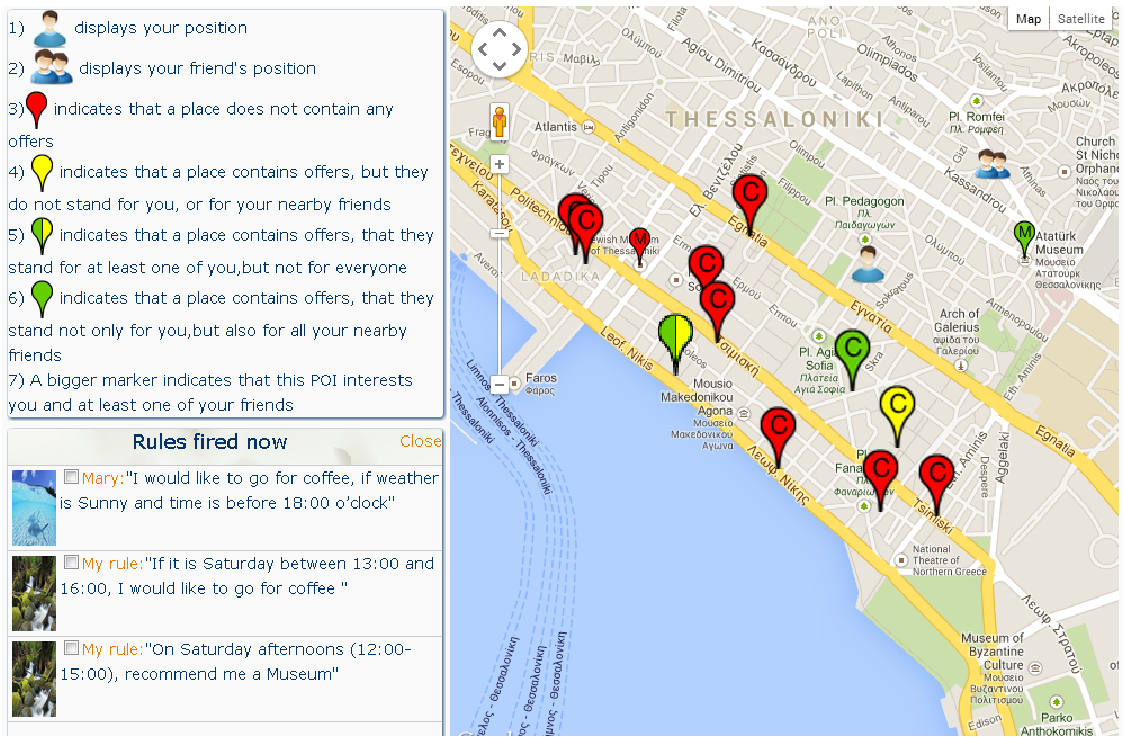
The researchers evaluated the system's "Nearby Friends" mode. In this scenario, the system doesn't just look for individual matches; it performs a joint logic intersection.
- Collaborative Filtering 2.0: If John wants coffee and Mary wants coffee, and a nearby cafe has a "Group Discount," the marker on the map grows larger and changes color (e.g., to green), signaling a "Perfect Match" for the group context.
- Validation: 98% of surveyed users would recommend the system, highlighting that the interface successfully masked the complexity of the underlying Semantic Web logic.
Critical Insight: The Power of Interoperability
By adopting schema.org and RuleML, Geosocial SPLIS ensures that the rules created by its users aren't trapped in a silo. These rules can theoretically be exported and understood by other Semantic Web applications (like Google or Bing), paving the way for a "Global Preference Layer" across the internet.
Limitations & Future Work
While the form-based editor is efficient, it still requires manual effort. The next frontier involves using Natural Language Processing (NLP) to allow users to speak their preferences, which the system then automatically serializes into Jess rules. Additionally, moving from a centralized triple store to a decentralized "Personal Data Store" approach could enhance privacy.
Conclusion
Geosocial SPLIS proves that rule-based systems aren't obsolete in the age of AI. When combined with social networking and user-generated logic, they provide a transparent, explainable, and highly precise alternative to "Black Box" recommendation algorithms.