
Fighting Fire with Metadata: The Power of Boost Nodes in Rumor Correction
Rumor correction maximization problem in social networks
This paper introduces the Rumor Correction Maximization (RCM) problem, which aims to maximize the number of "corrected" users in a social network by strategically deploying truth seed nodes and boost nodes (individuals who facilitate spread without being primary adopters). The authors propose the Boosting Independent Cascade (BIC) model and provide the Sandwich Approximation (SA) algorithm to solve this NP-hard, non-submodular optimization problem.
TL;DR
Social networks are breeding grounds for rumors. While traditional methods focus on "planting truth seeds" or "blocking users," this paper suggests a more nuanced approach: Boosting. By targeting users who pre-sensitize the network to the truth, we can maximize rumor correction even when the underlying objective function is mathematically "misbehaved" (non-submodular).
The Core Insight: Seeds vs. Boosters
In viral marketing, there is a distinct difference between giving a user a free product (Seed) and giving them a leaflet (Booster). A seed user becomes an active advocate immediately. A boosted user doesn't adopt yet but is primed—if a friend later mentions the product, they are much more likely to switch.
The authors translate this to Rumor Correction. If a rumor has already swept through a network, "Correction Nodes" (Truth seeds) are expensive. "Boost Nodes" are cheaper, helping the truth propagate through infectious regions with higher probability.
The Mathematical Headache: Non-Submodularity
Most influence maximization (IM) problems rely on submodularity (the law of diminishing returns). However, adding boost nodes breaks this property. In the proposed Boosting Independent Cascade (BIC) model, adding a boost node might actually increase the marginal gain of other nodes, creating a "synergy" that submodular functions cannot represent.
Furthermore, calculating the expected number of corrected nodes is #P-hard, and finding the optimal set is NP-hard.
Methodology: The k-PRR Graph and the Sandwich
To tackle this, the authors introduce a new data structure: the k-Potentially Reverse Reachable (k-PRR) graph.
- k-PRR Graph Architecture: Unlike standard RR sets that only track reachability, k-PRR graphs track paths that could become active if a certain number of boost edges (up to ) are activated.
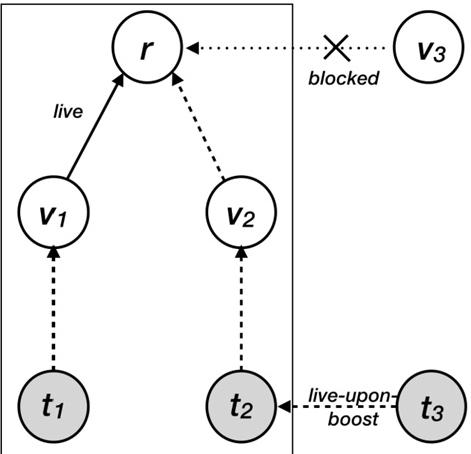
- Sandwich Approximation (SA): Since the objective is hard to optimize, the authors find:
- A submodular Lower Bound ()
- A submodular Upper Bound ()
By running a greedy algorithm on both bounds using Reverse Influence Sampling (RIS), they "sandwich" the optimal solution, guaranteeing a data-dependent approximation ratio.
Experimental Validation
The researchers tested their approach against 282K-node networks. The results were clear:
- Seed Selection: Their algorithm reached the desired correction threshold with fewer seeds than standard IM techniques.
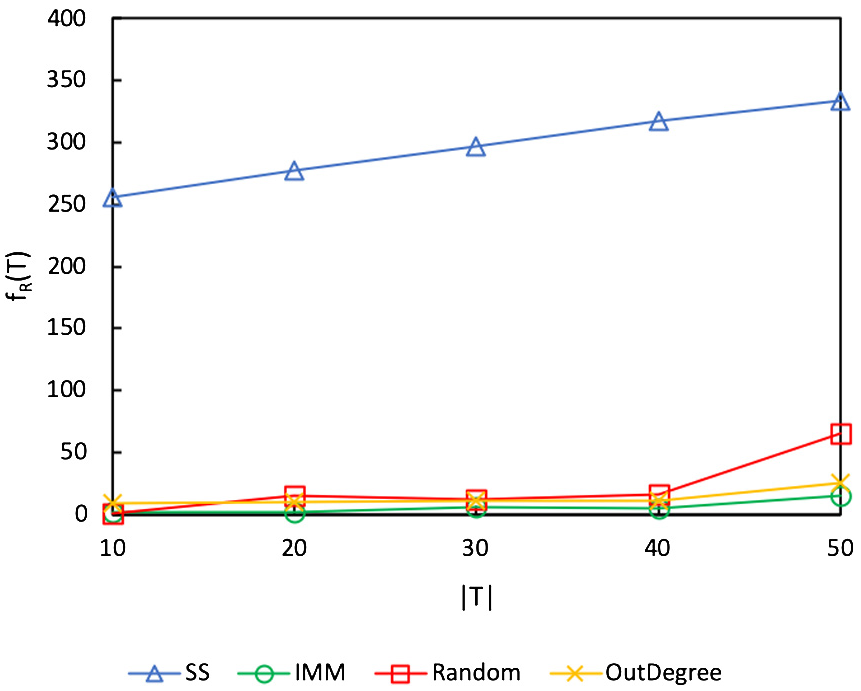
- Boost Performance: The SA algorithm consistently outperformed OutDegree and Random selection, proving that "who" you boost matters as much as "how many" you boost.
Critical Perspective
While the paper provides a rigorous theoretical framework, it makes a key assumption: the rumor propagation has already "terminated" before correction begins. In real-world scenarios, rumors and truths often spread simultaneously. Future research should look into Dynamic RCM, where seeding and boosting happen while the rumor is still live.
Additionally, the "boost" effect (modeled as an increased probability ) is assumed to be known. In practice, estimating how much a "leaflet" or a "social media ad" increases adoption probability remains a difficult sociological challenge.
Conclusion
This work moves beyond the "binary" view of rumor containment. By formalizing the RCM problem, it provides a mathematically sound way to utilize "weak influencers" (Boosters) alongside "strong influencers" (Seeds) to sanitize social ecosystems.