
HSA-BLSTM: Navigating the Hierarchy of Social Misinformation through Attention
Rumor Detection with Hierarchical Social Aention Network
The paper introduces HSA-BLSTM, a Hierarchical Social Attention Bidirectional LSTM network designed for microblog rumor detection. It treats rumor events as a multi-level structure (word, post, and subevent) and integrates hand-crafted social features directly into the attention mechanism to achieve SOTA accuracy and superior early detection performance.
TL;DR
Rumor detection on social media is a race against time. This paper presents HSA-BLSTM, a hierarchical neural network that mimics human investigative behavior by looking at words, posts, and sub-events simultaneously. By fusing Social Features (like user credibility and sentiment) directly into the Attention Mechanism, the model reaches a staggering 94.3% accuracy on Weibo and provides robust early detection capabilities, identifying rumors long before they go viral.
Background & Positioning
In the landscape of rumor detection, we have moved from manual feature engineering (Decision Trees/SVMs) to deep sequence models (GRU/LSTM). However, standard RNNs treat a stream of comments like a flat sentence. This paper, published at CIKM '18, positions itself as a structural bridge: it acknowledges that social media data is hierarchical and that the social context (who is talking and how) is just as important as the raw text.
The Problem: Why Flat Models Fail
Traditional models suffer from "Information Dilution." In an event with 1,000 comments, only a handful—such as those questioning the source or expressing extreme skepticism—carry the "DNA" of rumor debunking. Flat RNNs struggle to maintain this focus over long sequences. Furthermore, semantic information alone is insufficient; a suspicious post from an unverified user with zero followers should be weighted differently than a post from a reputable news outlet.
Methodology: Hierarchical Social Attention
The core innovation is a three-tier architecture that processes information from the ground up:
- Word Level: Uses Bi-LSTM to encode local semantics.
- Post Level: Aggregate word representations into post vectors. Here, the model introduces Social Attention. Instead of just looking at word importance, it uses global social features (User Profile, Propagation patterns) to decide which posts deserve more "weight."
- Subevent Level: Groups posts into time-based subevents to capture the evolution of the story.
Model Architecture
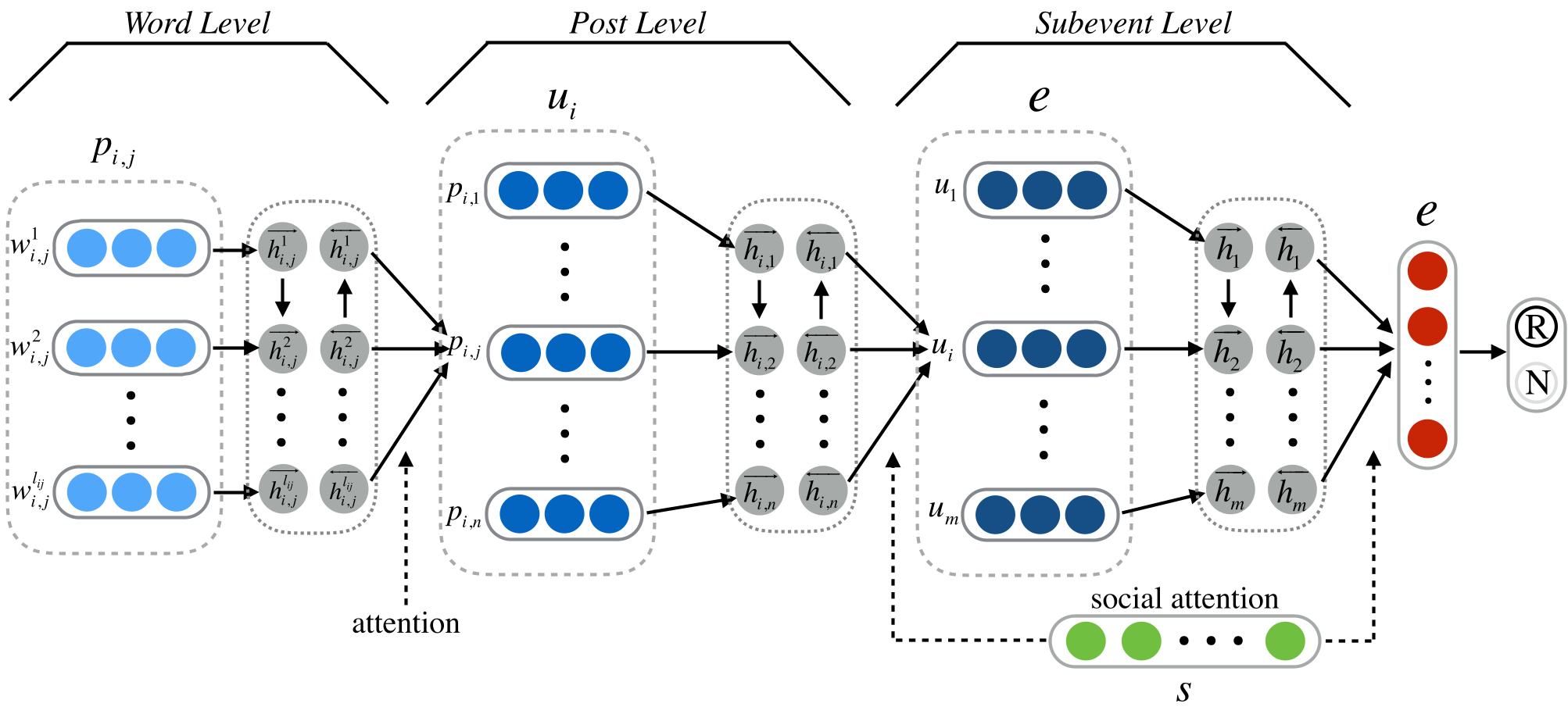 Figure 1: The hierarchical structure from word to subevent, showing the integration of social features into the attention layers.
The social features used (Table 1 in the paper) include 22 distinct measures across user profiles (reputation, verification), propagation (reposts, comments), and text statistics (sentiment, use of punctuation like '?' and '!').
Experimental Breakthroughs
The model was tested against state-of-the-art baselines like ML-GRU and CallAtRumor.
SOTA Performance
HSA-BLSTM outperformed all competitors across two major datasets:
- Sina Weibo: 94.3% (vs. 88.7% for the best baseline).
- Twitter: 84.4% (vs. 80.4% for the best baseline).
The "Golden Hour": Early Detection
The most impressive result is the model's performance in the early stages of a rumor. In real-world applications, we need to stop a rumor within the first few hours.
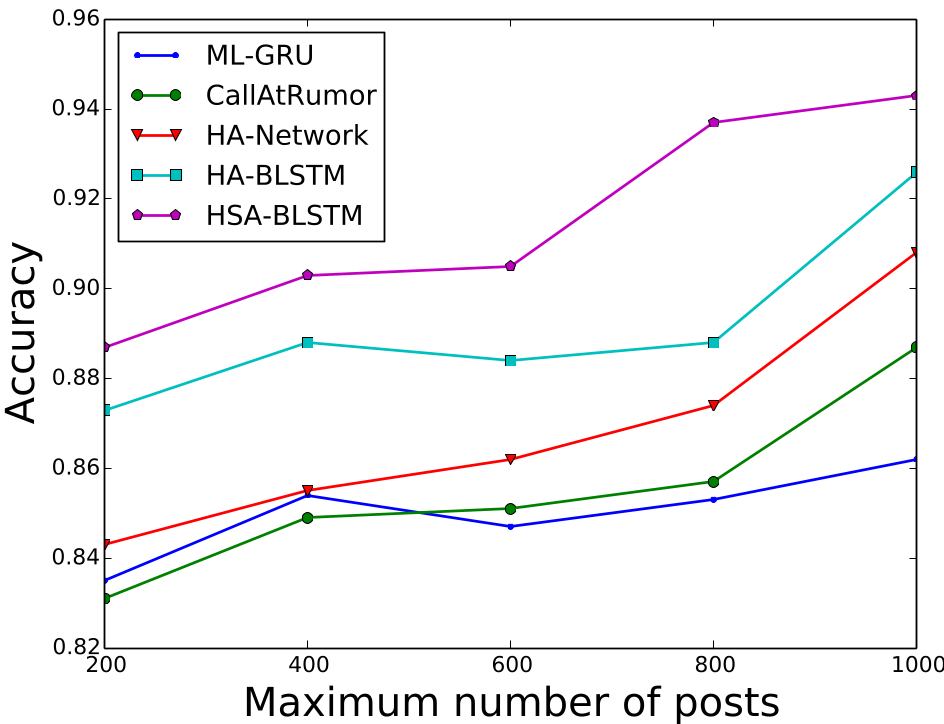 Figure 2: Performance on Weibo as the number of available posts increases. HSA-BLSTM (top line) achieves high accuracy much faster than other models.
Critical Insights: The Power of Doubt
Through attention visualization (Figure 3), the authors found that the model naturally gravitates toward words and posts that represent verification requests or skepticism. While a rumor might contain sensationalist words, the "Social Attention" learns to ignore the noise and focus on the community's collective doubt—the strongest indicator of a rumor.
Summary and Limitations
HSA-BLSTM proves that hierarchy and context are the two pillars of social media understanding. By embedding social metadata into the attention mechanism, the model doesn't just "read" the text; it "understands" the environment.
Limitations: While powerful, the model relies on hand-crafted social features which may change as platform algorithms evolve. Future work could involve end-to-end learning of propagation graphs (GNNs) to replace these manual features.