
Rumor Logic: Why Expert Lag Time Creates Unpredictable Social Chaos
Rumor model on homogeneous social network incorporating delay in expert intervention and government action
This paper proposes a computational mathematical model for rumor dynamics on a homogeneous social network, specifically incorporating time delays in expert intervention and government action. By utilizing epidemiological modeling techniques, the researchers establish the "Basic Influence Number" () to determine SOTA conditions for rumor extinction or persistence.
TL;DR
Rumors spread like viruses, but their "cure" (expert debunking) isn't instantaneous. This paper introduces a mathematical model that accounts for the time delay in expert reactions and government policies. It discovers a "tipping point" (Hopf Bifurcation): if experts wait too long to intervene, rumor levels don't just stay high—they become wildly unpredictable and oscillatory.
Problem & Motivation: The Cost of Hesitation
In the digital age, a rumor can circle the globe before the truth has even put on its shoes. Most existing models treat social networks as "static" or assume that once an expert speaks, the rumor begins to die.
The authors argue that this is unrealistic. There is a latent period where:
- Experts are analyzing the news.
- The government is formulating a policy.
Why does this matter? Because in a network, delay isn't just a pause; it’s a parameter that can change the fundamental physics of the system.
Methodology: The Framework
The researchers categorize the network into three distinct classes:
- (Susceptibles): Users unaware of the rumor.
- (Experts): Users who know the truth and actively fight the rumor.
- (Influenced): Users who have adopted and are spreading the rumor.
The Governing Equations
The model uses a system of delayed differential equations. A key innovation is the Network Alertness Coefficient (), which decreases the transmission rate as the rumor becomes more "viral"—a form of social immunity.
 The system of equations (1-3) defining the interactions between susceptibles, experts, and the influenced.
The paper defines the Basic Influence Number (): If , the rumor dies. If , it persists. But with delay (), the stability of that "persistence" is thrown into question.
The "Critical Value" of Delay
The most striking finding is the Hopf Bifurcation. The authors prove that there is a critical delay value ().
- Below Critical Delay: The network reaches a "Stable Endemic State" (the rumor stays at a constant, manageable level).
- Above Critical Delay: The system loses stability. The population of rumor-spreaders begins to oscillate in waves, making it impossible to predict the social state or secure data.
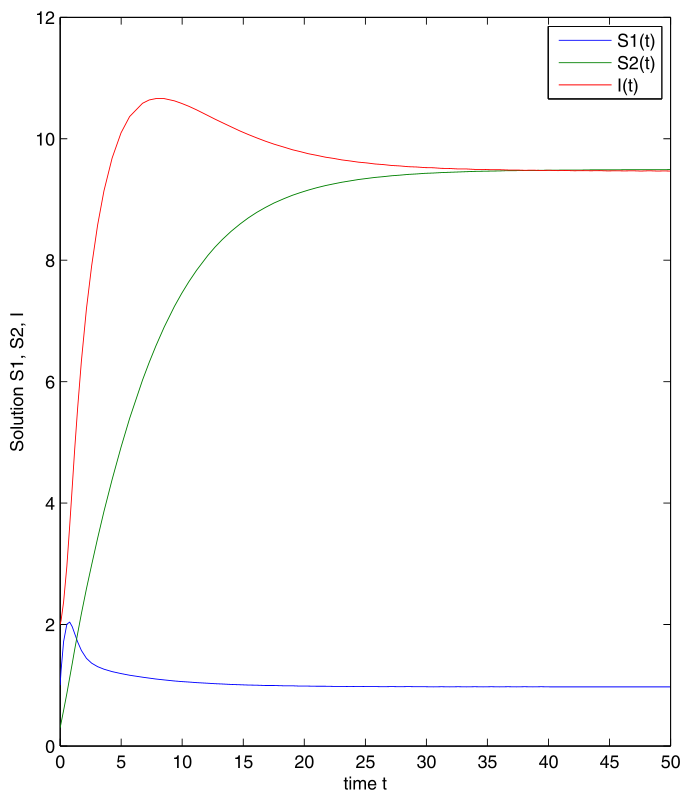 Fig 4 & 5: When delay exceeds the threshold, the steady state (left) transforms into chaotic oscillations (right).
Experiments & Sensitivity Analysis
The authors conducted sensitivity indices to see which "lever" moves the needle the most.
- Transmission Rate (): Positive 1.0 index (The more "viral" the rumor is designed to be, the harder grows).
- Expert Interaction (): Negative 0.86 index (Increasing expert activity is the most potent weapon against the rumor).
- Government Recovery (): Significant role in expanding the "Stability Region," effectively buying experts more time.
 Table 3: Sensitivity Indices showing how each parameter impacts the spread.
Critical Insight & Conclusion
Takeaway
The paper proves that the "truth" is not enough to stop a rumor if it arrives too late. The effectiveness of experts is bound by a mathematical deadline. Once that deadline () passes, the social network enters a state of unpredictability that no amount of government policy can easily fix.
Limitations
The study assumes a homogeneous population, meaning it treats everyone as equally connected. In reality, "Super-spreaders" or "Influencers" create high-degree nodes that would likely make the critical delay even shorter and the bifurcation more violent.
Future Work
The logical next step is to apply this "Delay Logic" to heterogeneous networks or multi-layered social platforms where experts on one platform might have different delay times than those on another.