
Unmasking the Trolls: A Bayesian Approach to Rumor Detection in Social Networks
Rumor Propagation Detection System in Social Network Services
This paper presents a Rumor Propagation Detection System specifically designed for Social Network Services (SNS) like Twitter. It leverages a Bayesian Network classifier integrated with account-based, content-based, and a novel propagation-based feature set to identify malicious accounts spreading rumors, achieving a SOTA-level accuracy of 91.94% and an F-measure of 93.76%.
TL;DR
Social Network Services (SNS) have become a double-edged sword: they facilitate rapid information sharing but also act as a breeding ground for malicious rumors. This paper proposes a high-accuracy detection system utilizing Bayesian Networks. By analyzing account behavior, content patterns, and unique "propagation" features (like edited retweets), the authors achieved a 91.94% accuracy in distinguishing rumor-mongers from legitimate users.
Problem & Motivation: Why Current Filters Fail
Most existing anti-spam systems are designed to catch commercial "junk" mail—links to pharmacies or phishing sites. However, rumors are different. Rumors often:
- Persist longer than general news.
- Spread through unconnected individuals rather than established friendship clusters.
- Exploit mass psychology by mimicking credible sources through edited retweets.
Traditional detectors often overlook these structural nuances. The authors identified a need for a system that doesn't just look at what is being said, but how it spreads through the network graph.
Methodology: The Bayesian Insight
The core of this work lies in its tripartite feature extraction and the use of Bayesian Networks (BN). Unlike rigid classifiers, BN handles uncertainty by calculating the posterior probability of an account being "malicious" based on observed features.
1. Multi-Dimensional Feature Set
The authors categorized features into three buckets:
- Account-Based: Follower/Following ratios (malicious accounts often follow thousands but have few followers) and account age.
- Content-Based: Frequency of shortened URLs (bit.ly), hashtag density, and "mentions" (@username) to force-feed info to influencers.
- Propagation-Based (The Innovation): Focused on the Ratio for RT. Malicious users often "Retweet and Edit" to add a layer of false credibility or opinion to an existing post.
2. Bayesian Network Architecture
By treating features as dependent or independent variables, the system creates a Directed Acyclic Graph (DAG) to determine the probability of a "Rumor" hypothesis.
(Note: Refer to the paper's transition from Equation 1 to Figure 8 for the Bayesian structure visualization)
Experiments & Results: Outperforming the Baselines
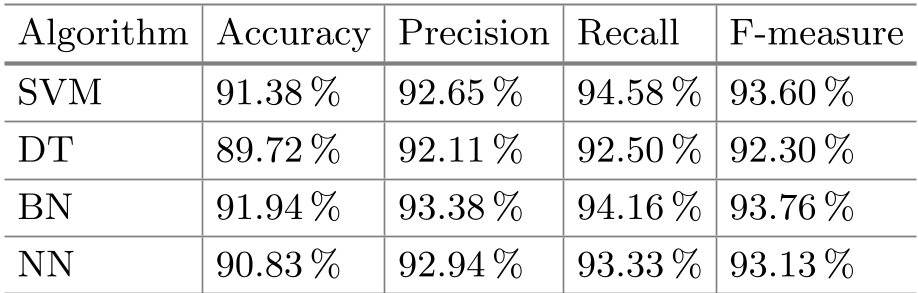
The researchers crawled data on 20 rumor topics (verified via Snopes.com) and tested their model against Support Vector Machines (SVM), Decision Trees (DT), and Neural Networks (NN).
Key Results:
- Accuracy: The Bayesian Network (BN) led with 91.94%.
- F-measure: Reached 93.76%, indicating a superior balance between precision and recall.
- Recall Performance: While SVM showed slightly higher recall (94.58% vs 94.16%), the BN provided a more robust precision, meaning fewer "normal" users were wrongly flagged.
| Algorithm | Accuracy | Precision | F-measure |
|---|---|---|---|
| Bayesian Network | 91.94% | 93.38% | 93.76% |
| SVM | 91.38% | 92.65% | 93.60% |
| Neural Network | 90.83% | 92.94% | 93.13% |
Critical Analysis & Future Outlook
The system's strength lies in its re-learning capability. When a new malicious account is identified, its data is fed back into the training set, allowing the Bayesian probabilities to shift as "troll" tactics evolve.
Limitations:
- Data Volume: The study used a relatively small sample (360 accounts). Scaling this to the millions of daily tweets would require significant computational optimization.
- Shortened URLs: While the system identifies links, it doesn't always resolve the final destination to check for malicious payloads in real-time.
Future Work: Integrating Natural Language Processing (NLP) to detect "doubt and denial" words—as suggested in the related works—could further sharpen the system's ability to distinguish between a "breaking news story" and a "emerging rumor."
Conclusion
This paper proves that rumor detection is not just a linguistics problem, but a behavioral and structural one. By focusing on the "Propagation Approach," the authors have provided a viable path for SNS platforms to clean up their ecosystems with high reliability.