
The Order of Truth: Why Sequence Matters in Combating Multiple Rumors
Rumor Remove Order Strategy on Social Networks
This paper introduces the "Rumor Remove Order Strategy" to minimize total infected users in social networks facing multiple simultaneous rumors. It proposes two novel algorithms, OSLA and MSLA, alongside an extended SIR model that differentiates between "stiflers" and "spreaders" to enhance practical accuracy.
TL;DR
In the digital age, rumors don't arrive one at a time. Addressing them requires more than just detection—it requires a "triage" strategy. This paper presents the first systematic study of Multiple Rumor Remove Order, introducing an extended SIR model and look-ahead algorithms (OSLA/MSLA) to determine which rumors to kill first to minimize total social infection.
The "Triage" Problem: Motivation
Imagine a social media platform hit by five different "fake news" stories simultaneously. Administrators have limited bandwidth and can only remove a fixed number of posts per hour. If they spend three hours removing a slow-moving rumor while a high-velocity rumor (high acceptance rate) spreads unchecked, the battle is lost.
The authors argue that the order of removal is a critical, yet overlooked, variable. Existing literature focuses on single-rumor control, but network heterogeneity (user connectivity) and rumor heterogeneity (believability) mean that the cost of delay varies wildly between different rumors.
Methodology: Extending the SIR Framework
The paper builds on the classic Susceptible-Infected-Recovered (SIR) model but adds a layer of realism. Not everyone who believes a rumor (Infected) becomes a vector for it.
1. The Stifler vs. Spreader Distinction
In the proposed model, an infected user becomes:
- Spreader (): Actively forwards the rumor.
- Stifler (): Believes the rumor but remains silent.
This distinction is vital for accurate modeling because the rate of infection depends specifically on the density of spreaders, not just the infected population.
2. Strategic Look-Ahead (OSLA vs. MSLA)
How do we decide the order? The authors propose:
- One-Step Look Ahead (OSLA): A greedy approach that selects the rumor with the highest growth in the immediate next time interval.
- Multi-Step Look Ahead (MSLA): Uses the Runge-Kutta method to project the rumor's trajectory over its entire expected lifespan of removal (). This prevents "traps" where a rumor looks dangerous now but would naturally fizzle out later.
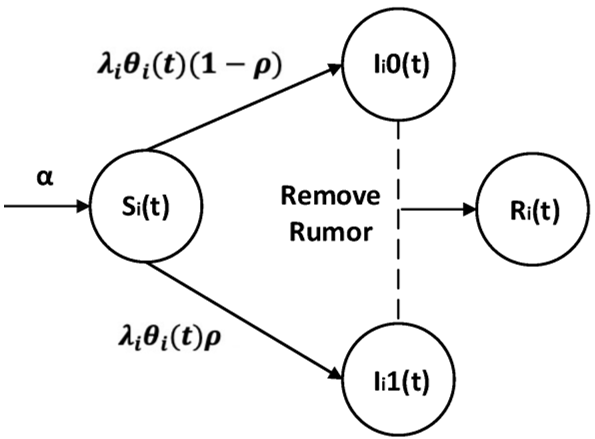 Figure 1: The extended state transition model showing the path from Susceptible to Stifler/Spreader.
Simulation & Results
The researchers tested their strategies against a "Random Selection" benchmark on a network following a Power-Law distribution (mirroring real-world social topographies).
Impact of Acceptance Rate and Connectivity
The simulations confirmed two logical but mathematically quantified intuitions:
- Rumor Acceptance Rate (): Higher believability shifts the "Susceptible-to-Infected" curve leftward, demanding priority.
- Impact Factor (): Rumors in highly connected clusters spread exponentially faster.
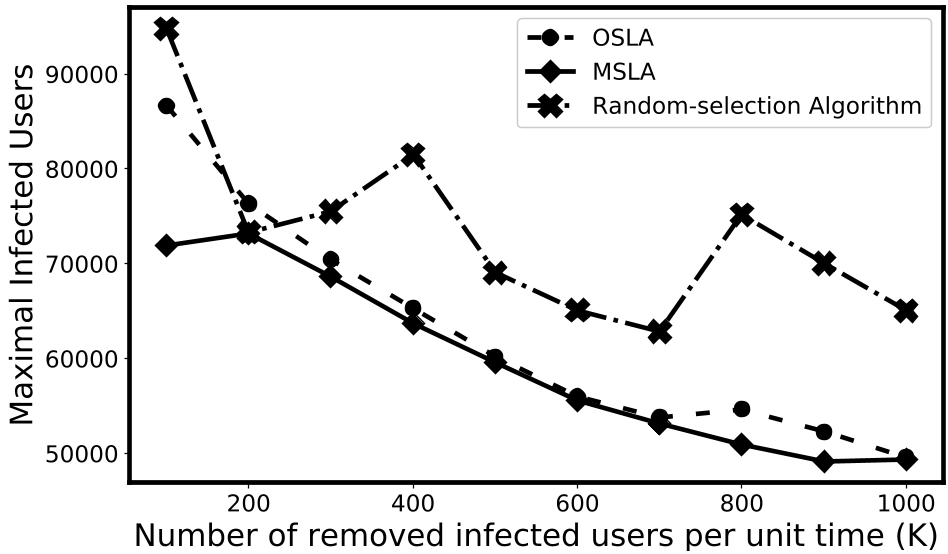 Figure 2: Maximal Infected Users vs. K (Removal Capacity). MSLA (Green) consistently maintains the lowest infection count.
The results show that MSLA is the superior strategy. While OSLA is stable, it often falls into local optima because it doesn't account for how long a large rumor takes to be fully purged. MSLA realizes that some rumors, even if they have many infected users, should be handled later if they have already "saturated" their potential audience, prioritizing smaller, high-growth rumors instead.
Critical Analysis & Takeaways
The core contribution here is the shift from "How do we stop this?" to "In what order do we stop these?".
Key Insights:
- Greedy isn't always good: OSLA (greedy) can fail because it ignores the time-to-remove.
- Modeling matters: By separating stiflers from spreaders, the model avoids overestimating the immediate threat of a "stagnant" rumor.
Limitations:
- The model assumes we can accurately observe the number of stiflers vs. spreaders, which is difficult in privacy-constrained environments.
- The removal process is "all-or-nothing" at the node level; it doesn't account for the "Truth-Spreading" counter-message strategy where one rumor might help debunk another.
Conclusion
As platforms move toward more automated moderation, the Multi-Step Look Ahead approach provides a mathematical foundation for algorithmic triage. Success in the "rumor war" isn't just about the strength of your delete key—it's about the intelligence of your queue.