
Beyond the Verdict: Decoding How We "Click" on Rumor Verifications
Rumor verifications on Facebook: Click speech of likes, comments and shares
This paper investigates how social media users react to rumor verifications (confirmations or refutations) shared by Snopes on Facebook. By analyzing "click speech"—Likes, Comments, and Shares—across 1,861 posts, the study reveals that engagement patterns fluctuate significantly based on rumor type (wish, dread, neutral) and the specific verification verdict.
TL;DR
Does confirming a rumor as "True" generate more buzz than debunking it as "False"? According to this study of Snopes' Facebook activity, the answer is a resounding yes. Users are highly active in Liking and Sharing confirmed truths—especially negative "dread" rumors—but remain strangely silent when a rumor is proven false. This "engagement gap" reveals a fundamental challenge in the fight against misinformation.
Problem & Motivation: The Silence of the Rebuttal
In the digital age, rumors travel at the speed of light, but their "execution"—the moment they are verified—rarely gets the same spotlight. Most academic focus has been on rebuttals (the "False" verdict). However, the authors argue that we are missing half the story: How do we react when a rumor is confirmed as True?
The researchers identified a critical gap: if users don't engage with (Like or Share) the debunking of a rumor, the false information continues to circulate in the ecosystem's "blind spots." They set out to solve this by analyzing how the type of rumor (Wish vs. Dread vs. Neutral) interacts with the verdict (True vs. False) to drive user behavior.
Methodology: Analyzing the "Click Speech"
The study analyzed 1,861 unique posts from the Snopes Facebook Fan Page. The authors utilized the concept of Click Speech, a form of digital expression where opinion is delivered via simple interactions:
- Likes: Passive endorsement.
- Shares: Active propagation to one's own network.
- Comments: Cognitively demanding engagement (Sense-making).
Qualitative Themes
Through inductive content analysis of 1,800 first comments, the researchers identified three primary user motivations:
- Personal Opinion (68%): Collective sense-making and expressing disbelief or gratitude.
- Emotive Expression (27%): Ranging from "LOL" to "panic attacks."
- Call-to-Action (7%): Specifically urging others not to believe everything they read.
Experiments & Results: The Asymmetry of Engagement
The results showed a stark contrast in how "Likes" and "Shares" behave.
The "Like" Pattern
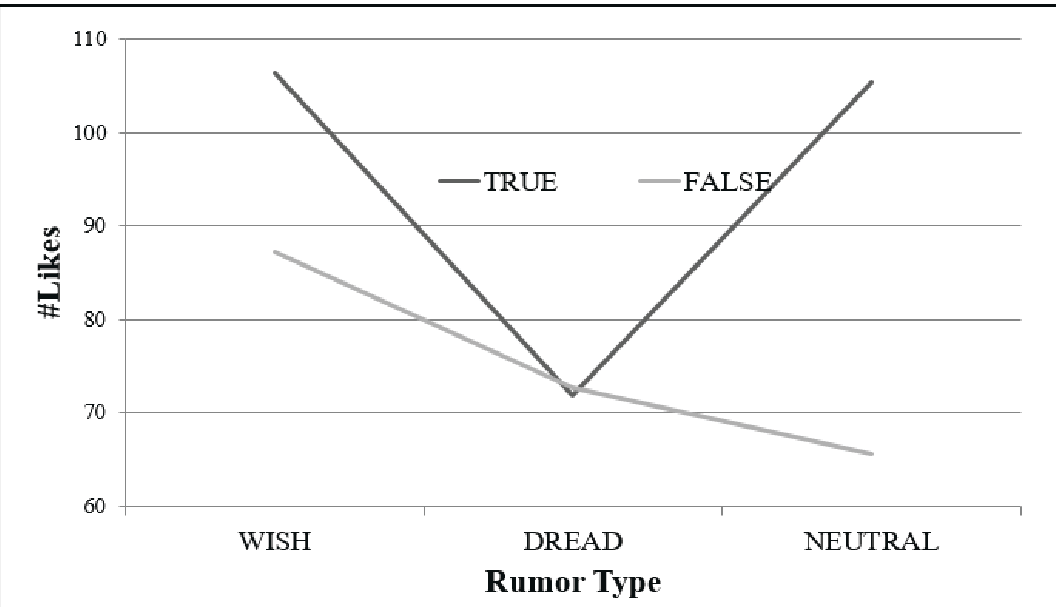
Likes were most prevalent when Wish rumors (good news) or Neutral rumors were verified as True. People enjoy endorsing confirmed positive outcomes or simple facts.
The "Share" Pattern
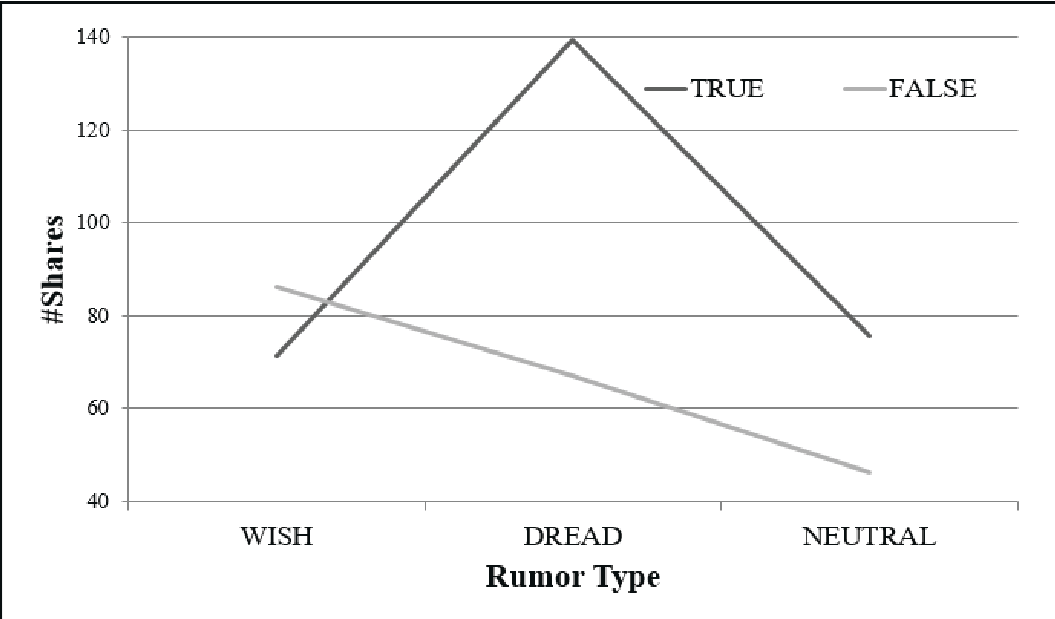
Sharing behavior was driven by "Dread." The highest number of shares occurred when Dread rumors were verified as True. This aligns with evolutionary psychology—we are hardwired to warn our "tribe" about confirmed negative threats.
The Danger Zone: False Rumors
Across all categories, when a rumor was verified as False, engagement plummeted. Users were "nonchalant" about the truth if it meant a rumor was merely debunked. This explains why lies persist: the "antidote" (the verification) lacks the viral velocity of the "virus" (the rumor).
Critical Analysis & Conclusion
Insight: The Third-Person Effect
One of the most fascinating findings was the appearance of the Third-Person Effect. Commenters often warned others to be careful ("People, don't believe everything..."), implying that they themselves were immune to deception while the rest of society was vulnerable. This psychological bias may prevent users from seeing themselves as part of the problem.
Limitations
The study is limited by its timeframe (2013-2015), missing modern Facebook reactions like "Angry" or "Sad," and only analyzed the first comment on each post.
Takeaway for Fact-Checkers
Simply stating "This is False" is not enough. To break the silence, fact-checking organizations must:
- Inject Call-to-Action statements into their posts (e.g., "Share this to stop the spread!").
- Recognize that Neutral rumors (often ignored by researchers) actually command significant attention when confirmed true.
- Address the Engagement Gap: Rebuttals need to be made as "engaging" or "sharable" as the sensational rumors they seek to replace.
Future Work
The next frontier is understanding the motivation behind "Angry" or "Love" reactions in the era of deepfakes and AI-generated misinformation.