
Rural Islandness: Why Modern HCI Fails Where the Sea Begins
Rural Islandness as a Lens for (Rural) HCI
The paper introduces "Rural Islandness" as a socio-cultural and analytical lens for Human-Computer Interaction (HCI) research. Using an ethnographic study of a community radio project on an Irish island, it demonstrates how geographical "separateness" and unique social dynamics like "strategic silences" reshape technology appropriation and community participation.
TL;DR
Most technology is built for the city, assuming "connection" is an absolute good. This paper argues that for rural islanders, separateness is a feature, not a bug. By studying a community radio project in Ireland, the authors reveal that "Rural Islandness" creates unique social constraints—like the need to remain silent to "keep the peace"—that make standard participatory design workshops ineffective. True rural HCI requires "islanding": the artful hacking of available tools to ensure reliability in places where the weather defines the infrastructure.
The Problem: The Urban Bias and the "Deficit" Traps
Standard HCI research typically enters rural spaces with a "Deficit Model." We look at an island and see what it lacks: no 5G, no fast delivery, no "always-on" connectivity.
However, the authors argue that these "deficits" are often intentionally maintained values. The sea acting as a barrier provides insulation, a slower pace of life, and a distinct identity. When designers try to fix rurality with urban solutions, they often ignore the Social Harmony required to survive in a micro-society. On an island, you cannot "cancel" your neighbor over a disagreement; you might need them to help you calve a cow or fix a leak tomorrow. This leads to Strategic Silences—a refusal to speak up that urban designers often mistake for "lack of interest."
Methodology: Deciphering the "Publics"
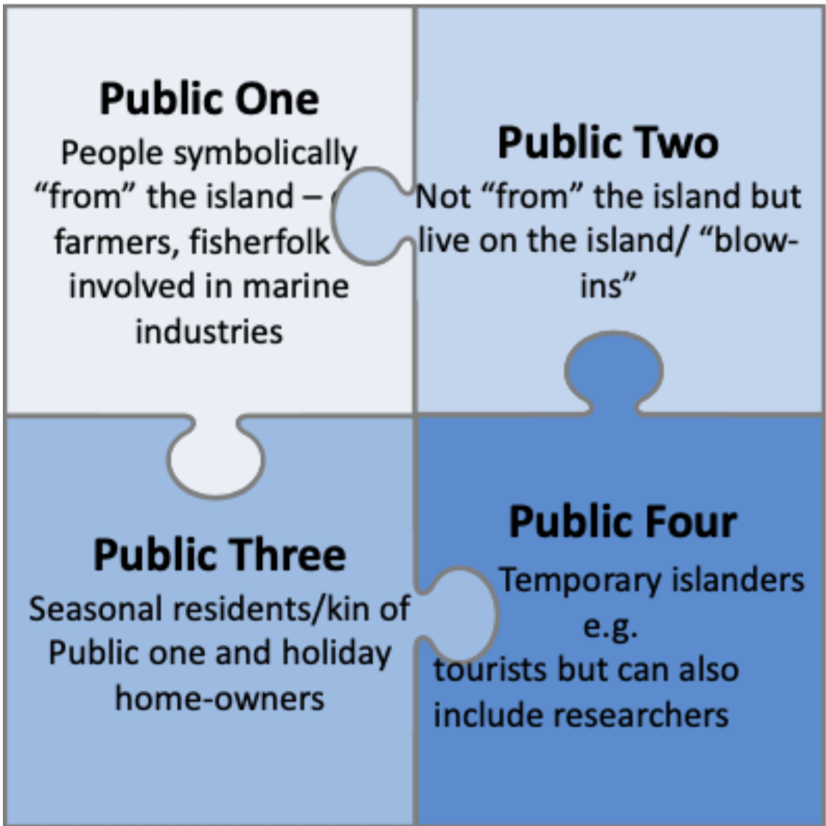
To understand who speaks and who stays silent, the researchers used a sociological lens called Gill’s Publics, which divides the community into:
- Public One (Islanders): Born and bred; often the most silent in public meetings to avoid conflict.
- Public Two (Blow-ins): Migrants from cities; often highly educated and the first to volunteer for "pushing things ahead."
- Public Three (The Diaspora): Those who left but listen from afar.
- Public Four (Visitors/Researchers): Temporary outsiders.
The "Islanding" of Technology
The project's turning point occurred when the researchers’ high-tech radio prototype (based on Android phones and cloud software) failed in the harsh Atlantic winds.
Instead of waiting for a "fix" from the developers, the islanders engaged in "Islanding"—assembling a solution from whatever was at hand. They replaced a fiberglass mast that snapped in the wind with a local aluminum one. They ditched the unstable cloud app for a $100 Focusrite box and free 18th-century "amateur dramatic" mixing desks.
Why did they do this? Because in a small community, Reliability is Respect. If a broadcast drops out during a funeral or a local mass, it’s not just a "bug"; it’s a public embarrassment.
Critical Insights: The Power of the "Watch and Wait"
The most profound finding is the Watch and Wait approach of the core islanders (Public One).
- The Silence: They don't join the workshops. They don't sign the consent forms (which they find "alien" and "urban").
- The Logic: They wait to see if the technology supports the actual future of the island (primary production, farming) or just the tourist idyll (holiday homes).
Conclusion: Designing "From" the Rural
This paper is a call to action for HCI researchers to stop "designing for" the rural from their city offices.
- Embrace Separateness: Recognize that disconnection is sometimes a choice.
- Respect the Silence: Understand that non-participation in a workshop might be a survival strategy to maintain social harmony.
- Place-Making over Product-Making: Future rural technology should focus on Repair and Care. It shouldn't be about the "next generation of products," but the "next generation of the community."
As the authors conclude, we must learn to see the world through the lens of those who live on the edge, where the "collective mask" of a community is more important than a feature-rich app.