
Rural mmWave: Debunking the Range Myth with the CIH Model
Rural Macrocell Path Loss Models for Millimeter Wave Wireless Communications
This paper presents a novel Rural Macrocell (RMa) path loss model for millimeter-wave (mmWave) communications based on 73 GHz measurements. It introduces the Close-In with Height dependency (CIH) model, which achieves significantly higher accuracy and simplicity compared to existing 3GPP/ITU-R standards, supporting frequencies from 0.5 to 100 GHz.
TL;DR
Contrary to the popular belief that millimeter-wave (mmWave) is strictly for short-range urban "cells," this research proves that 73 GHz signals can cover over 10 kilometers in rural settings. By replacing the convoluted, legacy 3GPP standards with a physically-grounded CIH (Close-In with Height) model, the authors provide a simplified framework for 5G/6G deployment that is accurate from 0.5 GHz all the way to 100 GHz.
The Motivation: Legacy Models in a High-Frequency World
For years, the industry relied on Rural Macrocell (RMa) models derived from 1990s measurements in downtown Tokyo at 1.4 GHz. These models include bizarre variables for rural areas, such as "average building height" and "street width."
As we move toward mmWave (5G and beyond), these legacy standards break. The "breakpoint distance" used in 3GPP models — where the signal decay supposedly shifts from to — often exceeds 10 km at high frequencies, rendering the standard equations mathematically irrelevant for most practical deployments.
Methodology: Grounding Propagation in Physics
The authors conducted an extensive 73 GHz measurement campaign in rural Virginia. They realized that in these environments, the complexity of urban multipath is absent; instead, the Base Station (BS) height is the dominant factor.
The CIH Model Logic
Instead of using regression "patches," the authors proposed the CIH (Close-In with Height) model. The core intuition is:
- The First Meter is Universal: All signals follow Friis’ free-space law for the first meter.
- Height Adjusts Decay: Taller towers have a "clearer" view, naturally reducing the Path Loss Exponent (PLE).
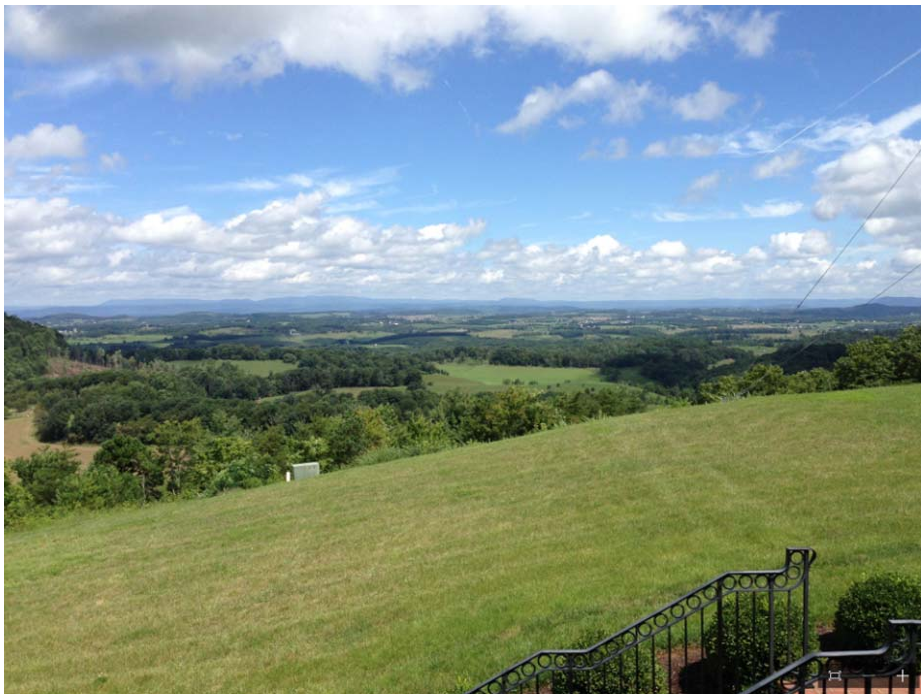 Figure 1: The experimental setup in rural Virginia, utilizing a transmitter atop a mountain ridge to simulate high-tower macrocell behavior.
The model is elegantly expressed as: This equation replaces dozens of lines of legacy 3GPP code with a single, height-aware decay term.
Experimental Evidence & Results
The campaign utilized a 73 GHz CW system with a 190 dB dynamic range. The results were startling:
- Extreme Range: Stable links were maintained at distances exceeding 10 km.
- Lower Decay: The measured PLE for Non-Line-of-Sight (NLOS) was 2.75, significantly lower than the ~3.0 usually assumed in urban microcells.
- Superior Stability: The CIH model reduced Shadow Fading (error) to as low as 1.7 dB in LOS conditions, compared to the 4-6 dB range typical of 3GPP models.
 Table 1: Comparison showing the CIH model parameters. Note the negative values, which correctly predict that increasing tower height significantly reduces path loss.
Critical Insights: Why This Matters for the Future
The industry has long feared that mmWave requires a base station on every street corner. This paper turns that notion on its head for rural connectivity.
- Fiber Replacement: 73 GHz can serve as a multi-gigabit backhaul for remote areas, acting as a "wireless fiber" over 10km spans.
- Standards Reform: The paper exposes that 3GPP RMa standards were "forced" to 30 GHz without empirical backup. The CIH model offers a frequency-transparent alternative that works for sub-6 GHz and mmWave simultaneously.
- Interference Management: By accurately predicting lower path loss at long distances, the CIH model prevents engineers from over-transmitting and causing massive interference in adjacent cells — a common mistake when using the 3GPP’s overestimated loss projections.
Conclusion
The move to the CIH model represents a shift from "black-box" empirical curve-fitting to "gray-box" physical modeling. For 5G-Advanced and 6G, this ensures that rural macrocells can be designed with the same precision as urban hotspots, bridging the digital divide using high-frequency spectrum.