
Beyond Literal Similarity: Decoding the Russian Social Media Paraphrase Corpus
A New Corpus of the Russian Social Network News Feed Paraphrases: Corpus Construction and Linguistic Feature Analysis
This paper introduces a novel Russian paraphrase corpus extracted by pairing official news headlines with their corresponding social network feed versions from VKontakte. Covering over 8,460 pairs, it enables the study of "loose paraphrases" influenced by social media pragmatics, achieving a preliminary classification baseline via SVM.
TL;DR
Researchers have unveiled a new Russian corpus that captures the "pragmatic gap" between formal news headlines and their click-driven social media counterparts. By analyzing 8,463 pairs from the VKontakte platform, the study reveals that traditional surface-level and semantic NLP models fail miserably (dropping from 74% to 40% accuracy) when faced with the irony, metaphors, and "attention attractors" used by journalists to hook social media users.
Motivation: The Style Gap in News Feeds
Why do we need another paraphrase corpus? Most existing datasets assume paraphrases are "precise"—different words, same objective meaning. However, in the ecosystem of Russian social networks, media agencies don't just copy-paste titles. They rewrite them to be more informal, provocative, or concise. This results in loose paraphrases, where the core event remains the same, but the linguistic "packaging" changes drastically.
The authors identified a unique opportunity: by tracking 13 different Russian media agencies (ranging from pro-government like RIA to oppositional like Fontanka), they could harvest thousands of natural paraphrases without expensive human annotation.
Methodology: High-Volume Extraction & Hybrid Detection
The construction method is elegantly simple:
- Real-time Parsing: Using the VKontakte API to grab social feed messages and their attached URLs.
- Headline Matching: Extracting the official title from the source website and the modified title from the post.
- Hybrid Feature Engineering: To test the corpus, the authors used an SVM classifier trained on two feature sets:
- Shallow Features: Overlap metrics like BLEU, edit distance, and proper name matching.
- Semantic Features: Leveraging Yet Another RussNet (YARN) and Tikhonov's dictionary to find synonyms and word-formation roots.
 Figure 1: The conceptual workflow of extracting paraphrases from social media feeds vs. official agencies.
Why Machines Fail: The "Irony" Problem
The most striking result is the performance drop. A model that was a SOTA contender in formal news (74% accuracy) was essentially guessing on the new dataset.
The Linguistic Culprits
Through manual annotation of misclassified pairs, the authors identified several "pragmatic markers" that confuse models:
- Attention Attractors: Headlines like "Naked King" instead of a formal title about "Antivirus Software."
- Irony & Metaphors: Particularly prevalent in oppositional media, where government actions are described through sarcastic lenses.
- Different Content: 87% of misclassified pairs contained additional info in one sentence not present in the other.
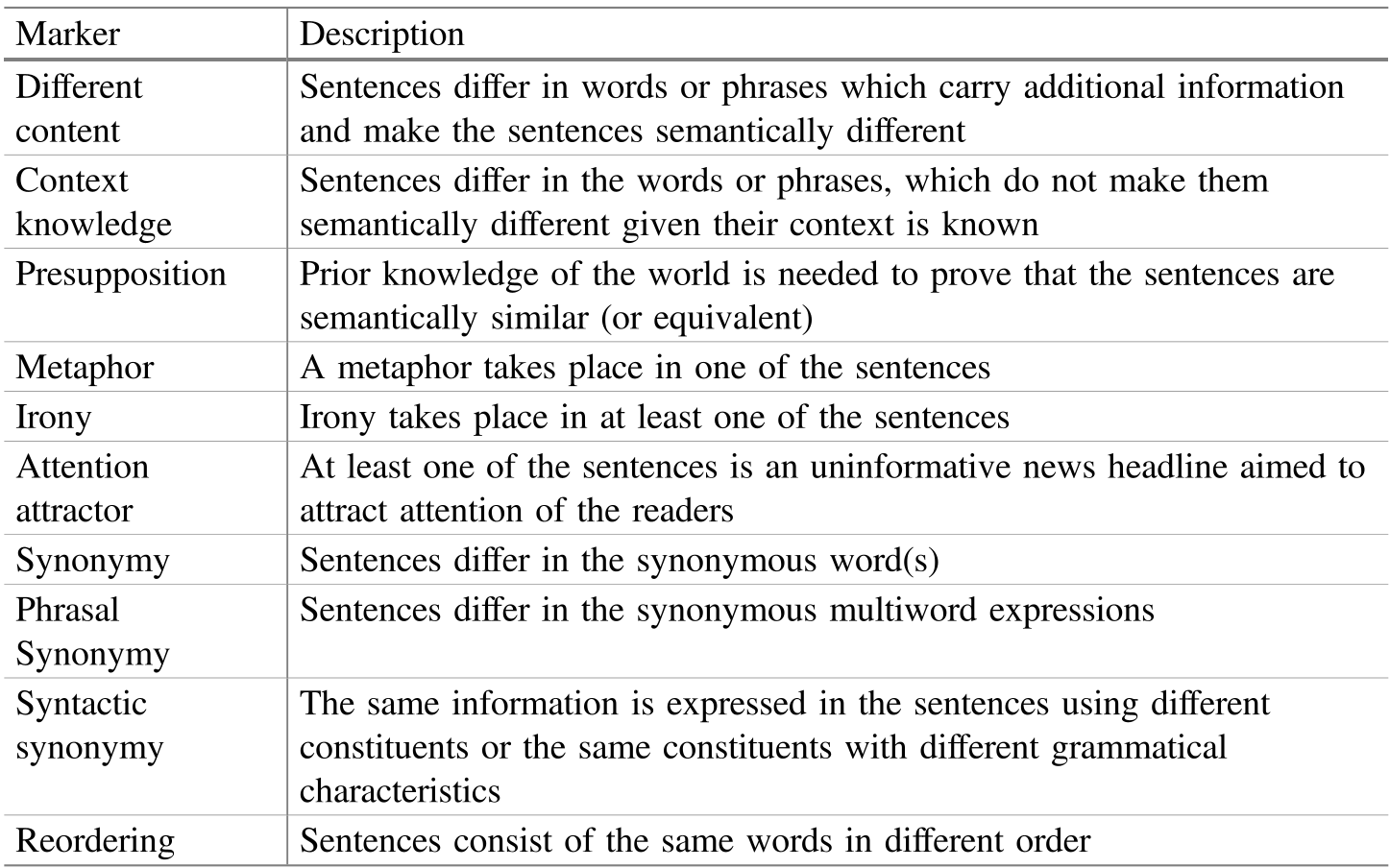 Table 1: Definitions of linguistic phenomena that increase the difficulty of paraphrase detection.
Results by Media Agency
The study provides a fascinating look at the "editorial style" of Russian media:
- RBC (Business): The easiest to detect (83% accuracy). Their social media staff stays close to the official, laconic business style.
- InoSmi (Foreign Translation): The hardest to detect (8% accuracy). Their titles are dense with cultural presupposition and complex linguistic shifts.
- Oppositional Media: Tended to use more irony and "attention attractors," making their headlines significantly harder for AI to recognize as paraphrases.
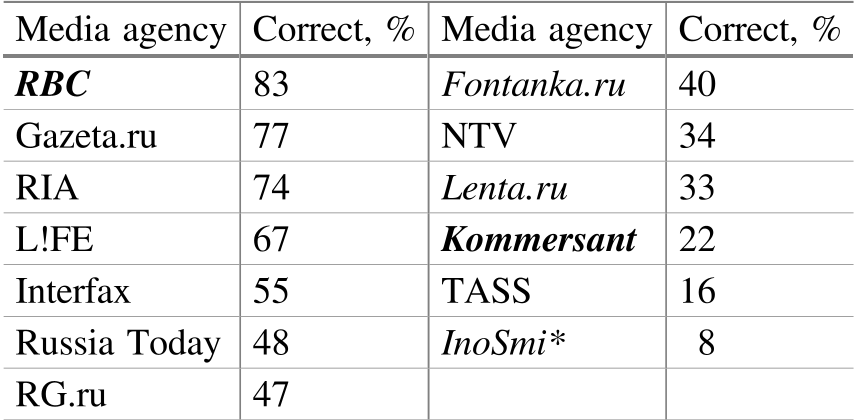 Table 2: Accuracy of the paraphrase detection model across different Russian media outlets.
Critical Insight & Future Outlook
The primary takeaway is that surface-level similarity is an insufficient proxy for truth in the era of social media. The "Russian Social Network News Feed Paraphrase Corpus" proves that paraphrase detection isn't just about matching synonyms; it’s about understanding the intent of the writer (e.g., to attract attention or express irony).
Future Directions:
- Integration of Irony Detection modules into paraphrase pipelines.
- Application of the corpus for Text Style Normalization (converting informal social posts back into formal reports).
- Exploration of "Presupposition"—the only complex linguistic feature that the model actually handled well, likely due to shared proper names.
This work serves as a reminder that for AI to truly "read" the web, it must first learn to navigate the subtle, often sarcastic art of the headline.