
S-MATCH: Reconciling Speed and Secrecy in Mobile Social Matching
S-MATCH: Verifiable Privacy-Preserving Profile Matching for Mobile Social Services
S-MATCH is a verifiable, privacy-preserving profile matching framework for mobile social services. It leverages Property-Preserving Encryption (PPE) optimized with entropy-increasing techniques and fuzzy key generation to achieve SOTA computational performance—at least one order of magnitude faster than Homomorphic Encryption (HE) based methods.
TL;DR
S-MATCH is a high-performance framework designed to help mobile users find friends with similar interests without exposing their private data to the server. By pivoting from heavy Homomorphic Encryption (HE) to optimized Property-Preserving Encryption (PPE), it achieves a 10x speedup while introducing a novel verification protocol to detect malicious server behavior.
Background Positioning
In the landscape of Privacy-Preserving Computation, we often face a "trilemma" between security, efficiency, and functionality. Previous SOTA works (like homoPM or FindU) favored Homomorphic Encryption, which offers great security but crushes mobile battery life. S-MATCH moves the needle toward practical deployment by fixing the inherent security flaws of PPE (Order-Preserving Encryption) for social data.
The Problem: Why PPE is "Broken" for Social Networks
Traditional PPE allows an untrusted server to compare ciphertexts (e.g., ) to find matches. However, the authors identify two critical vulnerabilities:
- Low Entropy & Landmark Attributes: Social data is predictable. If a server sees a certain encrypted "Interest" appearing frequently, it can guess the plaintext (e.g., "Football") via frequency analysis.
- The Key Sharing Deadlock: For PPE to work, users must use the same key. If users share a master key, a single compromised user/server collusion reveals everyone’s data.
Methodology: The S-MATCH Architecture
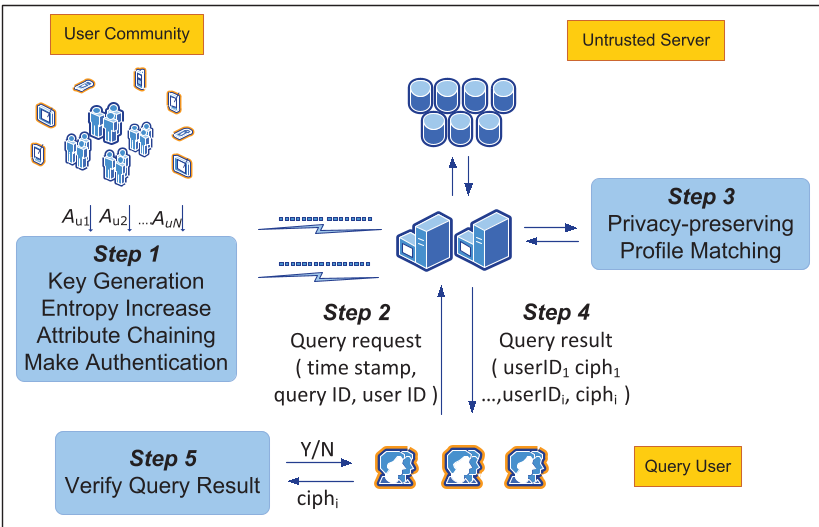
The core innovation lies in transforming raw social profiles into "High-Entropy Attribute Chains."
1. Fuzzy Key Generation (The RS Decoder)
Instead of a global secret key, S-MATCH uses a Reed-Solomon (RS) Decoder. Users with social profiles within a certain Euclidean distance threshold will naturally derive the same "Fuzzy Vector" and subsequently the same PPE key. This allows "similar" people to interact in the same encrypted space without a central authority.
2. Entropy Boosting (Big-Jump Mapping)
To stop frequency attacks, S-MATCH employs a Big-Jump Mapping. A single attribute value is mapped to one of possible values in a larger message space. This flattens the distribution, making the ciphertext appear uniform to the server.
3. Verifiable Results
Unlike previous methods where the server could return fake results, S-MATCH includes a Reverse Fuzzy Commitment. The querying user can verify if the result truly came from someone with a similar profile by attempting to decrypt a "witness" value provided by the matched peer.
Experiments & Results: Speed Meets Accuracy
The authors tested the system using the Weibo dataset (1 million users) and conference datasets (Infocom06/Sigcomm09).
- Performance: On an Android testbed (HTC Nexus One), S-MATCH maintained superior latency compared to HE-based methods. As the plaintext size increases, the gap widens significantly—S-MATCH stays efficient while HE costs grow exponentially.
- Accuracy: The system achieves a True Positive Rate (TPR) of ~93-97%. The slight loss in accuracy is a deliberate trade-off for the fuzzy matching capability.
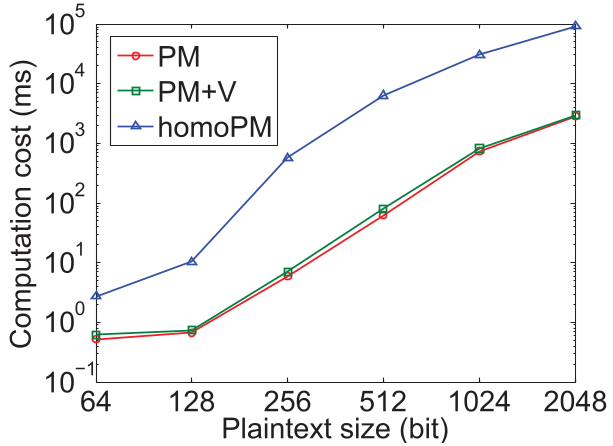 (Shown: Client-side computation cost on Infocom06 dataset; S-MATCH significantly undercuts HE methods as complexity grows.)
Critical Analysis & Takeaways
Key Insight: S-MATCH proves that you don't always need the heaviest cryptographic hammers (like FHE) to achieve privacy. By understanding the physical distribution of the data (social attributes), one can "patch" lighter encryption methods (PPE) to be secure.
Limitations:
- The RS Decoder threshold is fixed. If two users are just outside the threshold, they will never match, even if they are very similar.
- Security relies on the assumption that users won't intentionally lie about their attributes to "probe" the encrypted space.
Future Outlook: This framework sets a blueprint for Privacy-Preserving Proximity Services. Beyond finding friends, this "Fuzzy PPE" approach could be applied to decentralized IoT discovery or privacy-preserving local marketplaces.