
S-PUT: Solving the Tug-of-War Between Social Locality and Load Balancing
S-PUT: An EA-based framework for socially aware data partitioning
S-PUT is a novel Evolutionary Algorithm (EA)-based framework for socially-aware data partitioning in Online Social Networks (OSNs). By leveraging graph partitioning techniques (METIS) to seed the initial population, it achieves Pareto-optimal trade-offs between minimizing cross-server read loads and maximizing server load balancing.
TL;DR
Online Social Networks (OSNs) face a massive scaling challenge: how to split user data across thousands of servers without breaking the "social bond." If your data is on Server A and your friend's is on Server B, every time you check your feed, the system pays a "network tax." S-PUT is a sophisticated framework that uses Evolutionary Algorithms (EA) to find the perfect middle ground, reducing server read traffic by over 50% compared to traditional methods.
The "Sharding" Nightmare
Existing systems like Facebook and Twitter traditionally used Distributed Hash Tables (DHT). It’s simple: hash a User ID to a server. This is great for load balancing—no server gets too "fat." However, it destroys Social Locality. Because friends are hashed to random servers, a single newsfeed query might have to ping dozens of different machines, creating a bottleneck of high latency and internal traffic.
Previous attempts to fix this used standard graph partitioning (like METIS), but these tools treat all users as equal nodes. In reality, some users are "influencers" with massive read rates, and some "social bonds" are stronger than others.
S-PUT Methodology: EA Meets Graph Theory
The authors realized that the partitioning problem is a Multi-Objective Optimization (MOO) problem:
- Minimize Read Load: Reduce the number of cross-server requests.
- Maximize Load Balance: Ensure storage and maintenance costs are shared equally.
1. The Strategy: Hybridization
A raw Evolutionary Algorithm (starting from a random population) would take years to converge on a billion-node social graph. S-PUT solves this by "seeding" the evolution. It uses METIS to generate an initial population of "decent" solutions, then uses the SPEA2 algorithm to evolve these into "elite" solutions.
2. The Core Formulation
The model factors in:
- Read Rate (): How often a user checks their notifications.
- Social Bond (): The probability of user reading user 's data.
- Maintenance Rate (): The cost of hosting/updating a user's data.
Experimental Showdown
The authors tested S-PUT against three heavy hitters: Random (DHT), Pure METIS, and standard EA (SPEA2/NSGA-II).
- Read Load Performance: S-PUT smashed the competition. In the Facebook graph, it reduced the read load by ~50% compared to Random sharding.
- The Improvement Gap: While METIS is a strong baseline, S-PUT consistently improved upon METIS’s results by 20% to 26%, proving that a specialized evolutionary refinement is necessary for complex social structures.
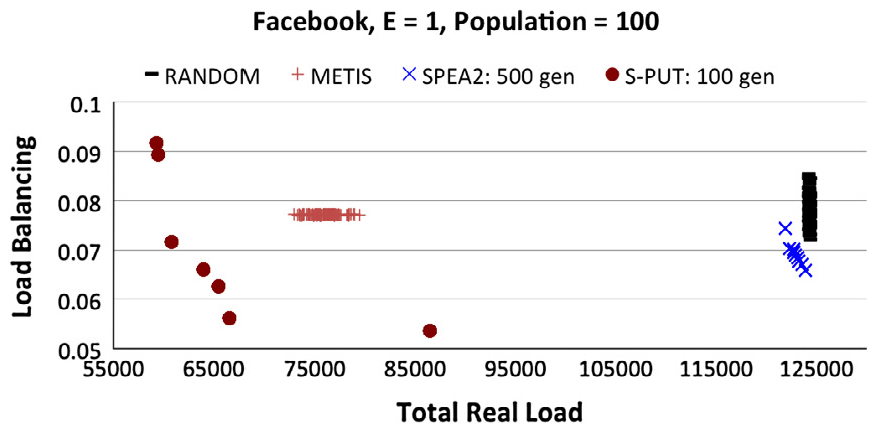 The chart above shows S-PUT (bottom left) achieving both the lowest read load and the best load balance (lower Gini).
Deep Insight: Why Bio-Inspired Algorithms Work Here
The beauty of S-PUT is its Representation. By treating a server assignment as a "DNA string" and using two-point recombination (crossover) and mutation, the algorithm navigates the massive search space to find "communities" of users that are social hotspots. By keeping these hotspots on the same hardware, we effectively "grease the wheels" of the OSN's infrastructure.
Closing Thoughts & Limitations
S-PUT is a breakthrough in Socially-Aware Data Partitioning. However, there is a trade-off: Computation Time. While the results are elite, running 500 generations of EA on a dataset like DBLP (700k+ nodes) can take up to 90 hours on moderate hardware. Future work would likely look at parallelizing this EA process on a GPU cluster to make real-time re-partitioning feasible.
Takeaway: In the world of Big Data, the structure of the data (the social graph) should dictate the hardware architecture, not the other way around.